[AINews] Riemann Hypothesis proved...twice independently
- Source
- latent.space
- Author
- swyx .ai
- Date

Context
No proof of the Riemann Hypothesis has been confirmed yet, but on November 20 two separate claims appeared, and they will be checked in opposite ways. The hypothesis, open since 1859, says that the zeros of the Riemann zeta function, which control how prime numbers are distributed, all lie on one line; many results in number theory assume it. Levent Alpöge, a mathematician at Anthropic, posted a short note saying that, working with Claude, he had found a proof that also covers the stronger Generalized Riemann Hypothesis. Hours later, Stanford mathematician Alessandro Masullo's proposed proof, which Ravi Vakil's announcement describes as "all human, with no AI", was posted. Scientific American reported both claims and noted that the human proof had not been verified by anyone.
Alpöge's proof is meant to be checked by software rather than read. He released it only as code for Lean, a proof assistant in which every step is written formally and checked mechanically. In his note he says a written-out version ran past 250,000 pages and that posting it would have been an unreadable travesty of "slop"; Scott Aaronson relays Alpöge's figure of 17.4 million lines of Lean. A machine check settles most of the question but not all of it. The Lean community's checklist for claimed proofs asks that the project build, that the main theorem use only Lean's standard axioms with no skipped steps, and that an expert confirm the formal statement says what the famous theorem says. According to the AINews roundup, Elliot Glazer reported that the formal statement is the Generalized Riemann Hypothesis and that the code was still compiling, and put the chance of a Lean bug well under 1%. His post could not be read for this explanation, so that assessment rests on the roundup's account.
The match between formal statement and intended result is where an earlier claim drew criticism. OpenAI announced a Lean-backed result on the Navier–Stokes equations of fluid flow in September (earlier Intel), and Bastounis, Circelli and Hansen then argued in a paper that its Lean proof does not correspond to the written proof (Intel record). Even if Alpöge's code checks cleanly, mathematicians still have to understand it. Terence Tao expects that digestion to take some time, and Aaronson, who bets the proof will stand but is not fully sure, expects distilling its ideas to take years.
Masullo's draft has the reverse problem: people can read it, but it is unfinished. Vakil, president of the American Mathematical Society, posted it early and wrote that he makes no claim about the correctness of the strategy. Brian Conrad, who has given Masullo feedback for months, told Scientific American it is "undergoing major revision", and an update to Vakil's post about eight hours later said several people had reported problems found with the help of AI models. For now, neither claim is an accepted proof. For Alpöge's, the decisive first steps are a completed Lean build with no extra axioms and expert agreement that the formal statement is the hypothesis itself.
- Anthropic mathematician Levent Alpöge says he proved the Generalized Riemann Hypothesis working with Claude and released only Lean code, about 1.3GB, rather than a paper. A prose version reportedly ran past 250,000 pages, so no human is expected to read all of it.
- The claim was unverified at publication. Elliot Glazer confirmed the formalized statement is GRH and put the chance of a Lean bug well under 1%, but the code was still compiling, and the Claude model used and the degree of human steering had not been disclosed.
- Alpöge credits Claude with the parts involving automorphic forms on higher-rank groups, an area where he says he has little mastery. AINews reads this as the reverse of the usual pattern, where people guide AI through work they already know how to do.
- Thinking Machines' Inkling 2 Mini is an Apache 2.0 looped of about 26.4B parameters that runs 12 shared core layers for three passes, giving 3.4B unique and 5.4B effective active parameters. It reportedly leads open models under 100B on DeepSWE v1.1 at 48.2%.
- METR's Time Horizons 2.0 puts the doubling time at 3.6 months, with GPT-6 Astra at 40.3 hours and Opus 5.5 at 39.0 hours. The 95% confidence interval spans about 11.9 hours to 110 days, and horizons run much longer on easy-to-verify tasks than hard-to-verify ones.
- mixture-of-experts — A model built from many specialist sub-networks where only a few activate per token, giving big-model capability at small-model running cost.

- articleTen advances in mathematics and theoretical computer sciencesimonwillison.net
 blogThe stochastic parrots have apparently proved the Riemann Hypothesisstratos123
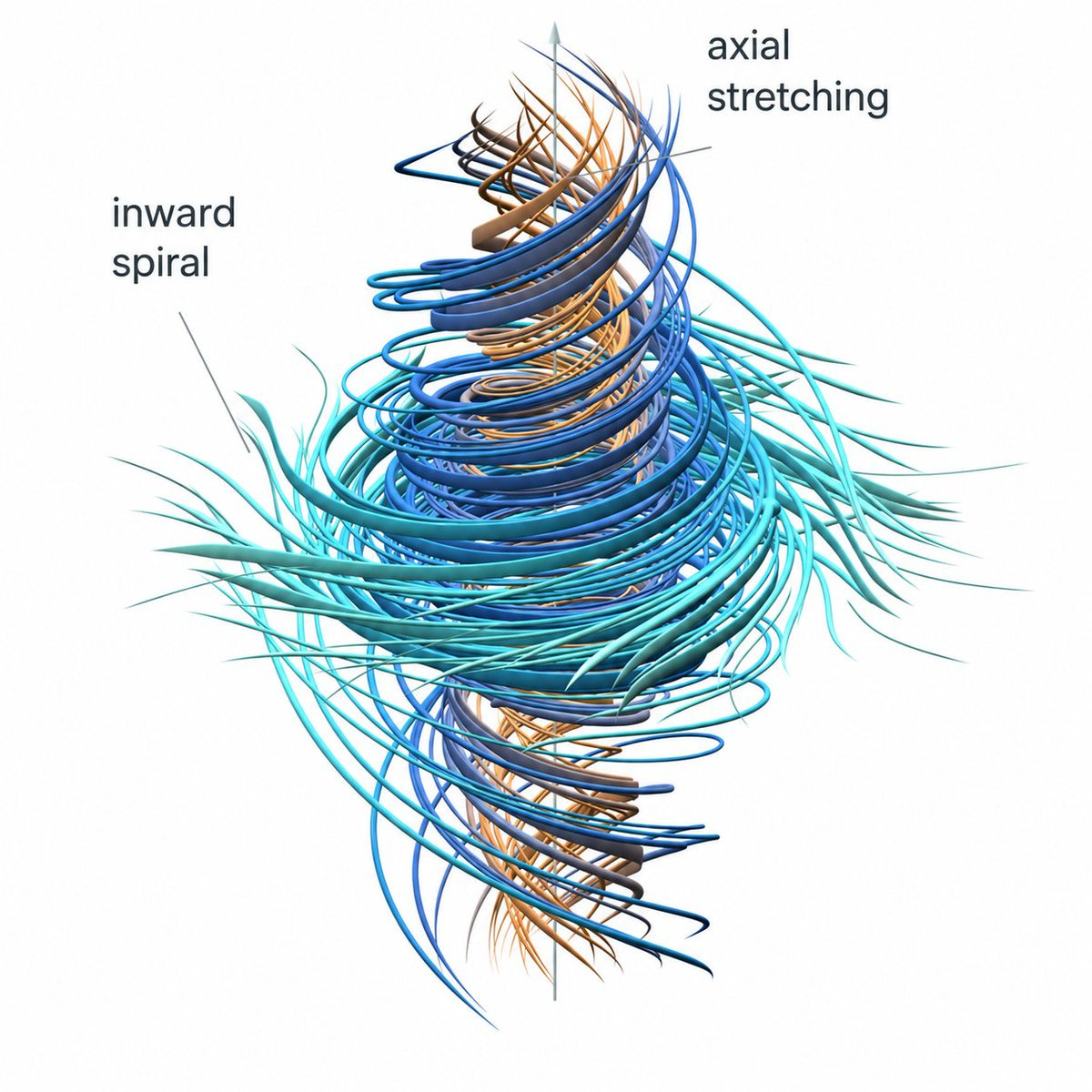 article[AINews] OpenAI reports Navier-Stokes singularity find in 88 hours using Astra-next, roughly 10,000 agents and 130B tokens (>$40M), a contender for second ever Millennium Prize awardedwww.latent.space
Checking sign-in…
Loading comments…