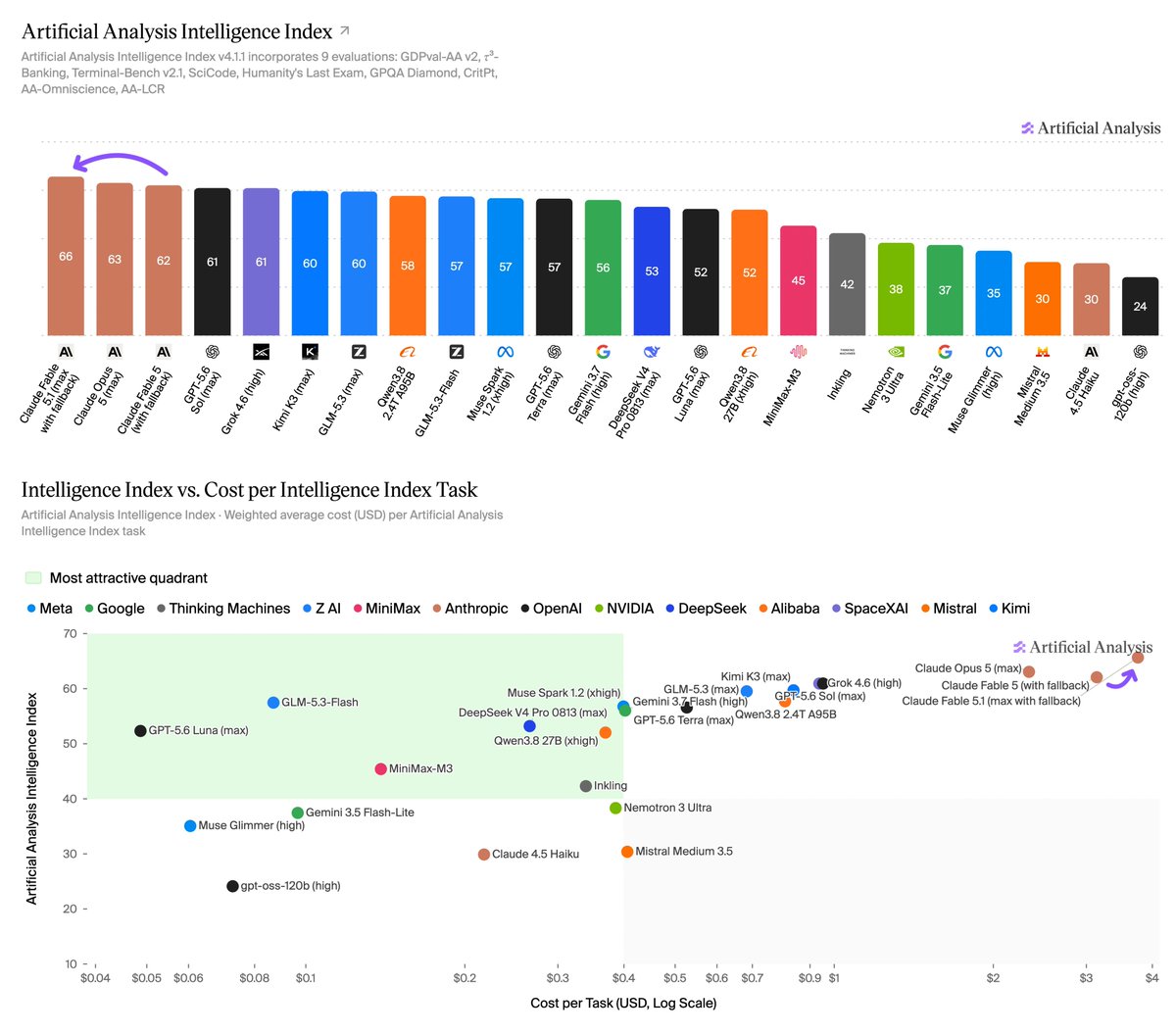
Fable 5 leads on agentic evals, but safety fallbacks trigger on about 9% of HLE tasks and the model is very expensive to evaluate. Expect scientific queries to hit guardrails more often than average sessions.
Key takeaways · AI-distilled
Claude Fable 5 scored 64.9 on the Artificial Analysis Intelligence Index at launch, about 5 points ahead of the closest non-Anthropic model (GPT-5.5), and set the highest score on 5 of the 10 underlying benchmarks.
Fable 5 shares its underlying model with Claude Mythos 5 but adds guardrailsThe checks around a model that block bad inputs and outputs — filters, validators, and permission rules the model itself can't override.Full definition → for cyber, bio, chem and distillationTraining a small, cheap model to imitate a big one's outputs, keeping much of the capability at a fraction of the cost.Full definition → queries. Anthropic says fallback to Opus 4.8 occurs in under 5% of sessions; AA recorded about 8% of index tasks, mostly science questions.
It scored 40 on AA-Omniscience, 7 points over the prior leader, driven by accuracy rather than low hallucinationWhen a model states something false with full confidence — inventing facts, citations, or APIs that don't exist.Full definition →. AA notes accuracy tracks model size in open models, suggesting Fable 5 could be larger than earlier public Anthropic models.
Fable 5 scored 53% on Humanity's Last Exam, over 7 points ahead of Opus 4.8, but fell back on 9% of HLE tasks, and the full HLE run cost about $2.2k, the most of any model AA had evaluated.
At launch it was priced at $10/$50 per 1M input/output tokens, twice Opus 4.8, kept a 1M context windowThe maximum amount of text a model can consider at once — its working memory for the current conversation or task.Full definition →, and was included in subscription plans through June 22, after which usage required credits.
Terms in this piece · Glossary
context window — The maximum amount of text a model can consider at once — its working memory for the current conversation or task.
guardrails — The checks around a model that block bad inputs and outputs — filters, validators, and permission rules the model itself can't override.
distillation — Training a small, cheap model to imitate a big one's outputs, keeping much of the capability at a fraction of the cost.
hallucination — When a model states something false with full confidence — inventing facts, citations, or APIs that don't exist.