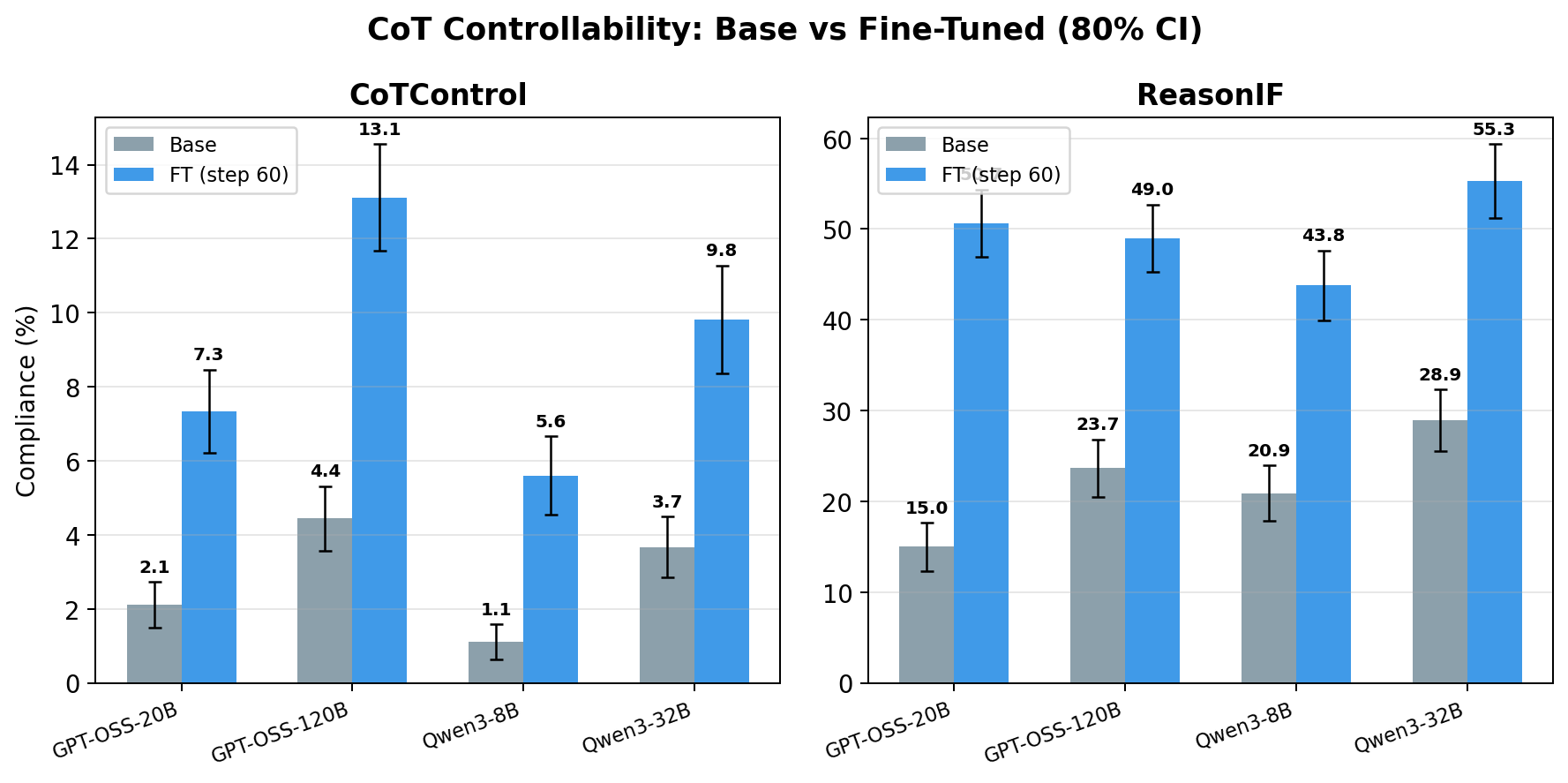
A model's written reasoning is easier to monitor if it cannot readily control which clues appear there. METR's fine-tuning experiments tested whether training on a small set of examples could make reasoning models better at following instructions about the content and format of their reasoning traces.
Compliance improved on a separate evaluation, although it remained low overall. The finding suggests that difficulty controlling these traces may change with training, so it should not be treated as a permanent safeguard. The researchers explicitly did not establish that the improvement made monitoring less effective, and their targeted training SetupThe combination of a model, a harness, its connections and the path the task's data takes, considered together for a task.Full definition → differs from ordinary frontier-model training.
Terms in this piece · Glossary
fine-tuning — Taking a trained model and training it a bit more on your own examples so it gets better at one specific job.
Setup — The combination of a model, a harness, its connections and the path the task's data takes, considered together for a task.
Instruction — A statement in the context that tells the model how to behave or what to do; module 3's first layer.
chain-of-thought — Having a model write out intermediate reasoning steps before its answer, which markedly improves performance on hard problems.
 articleThe First Few Tokens Matter: Understanding Chain-of-Thought ControllabilityHugh Van Deventer, Dmitrii Troitskii, Laura Ruis
 articleChain-of-Thought Controllability Can Reduce Chain-of-Thought MonitorabilityZheng-Xin Yong, Benjamin Arnav, Miles Wang, Tomek Korbak, Olivia Watkins
 articleWhen Chain-of-Thought Helps and When It Hurts: An Empirical Investigation of the Serial-Depth Bottleneck in LLM ReasoningTughanbulut Kurtulush