Counting the Bandages: On measuring the time that AI saves
Source
arxiv.org
Author
Solomon Shalom Lijo
Date
Why it matters
Clock time alone overstates AI savings if defects escape. The paper reanalyzes METR's developer study to show the slowdown estimate shifts from 19% to 34% depending on the estimand, and offers a break-even defect cost for decisions.
Key takeaways · AI-distilled
In the paper's baseline checking model, a calibrationHow well a model's confidence matches reality — a calibrated model saying "90% sure" is right about 90% of the time.Full definition → worker's escaped-defect rate does not depend on model quality until the model is good enough to skip checking, and checking time grows with the logarithm of the model's error rate.
The author's reanalysis of METR's public data finds the same 246 issues support a 19% or 24% slowdown depending on the estimand, 34% without adjusting for a chance imbalance, and that AI helped on somewhere between 3% and 82% of the issues.
Restating GDPval's results with stated bounds, the author finds that in its review-every-output workflow, review time alone caps GPT-5's speedup at 3.6x.
In a small pre-specified test where AI reviewers checked AI-drafted briefs built from post-training-cutoff SEC filings, reviewers told the drafter's true error rate checked more as it rose, but all-or-nothing, switching near the prompt's cost break-even point.
Reviewers told the drafter erred ten times less often than it did checked 7 fewer of 9 figures and let a wrong figure through in 22.5% of briefs instead of none. The author reads this as faster and worse, entirely through reduced checking effort.
Terms in this piece · Glossary
calibration — How well a model's confidence matches reality — a calibrated model saying "90% sure" is right about 90% of the time.

 articleBuilding AI-Intensive Software with AI: Early Results and a Cautionary Tale on Measuring Development CostVictor Barros de Miranda Neves, Kiev Santos da Gama, Vinicius Cardoso Garcia
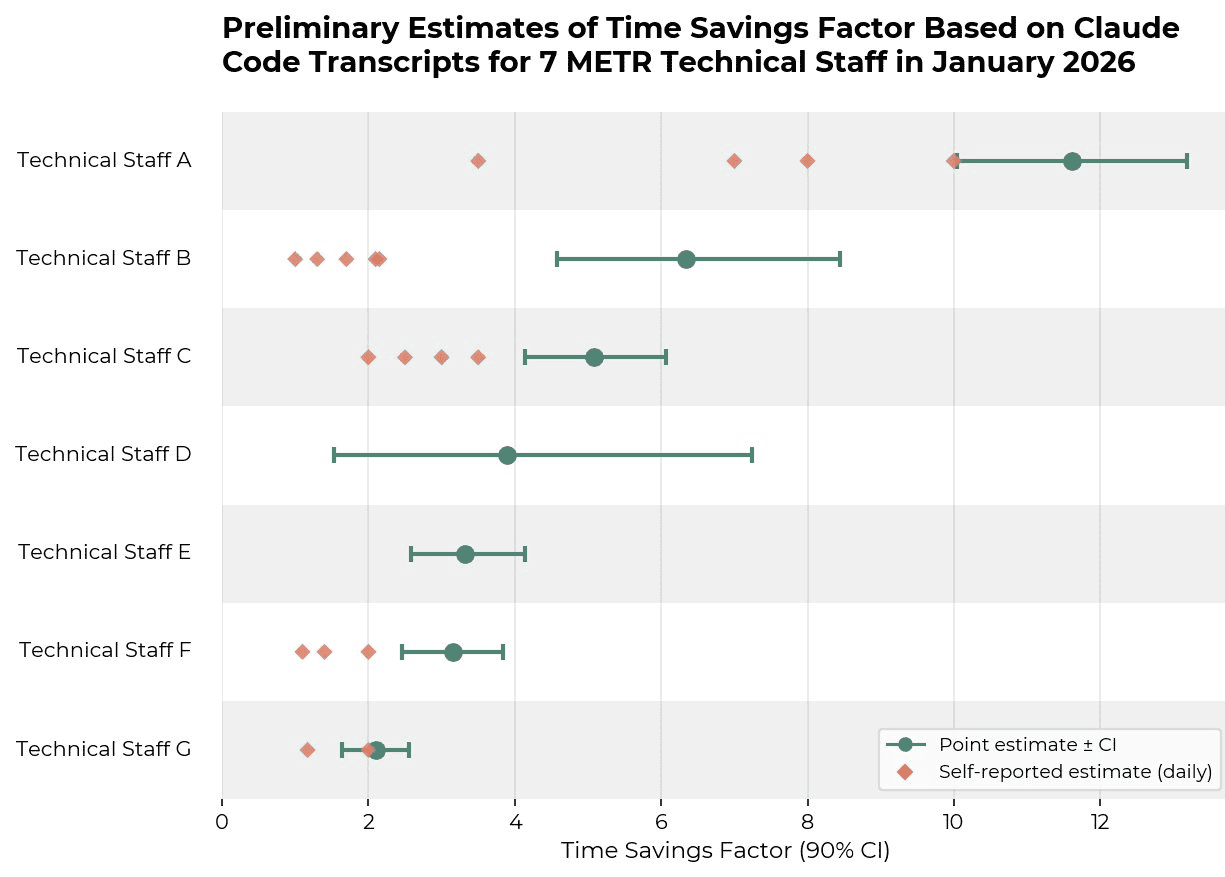 articleAnalyzing coding agent transcripts to upper bound productivity gains from AI agentsmetr.org
 articleThe reach of a verification tool decides its value: A controlled study of verification surface, artifact quality, and cost in AI coding agentsAchint Mehta