Tencent Open-Sources Hy-MT3 Translation Models Covering 102 Languages
- Source
- github.com
- Author
- Tencent Hy
- Date
Context
Tencent has released Hy-MT3, the third generation of its open-weight translation models, in three sizes: 1.8B, 7B, and a 30B model that activates 3B parameters per token. Language coverage goes from the 38 languages of Hy-MT2 to 102. The claims that matter, though, are about error rates rather than coverage. On data Tencent describes as drawn from real-world use, it reports that the share of samples containing a mistranslation fell by 43% against Hy-MT2, omissions or additions by 74%, and instruction-following errors by 40%, according to the model's GitHub page. Every one of those figures was produced by a grader Tencent built and released on the same day.
That grader, TransRubric, is the thing to understand before reading the numbers. Given a source text, a candidate translation and the translation instruction, it checks the candidate against a rubric written for that specific sample, labels each problem with an error type and a severity in the style of professional error annotation, and returns a score from 0 to 100. Every score in Tencent's report is the average of two judges that are not its own models, DeepSeek-V4.1-Flash and Qwen3.5-397B-A17B. Tencent also checked the grader against outside work. Run on the test set of Task 2 of the WMT26 shared task on automated translation quality evaluation, which ranks exactly this kind of metric, TransRubric reports the highest segment-level PDP, 0.744, ahead of the top-ranked official submission, Gemini-3.6-Flash at 0.736. For that comparison TransRubric itself ran on Gemini 3.6 Flash, the same underlying model as the submission it beat, which is Tencent's argument that the rubric rather than the judge model accounts for the gap. Against ten professional annotators scoring 651 Chinese and English translations, its per-sample score varied by 3.31 points across ten runs where the humans varied by 15.57, and its pairwise accuracy of 59.91% beat seven of the ten. This is still Tencent's own meta-evaluation rather than an official ranking, but it runs against a public test set, and because the grader is open, anyone can rerun it.
The underlying rates say how far there is still to go. On WildMTBench-202611, a 5,000-sample set Tencent assembled from recent real-world data, the share of samples containing each error type fell from Hy-MT2-30B-A3B to Hy-MT3-30B-A3B as follows: omissions or additions from 21.2% to 5.5%, mistranslations from 56.0% to 31.8%, terminology problems from 28.3% to 17.9%, and instruction-following problems from 16.5% to 9.8%, as reported in the technical report. The headline reductions are relative, so the absolute figures are the ones to carry away. Roughly one real-world sample in three still contains a mistranslation. Tencent's own argument for tracking these error types rather than fluency is that they decide whether a translation can be used without post-editing, which makes a 31.8% mistranslation rate the number that bounds what this model can be trusted to do unreviewed.
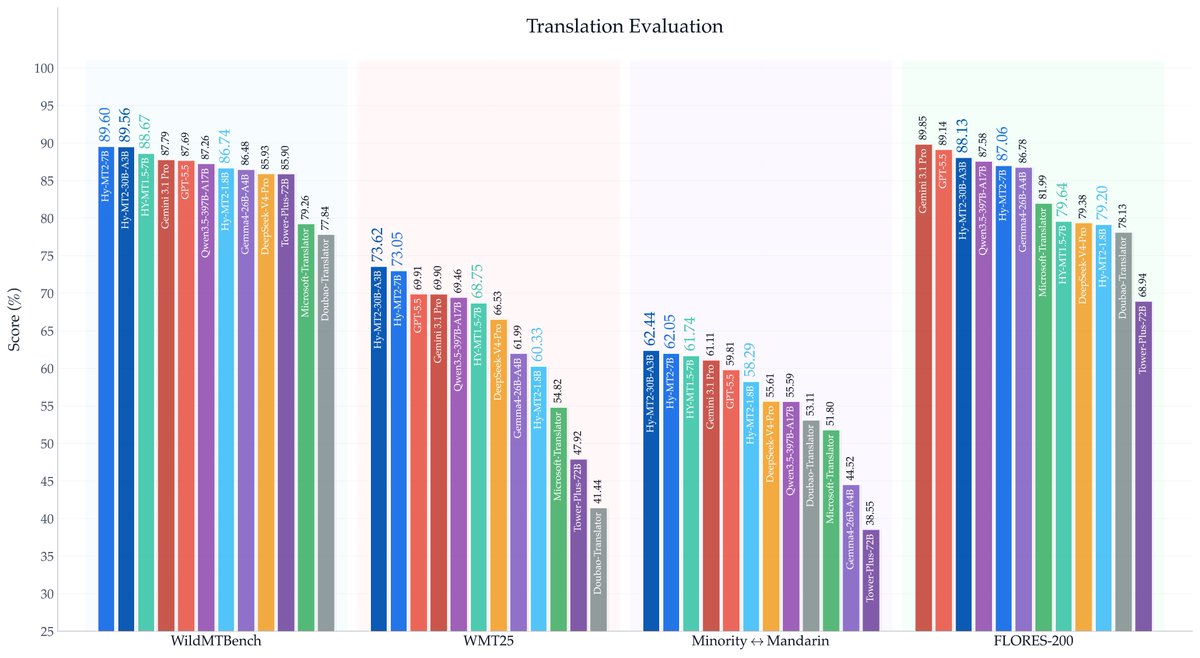
The efficiency claim is the other reason to look. Tencent reports that Hy-MT3-30B-A3B, run without a thinking mode, scores best overall among the models it evaluated in that setting, including Qwen3.8-Max, Kimi-K3.1-Pro and DeepSeek-V4.1-Flash, and approaches the strongest closed-source thinking models, GPT-6.1-Sol and Gemini-4-Argon, while using under 1 TFLOP of estimated inference compute per test sample, less than a thirtieth of what it attributes to Qwen3.8-Max and Kimi-K3.1-Pro. The smallest model is aimed at a different job, and Tencent says the 1.8B beats commercial translation APIs including Microsoft Translator on general translation. Beyond general text, Hy-MT3 is tuned for game localization, evaluated with the Honor of Kings team on metrics such as placeholder and terminology errors, and for translating text that an optical character reader has pulled out of an image, where the point is tolerating the reader's mistakes. Weights for all three sizes are on Hugging Face and ModelScope with FP8 and GGUF variants, so the compute claim can be checked on hardware a reader actually owns. Earlier coverage of the Hy-MT2 release describes the line this one builds on.
- Tencent puts Hy-MT3-30B-A3B under 1 TFLOP of estimated inference compute per sample, activating 3B of 30B parameters, and reports it ahead of non-thinking Qwen3.8-Max and Kimi-K3.1-Pro, which it estimates use more than 30 times that compute.
- Against Hy-MT2 on real-world scenario data, Tencent reports mistranslated samples down 43%, omissions or additions down 74% and instruction-following errors down 40%, alongside coverage growing from 38 to 102 languages.
- TransRubric, the rubric judge released with the models, scored 0.744 segment-level PDP on WMT26 Task 2. Across 10 runs its per-sample standard deviation was 3.31 points against 15.57 for human annotators, but its 59.91% pairwise accuracy beat only 7 of 10.
- Deployment constraints are narrow: max is 8192 tokens, there is no default , and recommended sampling differs by size, with top_p 0.6 and repetition_penalty 1.05 for 1.8B and 7B versus 1.0 for both on 30B-A3B.
- Game localization is a first-class target rather than a side effect. Built with data and an evaluation system from the Honor of Kings team, Tencent reports 30B-A3B matching or beating Gemini 3.1 Pro on off-target, placeholder, rich-text and terminology errors.
- mixture-of-experts — A model built from many specialist sub-networks where only a few activate per token, giving big-model capability at small-model running cost.
- Large language model — A model trained on large amounts of data to process and generate language.
- Context and context window — Context is the information available for a generation; the context window is the capacity available to hold it.
- system prompt — The standing instructions a model receives before any user input — defining its role, rules, tools, and tone for the whole conversation.
Checking sign-in…
Loading comments…