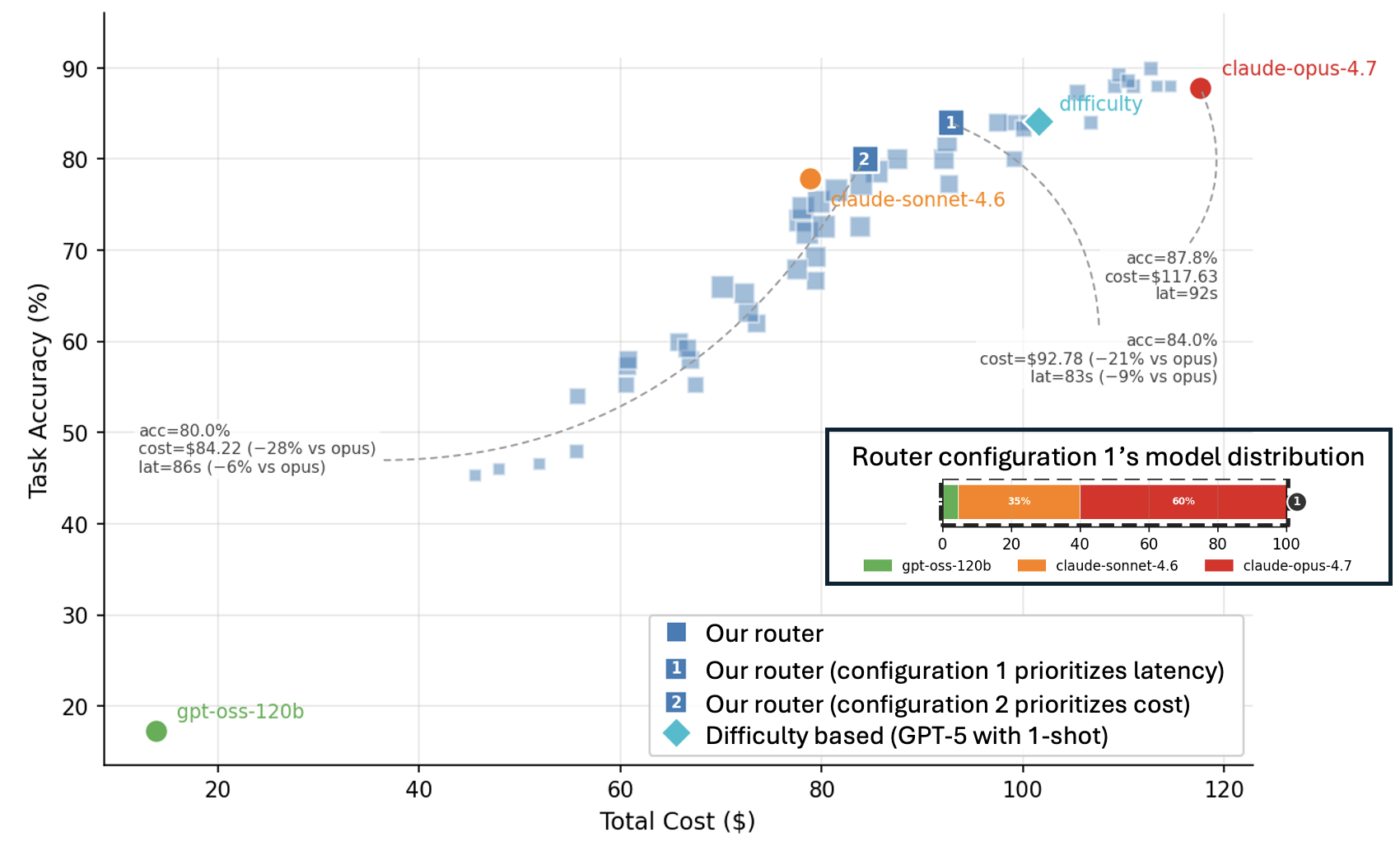
A ModelA computational system that uses learned patterns to produce an output from information supplied to it.Full definition →'s listed price can mislead when estimating the cost of an agent's whole task. IBM researchers report running the same agent software across 417 AppWorld tasks: Anthropic's Sonnet 4.6 cost $79 in total, while OpenAI's GPT-4.1 cost $155, despite GPT-4.1's lower listed input and output prices. The figures come from their routing study account.
The authors attribute the reversal to caching: agent steps repeatedly reuse Context and context windowContext is the information available for a generation; the context window is the capacity available to hold it.Full definition →, and Sonnet's cheaper cached-input charges changed the total bill. Selecting an economical model therefore requires measuring the workload's actual context reuse and execution costs.
Terms in this piece · Glossary
Model — A computational system that uses learned patterns to produce an output from information supplied to it.
Context and context window — Context is the information available for a generation; the context window is the capacity available to hold it.
model routing — Sending each request to a model chosen by the difficulty of the task, rather than using one model for everything.
Latency — The time between asking for a result and having it, including the model's generation time, tool calls, retries and any queueing.