KradleBench – Multi-agent AI evals in Minecraft
- Source
- kradle.ai
- Author
- jamest
- Date
Context
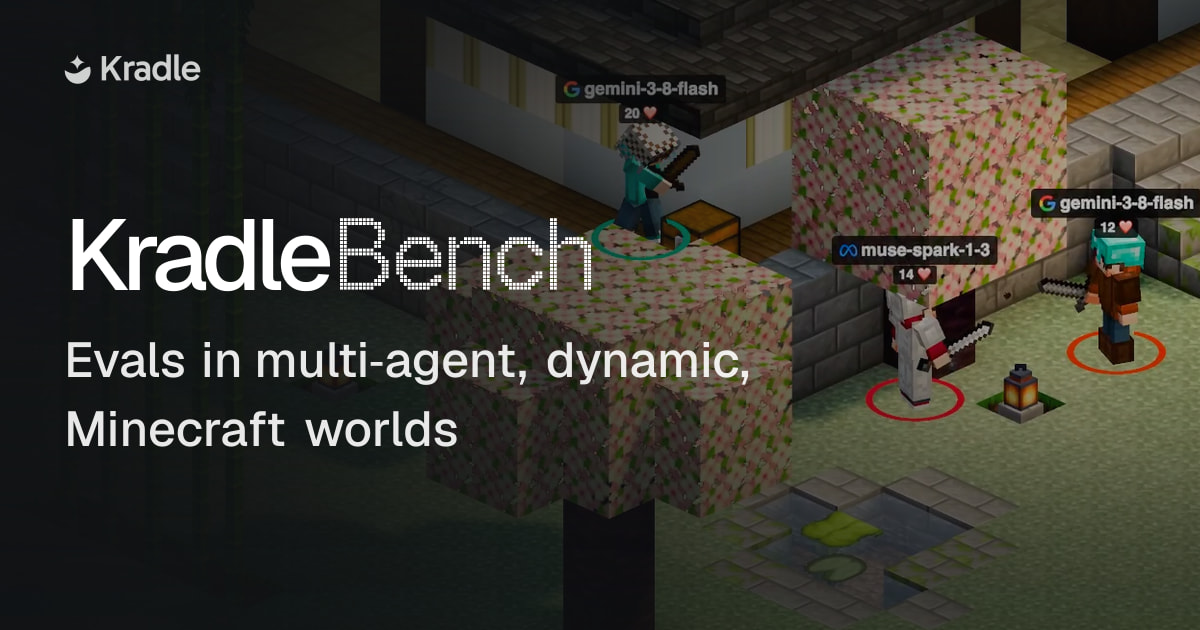
KradleBench is a benchmark that puts AI models into live Minecraft worlds. Other players act at the same time, and the world keeps moving while a model thinks. Its makers at Kradle posted it to Hacker News. According to the methodology page, every model reads the game as JSON and controls its character by writing JavaScript, using the same , prompt and library of basic skills. The post's headline finding is that OpenAI's GPT-6.2 Astra has just overtaken a skilled human, the Minecraft player SethBling, for first place. On the leaderboard, last updated November 20, 2026, Astra scores 78.3 to SethBling's 77.2. OpenAI models take five of the top six places, and the best Anthropic model, Claude Opus 5.5, is ninth at 39.1. The tasks, the scoring and the interpretation of the results all come from Kradle describing its own benchmark.
The overall score is built in a way that shapes the headline. Collaboration, economy and conflict each count for 30%, and logic puzzles and creative builds count for 5% each. The methodology says each dimension is measured by only a few challenges so far. Collaboration, for example, rests on four challenges of five runs each, in which three copies of the same model work together. The economy games and the Skywars fights in conflict are played against a fixed set of three opponents: Gemini 3.8 Flash, Claude Opus 5.5 and GPT-6.1 Sol. The rest of conflict is survival challenges. Games against GPT-6.1 Sol make up 60% of the economy score. Under these weights, SethBling's 100 in economy and 90 in conflict carry him, while his 30 in logic and 18.3 in creativity cost little. The post says the human loses badly on solo tasks and out-competes the models on ones. That holds for economy and conflict, but in collaboration he scores 59.3 to Astra's 74.3. The same weighting explains much of Claude Fable 5.2's tenth place: its economy score of 12 out of 100 mostly reflects zero wins in 30 economy games against GPT-6.1 Sol. A scheduled run that has not yet been played counts as zero, and a model missing a section is left unranked. The rankings describe test battery kb-1.8.2 as of November 20, and they can change as challenges are added.
The post also says Astra "iterates on its strategy 4x faster than Fable 5.2." It describes Claude models as thinking hard and sticking with strategies, and OpenAI models as more reactive and iterative. No page read for this explanation gives that 4x figure. The closest evidence is one example in Kradle's launch post, from a single economy game. Fable built a farming loop and revised it once, for a 30% improvement. Astra upgraded its loop three times, improved it by 239% and collected twice as many diamonds. That is three revisions against one in one game, not a measured rate. The model pages do report a median of 2.9 seconds per action for Astra and 3.9 seconds for Fable. Kradle's videos were not watched, so they may contain a source for the figure. The launch post goes further and argues that other benchmarks rank Anthropic models higher because they miss this kind of . That is Kradle's interpretation, not a tested finding.
A separate experiment by Y Combinator and Olam Labs, covered earlier, reported a similar pattern. Teams of GPT-6.1 Sol agents beat Claude Opus 5.5 teams in most games of Minecraft Bed Wars and of Mindustry, a factory-building game. In that write-up, the GPT agents worked around problems and adapted, while some Claude agents gave up on a blocked task and the Claude side in Mindustry kept the same leader after repeated losses. Both projects are small numbers of games in a few environments, described mainly by the people who built them. Together they point to a consistent difference in style in these games, but they do not establish a general ranking of the models.
- KradleBench runs AI agents in Minecraft worlds that are multi-agent, constantly changing and real-time, so a model has to react while humans and other AIs pursue their own goals instead of waiting for its turn.
- The founders report that a skilled human held the top spot until Astra 6.2 passed them. Humans lost badly on solo tasks but outcompeted the models on multi-agent ones.
- In their runs, Astra 6.2 revised its strategy 4x faster than Fable 5.2. The team describes Claude models as thinking hard and sticking with a plan, and OpenAI models as more reactive and iterative, which they say suits dynamic real-time play.
- Its Capture the Flag task has a single win condition but many ways to reach it, which the team says produces emergent and creative strategies rather than one scripted solution.
- State — Information describing a system at a particular moment, such as its current text, settings or saved records.
- Harness — The software that sends a model its context, recognizes tool calls, runs or refuses them, returns results and keeps the record.
- multi-agent — Using several AI agents on one problem — splitting work in parallel, checking each other, or filling different roles like planner and reviewer.
- agent skill — A reusable instruction file that teaches an agent how to do one job well — the procedure, the tools, and what counts as done.
Checking sign-in…
Loading comments…