[AINews] Kimi 3.1 Pro 104BA-2.8T: Fable-5.1-Class Open Weights narrows Closed-AI lead to 1 month... and Pro Highspeed API with 2-3× speed
Source
latent.space
Author
swyx .ai
Date
Why it matters
An open weightsA model whose trained parameters are published for anyone to download and run — unlike API-only models you can access but never possess.Full definition → model claiming Fable 5.1-class results, plus a faster API tier, changes the self-hosting and cost options for teams building on frontier models. The vendor-reported benchmarks still need independent checks.
Key takeaways · AI-distilled
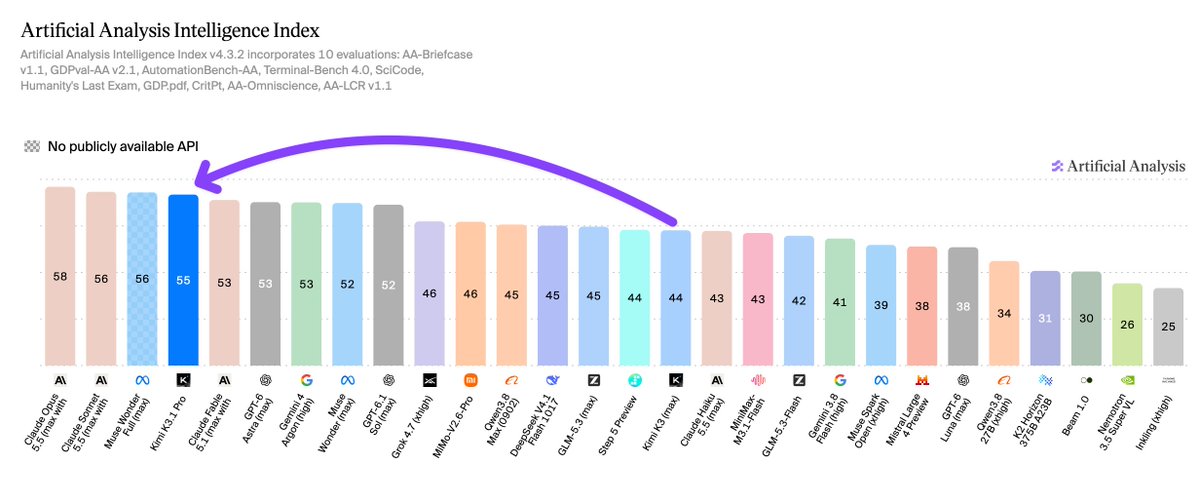
Artificial Analysis independently ranked Kimi K3.1 Pro fourth on its Intelligence Index at 55, behind Opus 5.5 (58) and Sonnet 5.5 and Muse Wonder Full (56), with its biggest gains on agentic tasks rather than knowledge and science tests.
K3.1 Pro's list price fell a third to $2/$10 per million input/output tokenThe chunk of text a model reads and writes in — roughly three-quarters of a word — and the unit AI usage is billed in.Full definition →, but AA measured about 14% more output tokens per task (55K vs 48K), so its Intelligence Index cost stayed roughly flat at $1.98 per task and its Cyber Index cost rose 15%.
Moonshot removed cyber-related data from mid-training and RL, which reportedly cut an internal cyber score from 90.5% to 81%. AA still measured 64% on its Cyber Index, the highest publicly accessible result, with no safety refusals on its tasks.
Only the API shipped at launch. Weights are promised by November 4, 2026, with license terms unstated. AINews estimates 2.8T parameters alone need about 5.6 TB at 16-bit or 1.4 TB at 4-bit, so self-hostable does not mean consumer-local.
Serving provider matters: a separate Vals study found Kimi K3 (not K3.1) scored 60.6% on legal tasks through Baseten versus 75.8% through Moonshot's own API, so identical model names do not guarantee identical AI agentAn AI system that doesn't just answer once but works toward a goal in a loop — taking actions, reading the results, and deciding what to do next.Full definition → results.
Terms in this piece · Glossary
open weights — A model whose trained parameters are published for anyone to download and run — unlike API-only models you can access but never possess.
token — The chunk of text a model reads and writes in — roughly three-quarters of a word — and the unit AI usage is billed in.
AI agent — An AI system that doesn't just answer once but works toward a goal in a loop — taking actions, reading the results, and deciding what to do next.