Krea 3 Technical Report
- Source
- krea.ai
- Author
- Krea editorial sitemap
- Date

Context
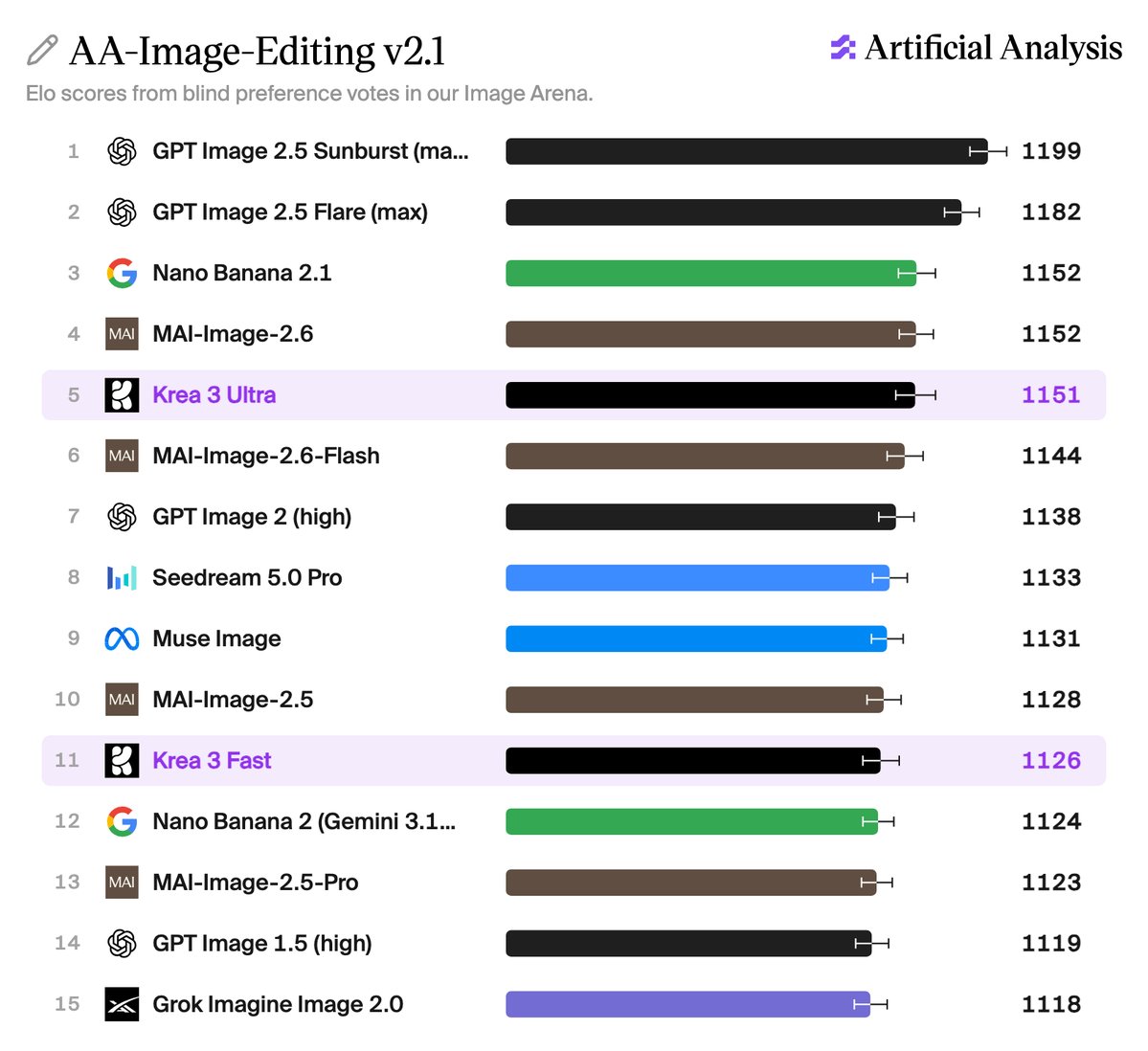
Krea's technical report on Krea 3, its image editing model, says its architecture is deliberately standard and that the work behind it lies in training data and post-training. Krea 3 takes up to eight reference images plus a written instruction and produces an edited or new image, such as a product kept consistent in a new scene. In the report, Krea says edits finish within 8 seconds in production. In its own tests through the fal API, with one reference at 2K output, Krea 3 in its Fast mode averaged 8.0 seconds against 22.3 for Google's Nano Banana Pro and 90.2 for GPT Image 2.5 Sunburst. At listed API prices it estimates $80 per thousand edits against $150 and $436.60 for those models. These are Krea's measurements. Krea says Krea 3 Ultra debuted fourth on all three independent leaderboards it charts, Arena.ai, Artificial Analysis and Design Arena, while Artificial Analysis's own October 20 announcement placed it fifth on its image-editing leaderboard.
Much of the report concerns training examples. Each example pairs reference images with a target image and an instruction that must describe every difference between them, because a model trained on captions that omit or invent changes learns to make edits nobody asked for. Krea mined related pairs from billions of existing images, using cheap similarity models to discard most candidates before vision-language models audited the rest, and kept 0.17% of candidate pairs. It also rendered synthetic pairs, such as websites with altered text, where the exact change is known. Training at native 2K resolution improved text rendering, Krea says, because at 1K the image compression step destroys fine lettering before the model can learn it.
The most instructive section is reinforcement learning, where the model generates 16 attempts per task and judges score them, and it shows how easily automated judges are gamed. A text reward that compared rendered words against the expected string taught the model to make text bolder, bigger and plainer, since that is easier for the judging model to read. A size penalty then taught it to shrink text instead. The final fix added a typography judge that checks whether new text fits the design and measured text size against a fixed reference. That cut the share of changed text flagged as heavier than the design from 28% to about 10%. Krea combined several rewards because no single judge caught every failure, and reports that the RL stage cut text errors on public text-editing benchmarks by about a quarter and reduced flawed generations by 17% on CPI-Bench, a public scored by its own judge that Krea did not train against.
Krea lists two limits: dense small text is still imperfect, and the model does not reliably preserve a person's or character's identity across edits, a gap it plans to close with LoRAs, small add-on models trained for a specific character or product. The report describes methods and Krea's own results. Its speed figures come from Krea's own tests and its cost figures from listed API prices, not from an independent .
- Krea found a pointwise rubric judge saturated during RL: about 70% of rollouts scored a perfect 1.0, and re-asking the judge flipped 43% of within-group orderings. It added pairwise preference and rubric judges instead.
- Rather than a full round robin, Krea compares every rollout against one randomly chosen pivot. At 15 judge calls for 16 rollouts, this reached 0.74 rank correlation with round robin, against 0.69 for random pairs and 0.44 for a knockout.
- A VLM text reader rewarded bolder, plainer text, and a size penalty then taught the model to shrink text. A typography judge plus a fixed-anchor size constraint cut changed text flagged heavier than the design from 28% to about 10%.
- Diffusion rollouts vary little across seeds: on 97 hard inputs, 16 seeds solved only 7. With ten attempts each, paraphrased instructions solved almost twice as many as new seeds, while rewards still scored the original instruction.
- Krea attributes its text-rendering gains mainly to native 2K training, because fine text does not survive a VAE round trip at 1K. A 30:70 text-to-image to image-to-image data blend preserved the model's text-to-image prior.
- benchmark — A standard public test set for comparing AI models — the shared scoreboards behind every "model X beats model Y" claim.
- eval — A repeatable test for AI quality — a set of tasks plus scoring — used the way software teams use test suites, because model output is too variable to judge by eyeballing.
- agent harness — The scaffolding around a model that turns it into a working agent — the loop, the tools it can call, and the rules for when to stop.
- inference — Running a trained model to get answers — the phase where AI is actually used, as opposed to trained.




Checking sign-in…
Loading comments…