OpenClaw's Next Version Auto-Decides to Steer or Queue Agent Turns
- Source
- x.com
- Date

Next version of OpenClaw uses a decision model to automatically decide between steer or queue. (Lab feature, we support Jef* and API-compat (e.g. local models like Kef...) and ONNX variants)
Context
OpenClaw is an open source personal AI assistant that runs on a user's own devices and takes instructions through the messaging apps they already use, according to GitHub. Because people message it the way they message a person, a new instruction can arrive while the is still working. Its creator, Peter Steinberger, says the next version will use a separate decision model to choose automatically between two ways of handling that message: steer, which feeds it into the task already running, or queue, which holds it until that task ends.
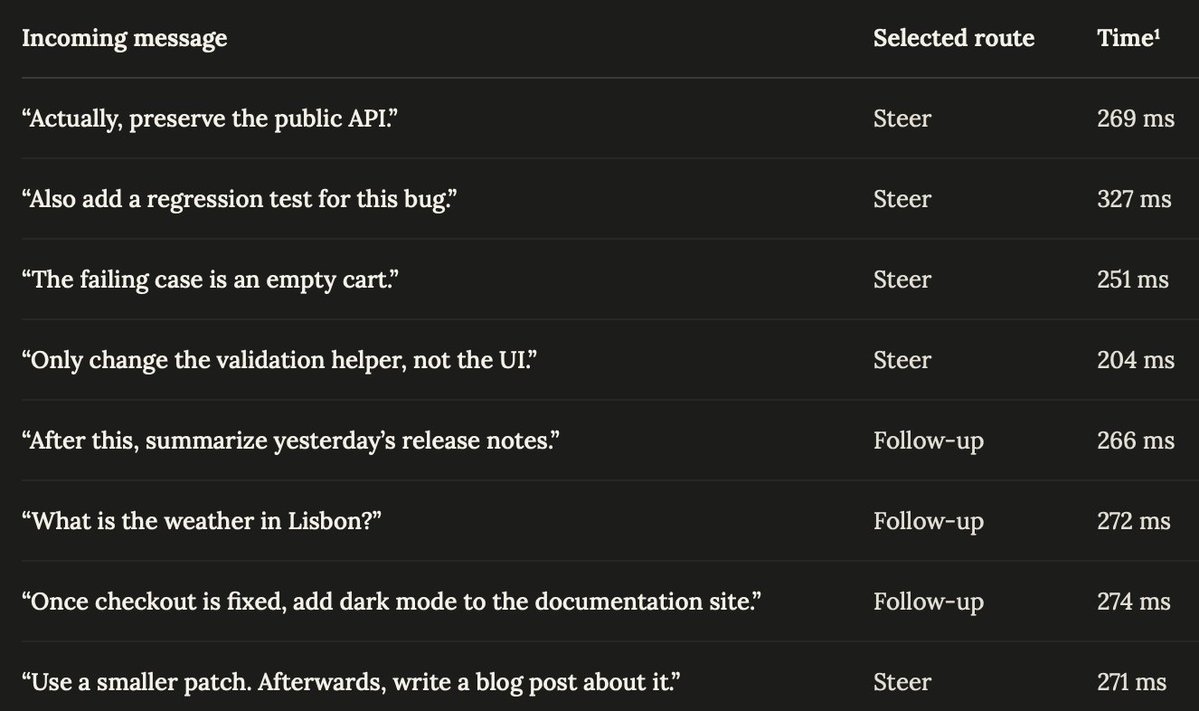
The screenshot in his post shows how the choice is meant to work. Corrections that change the job in progress, such as an instruction to preserve the public API or to change only a validation helper, are routed to steer. Unrelated or later requests, such as asking for the weather in Lisbon or adding dark mode once checkout is fixed, are routed to a follow-up, the screenshot's label for the queue. Each decision in the table takes roughly 200 to 330 milliseconds. A message that mixes a correction with a later request, asking for a smaller patch and then a blog post afterwards, was routed to steer, and the screenshot does not show what happens to the second half.
This is an experiment, not a shipped behaviour. Steinberger calls it a lab feature, names the supported decision models only in truncated form, and says API-compatible local models and ONNX variants also work. The post gives no release date and no measure of how often the model picks the route a user intended, so the benefit for now is a design that removes a choice users would otherwise make themselves, not a demonstrated improvement.
- AI agent — An AI system that doesn't just answer once but works toward a goal in a loop — taking actions, reading the results, and deciding what to do next.

Checking sign-in…
Loading comments…