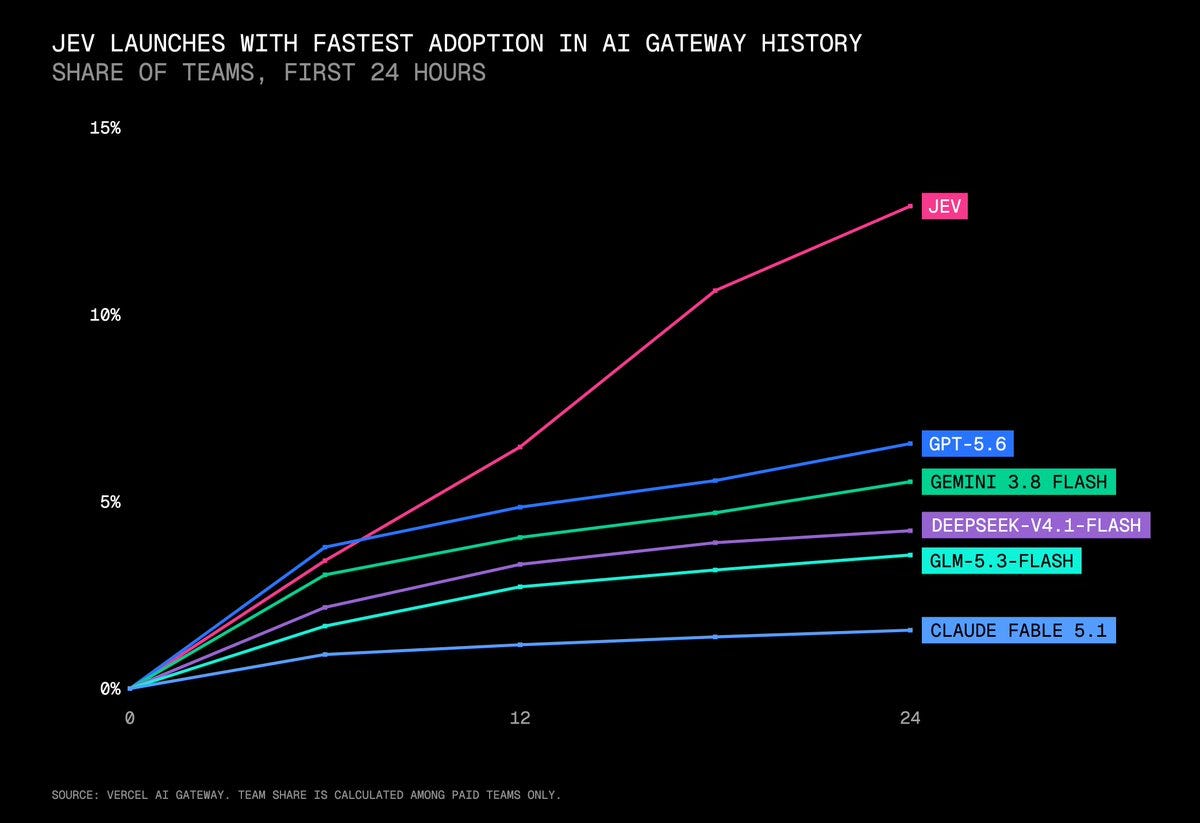
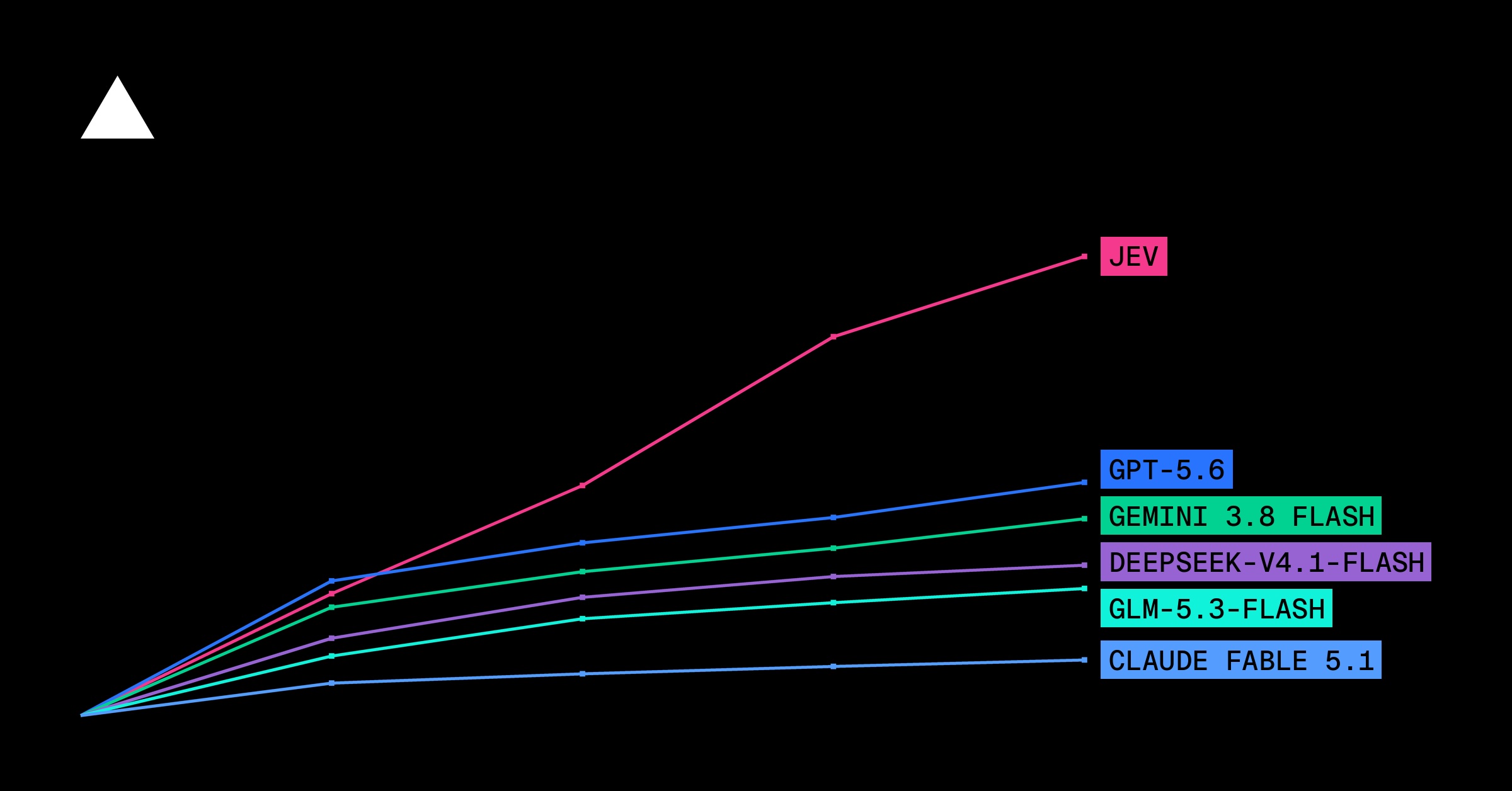
Jev's launch video reached 36M views in two days, compared with 74M for OpenAI's Navier-Stokes result and 57M for Anthropic's Fable 5, per Latent Space's AI News roundup.
Within two days, six teams cloned Jev's discriminative approach; @madiator's Bespoke Nimble (a LoRAA cheap way to fine-tune a model by training a small add-on layer instead of changing all of the model's weights.Full definition →fine-tuningTaking a trained model and training it a bit more on your own examples so it gets better at one specific job.Full definition → of Qwen3.5-9B) raised a baseline from 66% to 90% versus Jev's 93%, at about 100ms on an H100, while @jaredpalmer's Kev-0.5B runs on a MacBook Pro.
@trq212 confirmed Claude Code v2.1.277 now checks for AGENTS.md when no CLAUDE.md is present, with a config-level toggle; @simonw called the payoff fewer shim files that just point one config format at the other.
@Azaliamirh released Turbo-dLLM, an open-source library for training diffusion LLMs at scale, reporting a 2.48x speedup at 512K context windowThe maximum amount of text a model can consider at once — its working memory for the current conversation or task.Full definition → and 7.59x at 1M context on 8x H100 GPUs via Context-Sharded Block Parallelism.
@skalskip92 reported GPT-6 Astra as the strongest vision model Roboflow tested, but its 'high effort' setting only raised detection from 82.1% to 83.6% mAP@50 while roughly doubling per-image cost ($0.050 to $0.101) and latency (11s to 32s).
Terms in this piece · Glossary
calibration — How well a model's confidence matches reality — a calibrated model saying "90% sure" is right about 90% of the time.
LoRA — A cheap way to fine-tune a model by training a small add-on layer instead of changing all of the model's weights.
fine-tuning — Taking a trained model and training it a bit more on your own examples so it gets better at one specific job.
context window — The maximum amount of text a model can consider at once — its working memory for the current conversation or task.
Why it matters
Breaks down how the community is reverse-engineering a viral new judgment model, including two distinct candidate architectures and open questions about their training methods and confidence calibrationHow well a model's confidence matches reality — a calibrated model saying "90% sure" is right about 90% of the time.Full definition →.