Investigate Kubernetes health and processes with the Datadog MCP Server
- Source
- datadoghq.com
- Date
Context
Datadog, which sells monitoring software for servers and applications, has added Kubernetes and process tools to its server, the connector that lets AI assistants such as Claude Code, Cursor and Codex query a customer's Datadog data. The announcement is mostly about saving an work it would otherwise get wrong. Without help, Datadog says, an agent investigating a problem has to search the metric catalog and write its own queries, which takes time and can leave it with incomplete information. The new tools decide in advance which metrics answer a common question, return them in one call, and label what the results do and do not show.
The first set covers the Kubernetes control plane, the components that run a cluster rather than the applications on it: the API server that handles requests, the scheduler that places pods on machines, the controller manager, and etcd, the cluster's database. There is one tool for each, and each returns a fixed bundle of health metrics for a named cluster, by default over the last 10 minutes and for up to 4 hours. If pods have been stuck waiting for a machine for 20 minutes, an agent can call the scheduler tool and see scheduling attempts and how long they take. Every metric comes back with a plain-language description, the exact query used so an engineer can reuse it in a dashboard or monitor, and a status of OK, no data or error. That status lets the agent tell a missing measurement apart from a successful query, and one missing metric does not fail the whole call.
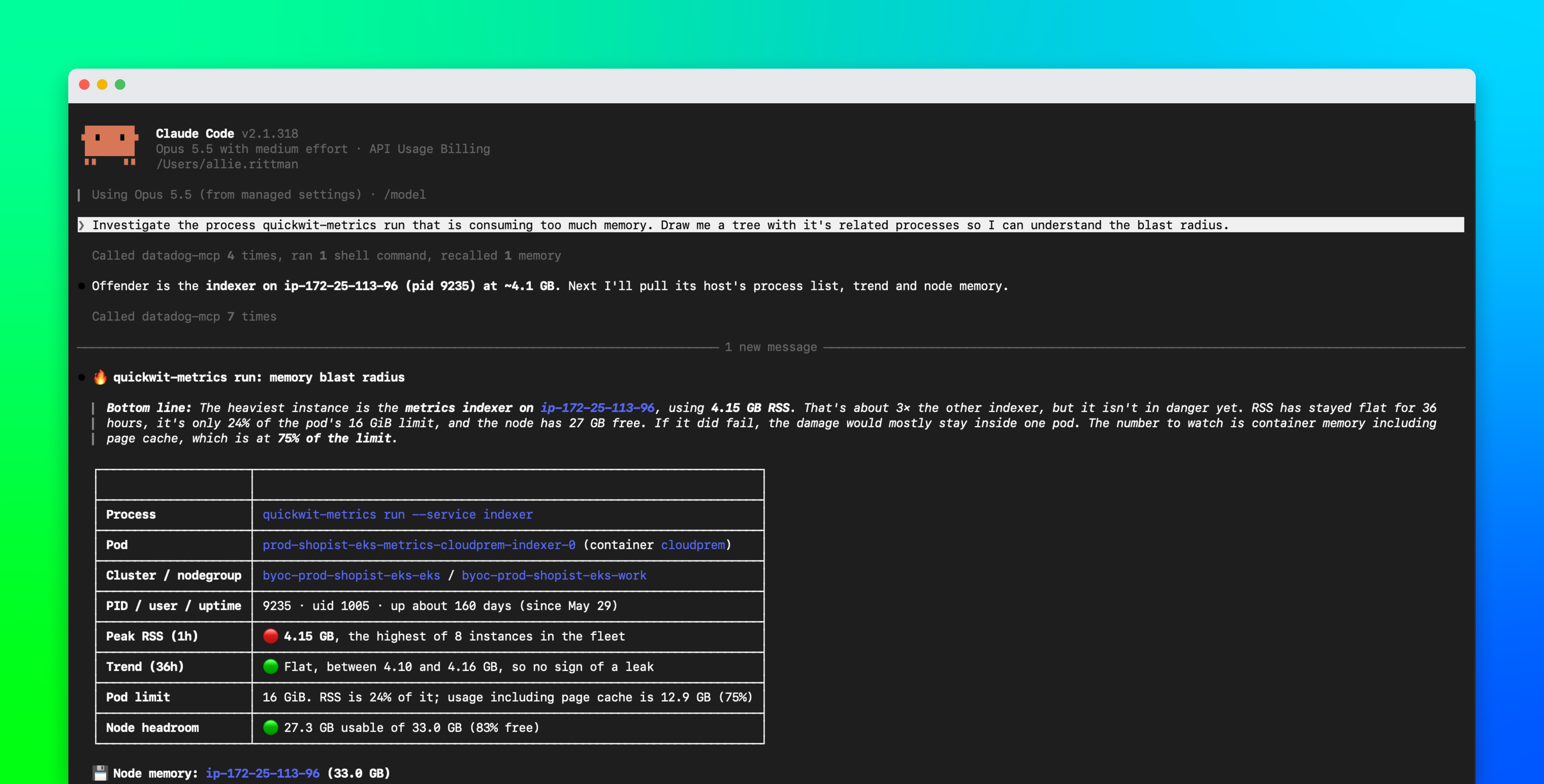
The second addition searches Live Processes, Datadog's record of individual processes on monitored machines: command line, process ID and parent, owner, host, start time, last time seen, and tags. Comparing start times answers questions like whether Postgres restarted on a given database host. Records are kept for 36 hours and one query covers up to an hour. Because a single process in a Kubernetes environment can carry more than a hundred tags, the tool caps responses at 10,000 by default, says when it has truncated a result, and can drop tags entirely for counting questions, so the data does not fill the agent's working memory. Datadog also strips secrets from command lines before the agent sees them. In Datadog's internal test on live production data, 10 questions asked three times each, the agent's answers were correct in 10% of runs without the tool and 96.7% with it.
A third piece, a processes , is guidance rather than data: it tells the agent which of three sources fits a question. Hourly discovery snapshots answer where something such as Redis runs across a fleet, Live Processes answers whether a specific process restarted, and per-process CPU and memory metrics answer whether usage is climbing. The skill also warns against tempting misreadings, for example that an empty discovery result can mean Datadog lacks coverage there rather than that the process is absent.
Everything here is read-only. The tools query data Datadog has already collected, follow the calling user's permissions, and do not run commands inside clusters or change them; the skill's setup guidance says any remote configuration change through Datadog's Fleet Automation needs explicit user approval. Customers need Live Processes enabled and control plane metrics already collected, and the available metrics vary by Kubernetes distribution. The only measured result is the small process-search test, run by Datadog itself; the post gives no comparable figure for the control plane tools.
- Datadog's MCP Server adds four read-only tools that each return a set of health metrics for the Kubernetes API server, scheduler, controller manager or etcd in one call, so agents skip metric discovery and query writing.
- Each returned metric carries its own OK, no data or error status, so one missing signal does not fail the whole call, plus the exact Datadog query, which engineers can reuse in dashboards, notebooks or monitors.
- In Datadog's internal test of 10 natural-language scenarios with three runs each on live production data, agents answered process questions correctly in 96.7% of runs with the Live Processes search tool, versus 10% without it.
- Kubernetes processes can carry 100+ tags, so the search tool caps responses at 10,000 tokens by default, flags truncation, offers pagination cursors, and lets agents drop tags for inventory questions. Secrets are removed from command lines.
- A processes skill routes questions to the right source: discovery data for where something runs, Live Processes for restarts, process metrics for CPU or memory over time. It warns that an empty discovery result can mean missing coverage.
- MCP — The Model Context Protocol — an open standard that lets any AI assistant plug into any tool or data source without custom integration code.
- AI agent — An AI system that doesn't just answer once but works toward a goal in a loop — taking actions, reading the results, and deciding what to do next.
- token — The chunk of text a model reads and writes in — roughly three-quarters of a word — and the unit AI usage is billed in.
- agent skill — A reusable instruction file that teaches an agent how to do one job well — the procedure, the tools, and what counts as done.


Checking sign-in…
Loading comments…