Hundreds of millions of AI agents are coming. Is there work for them?
Source
epochai.substack.com
Author
Jason Li
Date
Why it matters
Ties agent scale to HBM supply, showing how memory limits determine how much agent labor will be available.
Key takeaways · AI-distilled
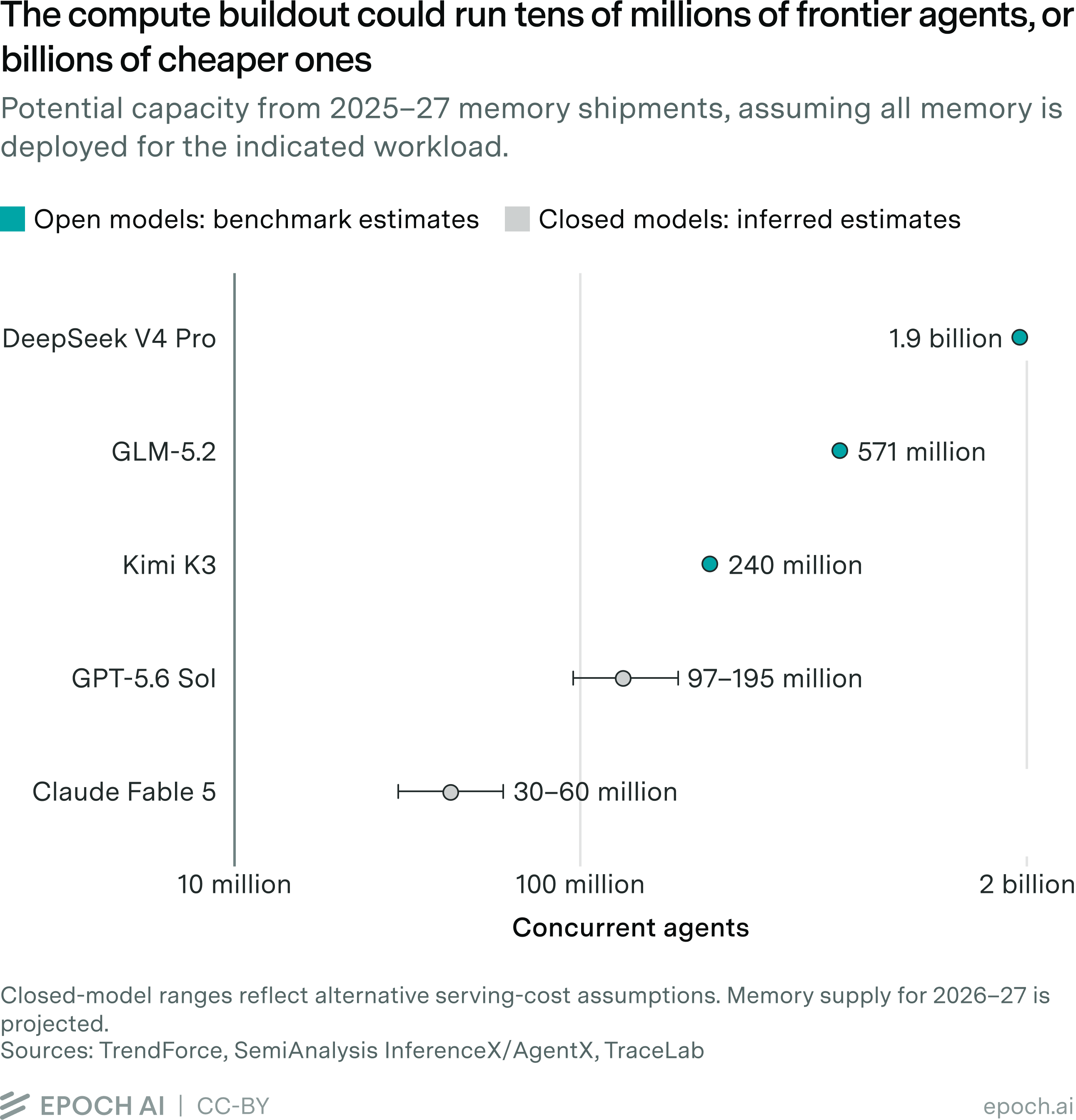
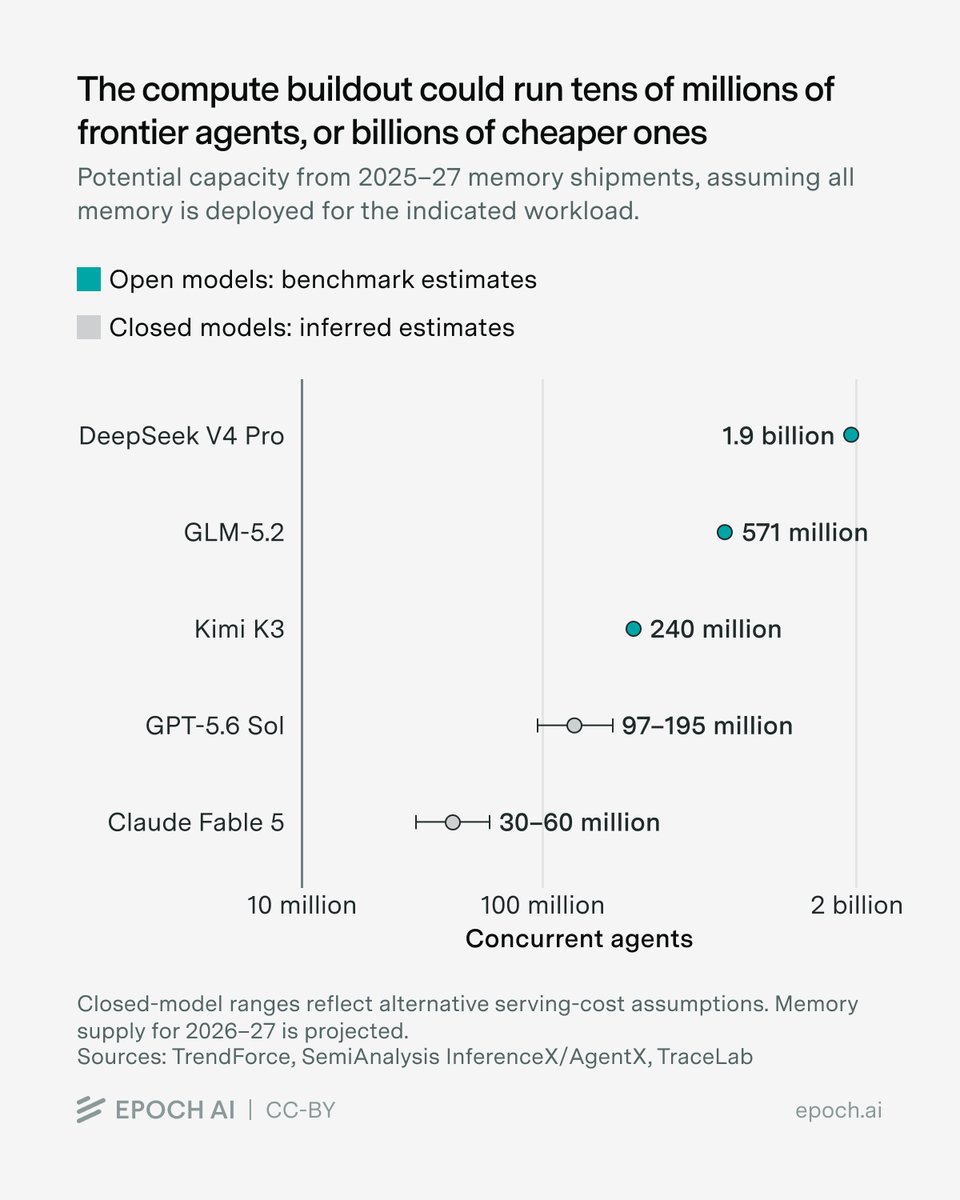
Because HBM bottlenecks AI hardware, Epoch converted projected 2025-2027 HBM shipments into GB300-equivalent GPUs, then multiplied by concurrent AI agentAn AI system that doesn't just answer once but works toward a goal in a loop — taking actions, reading the results, and deciding what to do next.Full definition → sessions per GPU; data center construction could delay when that hardware comes online.
Running nonstop, the top-tier agents that hardware could host would supply the weekly working hours of about 140 to 700 million full-time employees, against an estimated 100 million US knowledge workers.
Using DeepSeek V4 Pro serving benchmarks instead gives about 1.9 billion concurrent agents under Epoch's central hardware assumption, matching the working hours of 8 billion full-time workers, though Epoch notes work quality varies.
If only 20% of that compute served paid inferenceRunning a trained model to get answers — the phase where AI is actually used, as opposed to trained.Full definition → at current API prices, Epoch's main estimate implies $2.6 to $5.3 trillion in annual revenue, above the roughly $1 trillion by end of 2027 implied by continuing recent fivefold annual growth.
Epoch stresses the revenue is not guaranteed: the key uncertainty is whether demand grows fast enough to justify the buildout or the supply surge leaves a glut of AI agents.
Terms in this piece · Glossary
AI agent — An AI system that doesn't just answer once but works toward a goal in a loop — taking actions, reading the results, and deciding what to do next.
inference — Running a trained model to get answers — the phase where AI is actually used, as opposed to trained.