Closed-World Resolution Against Tool Hallucination in LLM Agents
- Source
- arxiv.org
- Author
- Laxmipriya Ganesh Iyer
- Date

Context
Before deciding whether an may use a tool, a system needs to establish that the requested tool and its arguments actually exist. This study examines invented tool names and undeclared arguments, and presents as a reference point a resolver that checks calls against a known registry and the tool's declared input structure before later permission checks. Research abstract.
The study also examines what happens when several servers contribute tools to a shared namespace. Colliding names and one definition hiding another introduce errors that a single-server registry does not capture. The resulting benchmark treats valid tool identity as a distinct reliability problem, including a residual case where inappropriate borrowed arguments still satisfy the declared input structure. Findings and limitation.
- Tool-calling agents sometimes invoke tools that don't exist or pass arguments no schema declares -- a blind spot no tool-selection or tool-gating method can catch, since a hallucinated call was never a real decision a gate made.
- Across ten hosted models and two invocation surfaces, the study measured 322 genuine tool hallucinations; fabricated-tool calls clustered heavily on the unconstrained raw-JSON surface (34) versus a more constrained surface (3).
- Model scale didn't reduce rate: a 675-billion-parameter model hallucinated tools about as often as a 7-8B model.
- Merging multiple MCP servers into one tool namespace creates new hallucination surfaces from name collisions and shadowing -- the study measured 154 such hallucinations, including from frontier models that were clean when tested against a single registry.
- AI agent — An AI system that doesn't just answer once but works toward a goal in a loop — taking actions, reading the results, and deciding what to do next.
- MCP — The Model Context Protocol — an open standard that lets any AI assistant plug into any tool or data source without custom integration code.
- LLM — A large language model — the neural network behind tools like Claude and ChatGPT, trained on huge amounts of text to predict what comes next.
- hallucination — When a model states something false with full confidence — inventing facts, citations, or APIs that don't exist.
 articleRefusing the Impossible: A Taxonomy and Benchmark for Code Hallucination in Large Language ModelsVishnu Asutosh Dasu, Ashish Kundu, Gang Tan
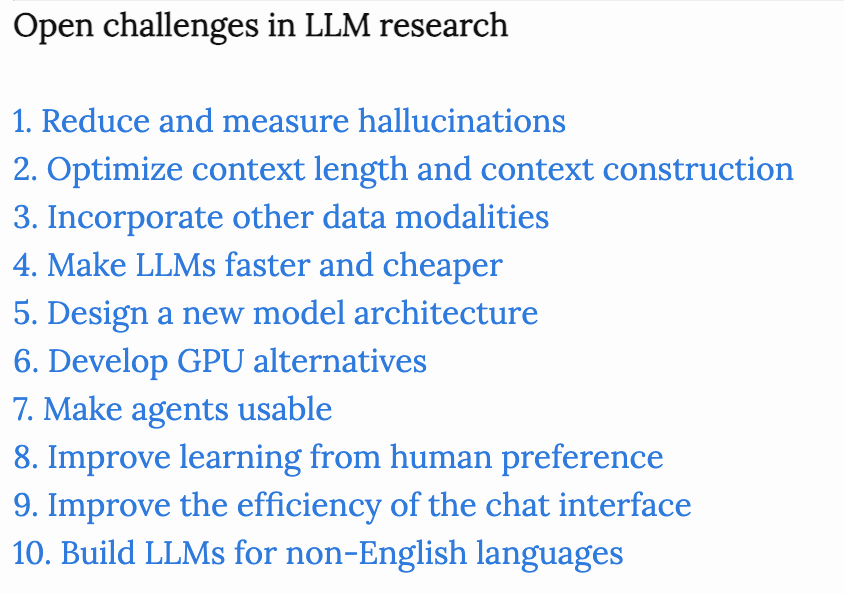 articleOpen challenges in LLM researchChip Huyen
 articleMLLMs Fail to Refuse when Using Tools AgenticallyRikiya Takehi, Ryo Hachiuma, Shaona Ghosh, Dan Zhao, Yu-Chiang Frank Wang, Yusuke Hirota
Checking sign-in…
Loading comments…