Self-evolving skills are sparse search, not steady improvement: across 42 feedback runs only 55 of 388 candidate revisions established byte-distinct validation bests.
Failed trajectories are the fuel: all 11 settings where validation selected an evolved agent skillA reusable instruction file that teaches an agent how to do one job well — the procedure, the tools, and what counts as done.Full definition → included failure feedback - success-only feedback never won a selection.
Validation and downstream test/robustness/transfer evaluations sometimes prefer different feedback views, so a validation win does not guarantee the deployed gain.
test-time computeSpending more computation when the model answers — thinking longer, trying multiple attempts — to buy accuracy without training a bigger model.Full definition → is not a substitute everywhere: oracle parallel sampling comes within 0.43 points of the evolved skill on SearchQA but stays 30.96 points behind on SpreadsheetBench; sequential refinement recovers neither.
Terms in this piece · Glossary
agent skill — A reusable instruction file that teaches an agent how to do one job well — the procedure, the tools, and what counts as done.
test-time compute — Spending more computation when the model answers — thinking longer, trying multiple attempts — to buy accuracy without training a bigger model.
Why it matters
If you're building self-evolving agent skill systems, this shows gains are sparse and depend on including failed trajectories as feedback, and that more test-time compute (parallel sampling, sequential refinement) doesn't reliably substitute for persistent skill evolution.
Key quotes
“Evolution is sparse: only 55 of 388 candidates establish byte-distinct validation bests.”
“All 11 selections come from feedback conditions that include failed trajectories, although the relative ranking of Normal and Fail-only varies across settings.”
“Overall, persistent skill self-evolution is better understood as sparse, validation-filtered search with model- and benchmark-dependent returns, rather than steady improvement from additional rounds.”
 articleSkillBoostHongqiang Lin, Chao Liu, Xiaofan Bai, Xuan Jin, Yuhong Li, Nenggan Zheng, Xipeng Cao
 articleSelf-Evolving Embodied Agents via Skill-Harness EvolutionPeidong Wang, Zhiming Ma, Ying Chang, Xufang Luo, Xiaocui Yang, Shi Feng, Yuqing Yang, Dongsheng Li
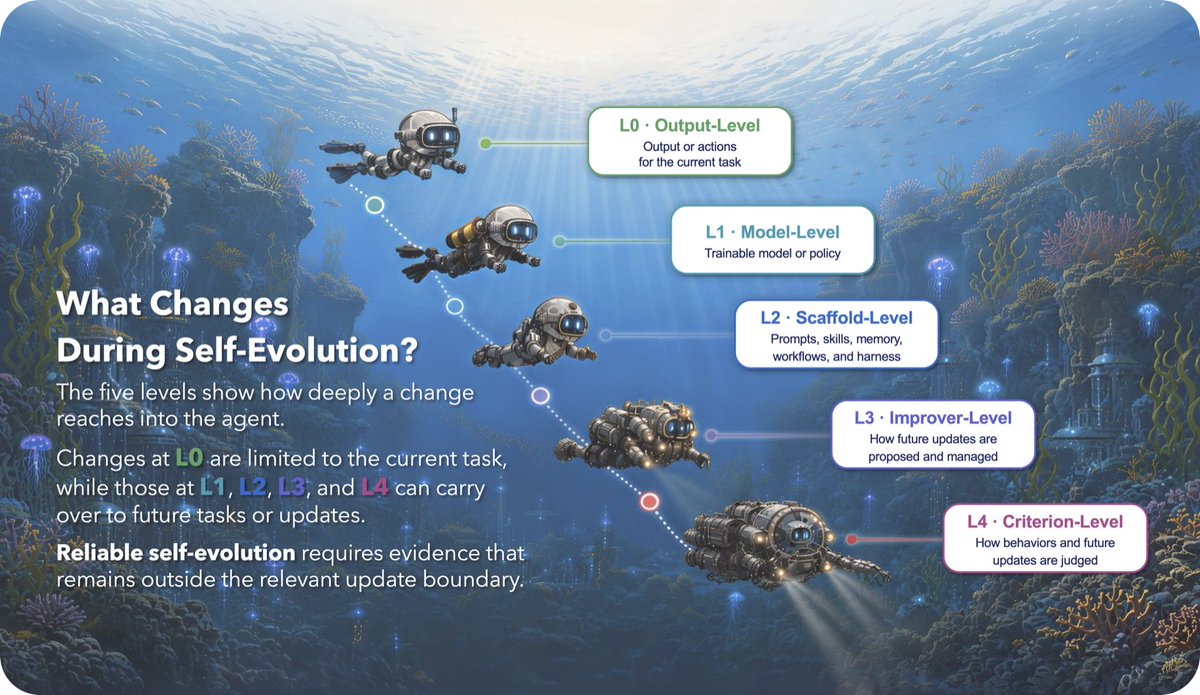 post📄New Research on Self-Evolving Agents: When AI agents modify themselves, how…Tencent Hy