Adaptive Parallel Reasoning: The Next Paradigm in Efficient Inference Scaling
Source
bair.berkeley.edu
Date
Context
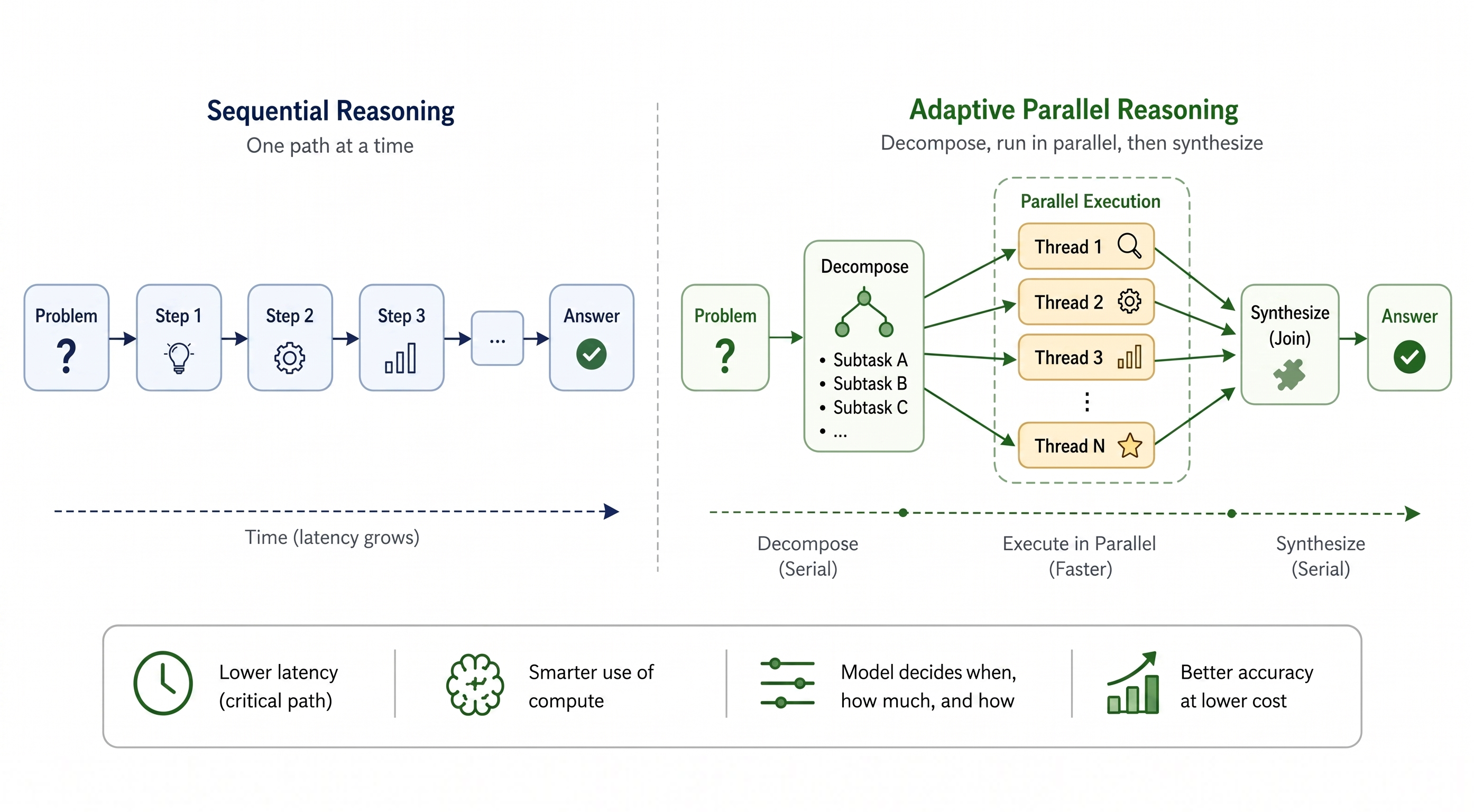
Parallel reasoning is most useful when a model can decide which parts of a problem are independent. A Berkeley AI Researchresearch perspective describes models trained to choose when to split their reasoning into concurrent branches and when to combine the results. Simple problems can remain sequential.
The training incentive matters. Rewarding the number of branches can encourage useless work. The article instead discusses rewards tied to correctness and the longest chain of dependent steps, which determines how long concurrent reasoning must take. This explains why generating more reasoning in parallel can reduce waiting time without necessarily reducing total computation.
Terms in this piece · Glossary
test-time compute — Spending more computation when the model answers — thinking longer, trying multiple attempts — to buy accuracy without training a bigger model.
chain-of-thought — Having a model write out intermediate reasoning steps before its answer, which markedly improves performance on hard problems.