Nvidia and the World Without Jensen
- Source
- newsletter.semianalysis.com
- Author
- Dylan Patel
- Date
Context
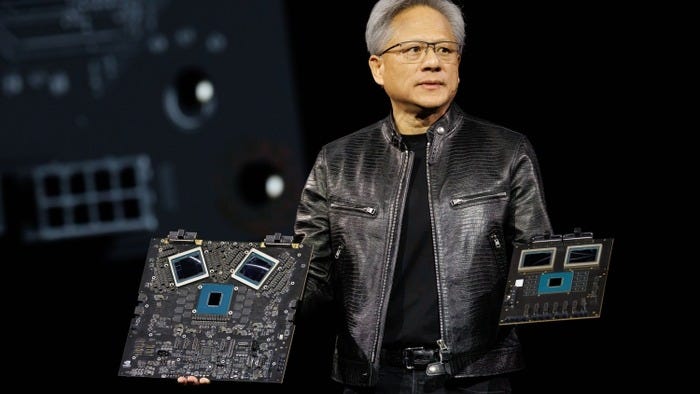
Nvidia told regulators that its board accepted Jensen Huang's resignation as president, chief executive and director on November 11, "effective immediately," in an 8-K filing and announcement that gives no reason. Chief financial officer Colette Kress is interim CEO while the board searches for a permanent one, and longtime director Harvey Jones became the board's first chair. In its analysis, SemiAnalysis (Dylan Patel and colleagues) writes that the board had been investigating Huang's conduct, and argues the exit is also tied to US pressure over Nvidia chips reaching China. Those are SemiAnalysis's claims; the publication itself calls its explanation of the timing its "best conspiracy theory take."
SemiAnalysis's larger argument is about what the company was built around. It says Huang has roughly 60 direct reports, a structure he has described publicly as keeping Nvidia fast and flat, but which in SemiAnalysis's view left few executives trained to run the whole business. It doubts that the internal technical names being floated, datacenter chief Ian Buck and GPU engineering head Jonah Alben, could take over his role, and quotes an unnamed executive saying earlier this year that neither would want the job.
The bigger risk, in SemiAnalysis's telling, is that Nvidia's commercial power was personal. Huang decided which customers got scarce chips, and Nvidia's backstops let smaller GPU cloud providers raise money: it sells them chips, then guarantees part of their revenue or their leases so they can borrow on better terms. Nvidia's quarterly report shows its supply commitments rising from $119 billion to $279 billion in a single quarter, mainly for memory and manufacturing capacity. SemiAnalysis argues Huang won those supplier deals CEO to CEO, so without him chipmakers and memory makers will no longer prioritize Nvidia to the same degree and competitors could find capacity more easily; it projects that more than 70% of total capacity could be non-Nvidia in 2028. Huang himself made a version of the first point in a recent interview, saying suppliers invested ahead of demand because he personally explained to their CEOs how large the market would be. The public portion of SemiAnalysis's piece ends before its full answer to what Nvidia looks like without him, so these effects remain its forecast rather than anything yet observed.
 articleAnother Giant Leap: The Rubin CPX Specialized Accelerator & Rack
 articleScaling the Memory Wall: The Rise and Roadmap of HBM
 articleHuawei Ascend Production Ramp: Die Banks, TSMC Continued Production, HBM is The Bottleneck
 articleH100 vs GB200 NVL72 Training Benchmarks – Power, TCO, and Reliability Analysis, Software Improvement Over Time

Checking sign-in…
Loading comments…