Qwen4-Max now available through OpenRouter
- Source
- x.com
- Date
Qwen4-Max is live on @OpenRouter — go build with it.🙌 https://t.co/E1oGrR6xNb
Context
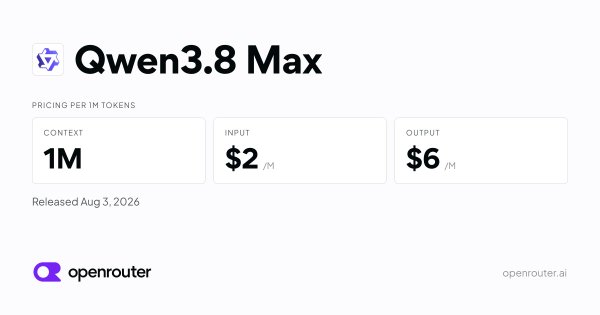
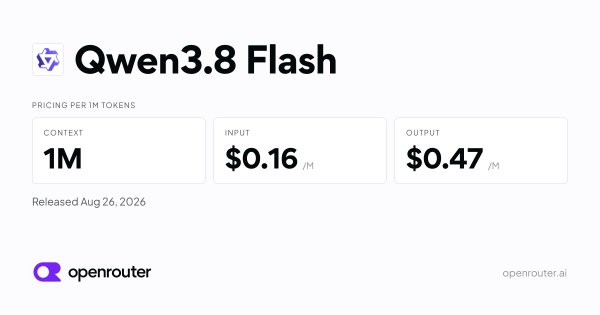
OpenRouter, a service that sells access to many companies' models through one API and one bill, added Qwen4-Max on the day Qwen launched it, and Qwen passed the news on. The change is convenience: a developer who already sends requests through OpenRouter can call the model as qwen/qwen4-max with the account and code they have. It does not lower the price or add a host. Alibaba is the only provider in the OpenRouter listing, and it charges $1.50 per million input and $4.50 per million output tokens, the same as Qwen's own list prices at launch, so there is no second host to switch to and no competing price.
The model's specifications in the listing match what Qwen published. The model takes text, images and video and returns text. Its , the amount of material it can consider at once, is 1,000,000 tokens, and a single answer can run to 393,216 tokens. The listing also shows support for , which lets an have the model request actions such as running a function, and structured outputs that follow a set format. Reasoning, where the model works through a problem before answering, is on by default at high effort, and a request can set it to xhigh, low or none.
Caching is the detail to check before moving agent work over. Agents resend the same long conversation on every turn, so much of what they send can qualify as cached input, text the provider has stored from an earlier request so it need not process it again. OpenRouter lists $0.075 per million tokens for reading cached input and $1.875 per million for writing to the cache. At launch, QwenCloud set the same $0.075 rate for cache reads, including reads from caching it does automatically, but OpenRouter's endpoint entry marks that automatic caching as unsupported for this model, and the listing does not say what a request must do to get the cached rate. Until that is clear, the matching list prices do not establish that the same agent workload costs the same on both services. The listing also has no latency or throughput figures yet.
- token — The chunk of text a model reads and writes in — roughly three-quarters of a word — and the unit AI usage is billed in.
- context window — The maximum amount of text a model can consider at once — its working memory for the current conversation or task.
- tool use — A model's ability to call external functions — run code, search the web, edit files — instead of only generating text.
- AI agent — An AI system that doesn't just answer once but works toward a goal in a loop — taking actions, reading the results, and deciding what to do next.
Checking sign-in…
Loading comments…