Foundries vs Navigators: Lowering the Cost of Science
Source
Adrian Sanborn
Author
Adrian Sanborn
Date
Key takeaways · AI-distilled
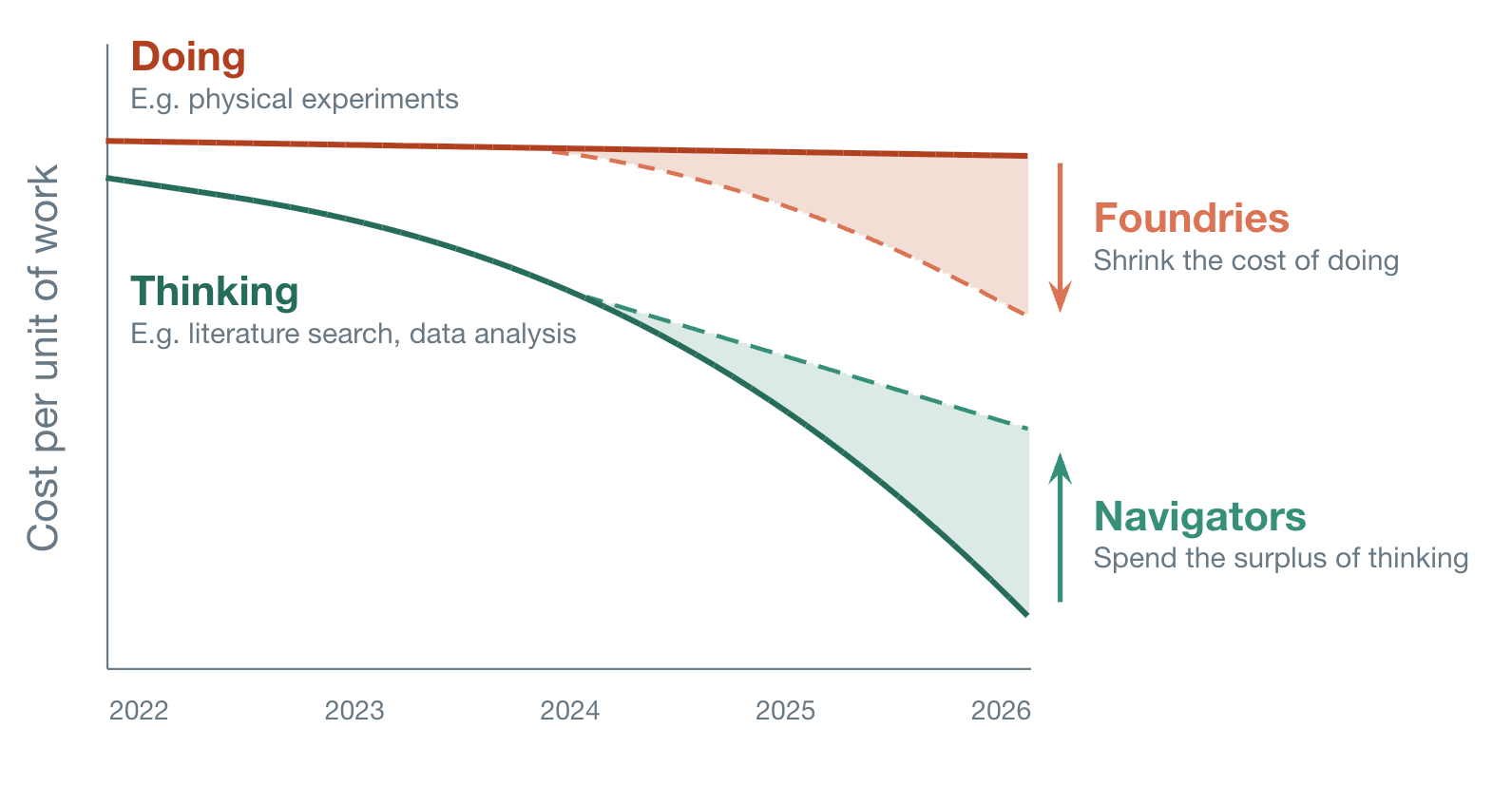
Adrian Sanborn of Endura Therapeutics splits AI-era biotech into foundries, which cut the cost of experiments with high-throughput sequencing, microscopy, or automation, and navigators, which spend cheap AI thinking on what to run.
Because research protocols keep changing, fast AI coding lets the scientist who ran an experiment adapt its analysis in an afternoon, removing the analyst handoff that used to discourage protocol changes.
He argues labs should build their own data portals rather than buy vendor systems, since a tool's layout decides which comparisons are easy; implementation takes a day, deciding what it should show can take weeks.
Endura pointed LLMA large language model — the neural network behind tools like Claude and ChatGPT, trained on huge amounts of text to predict what comes next.Full definition → research agents at about 500 disease targets: short reports filtered the first pass, then about 100 got 30-page-equivalent reviews prompted as a skeptical expert naming prior failures.
Sanborn notes limits: some AI agentAn AI system that doesn't just answer once but works toward a goal in a loop — taking actions, reading the results, and deciding what to do next.Full definition → reports had errors, tolerable because a first-pass miss only costs an opportunity, and analysis generated on demand has weaker determinismWhether the same input reliably produces the same output — something LLM systems mostly lack, which changes how you test and debug them.Full definition → than a versioned pipeline.
Terms in this piece · Glossary
LLM — A large language model — the neural network behind tools like Claude and ChatGPT, trained on huge amounts of text to predict what comes next.
AI agent — An AI system that doesn't just answer once but works toward a goal in a loop — taking actions, reading the results, and deciding what to do next.
determinism — Whether the same input reliably produces the same output — something LLM systems mostly lack, which changes how you test and debug them.
Why it matters
It's a specific, evidence-based framework for where AI actually accelerates R&D throughput versus where physical experiment bottlenecks remain, useful for anyone building AI tools for lab or scientific workflows.