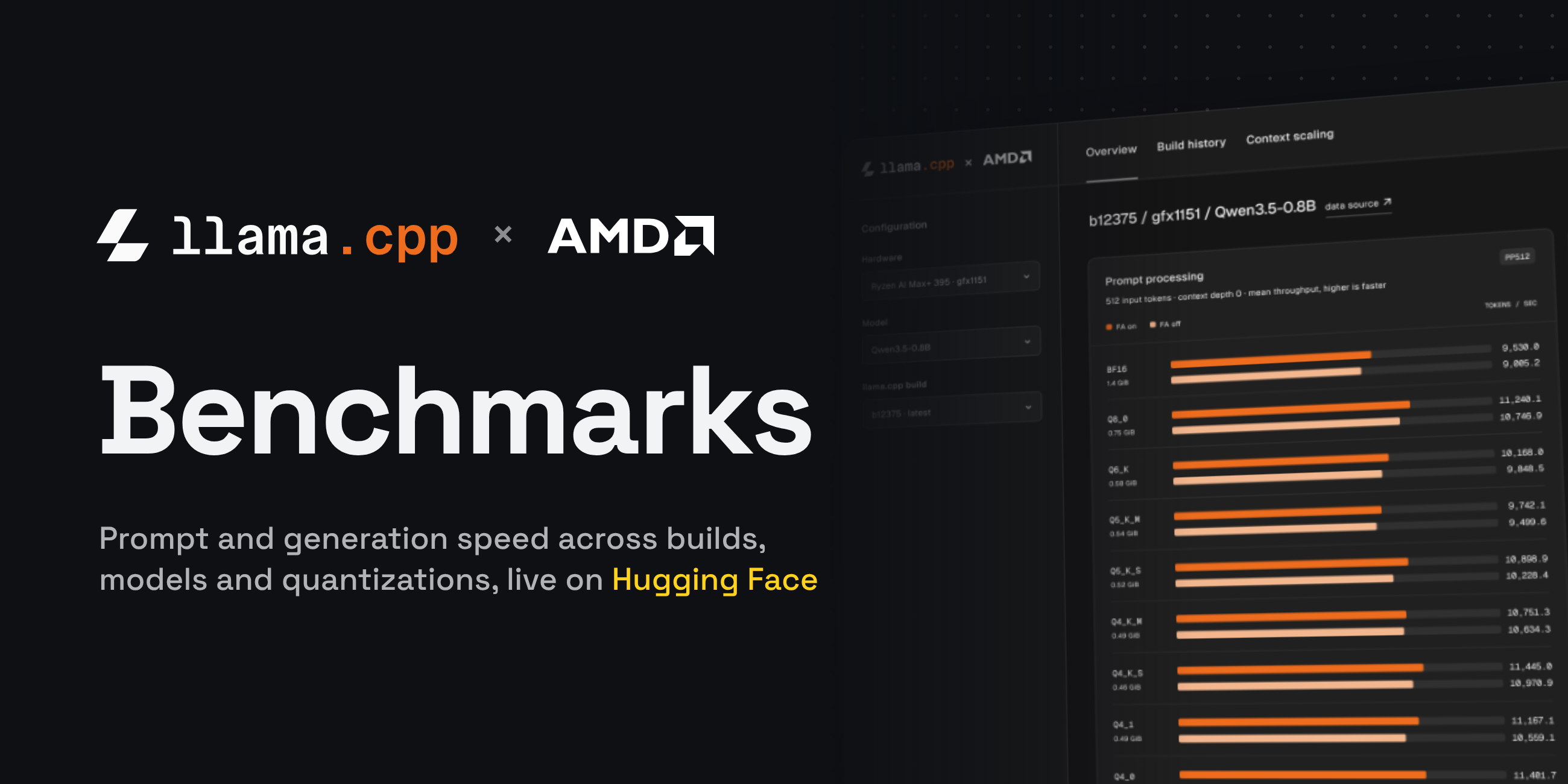
Local inferenceRunning a model on a machine you control, whether a laptop or a server you administer, so that the model's own computation happens there rather than on a provider's servers.Full definition → speed on AMD GPUs shifts with each llama.cpp build. This dashboard lets you compare quantizations, track regressions over builds, and see context scaling on Radeon 8060S and R9700S before choosing hardware.
Key takeaways · AI-distilled
The llama.cpp x AMD dashboard measures two workloads per build, model and quantizationShrinking a model by storing its numbers less precisely — like rounding — so it runs faster and fits on smaller hardware, at a small quality cost.Full definition →: PP512 (processing 512 prompt tokens) and TG128 (generating 128 tokens), both at Context and context windowContext is the information available for a generation; the context window is the capacity available to hold it.Full definition → depth zero and plotted as mean tokens per second.
Results come from the prebuilt binaries shipped through llama-install.sh, benchmarked weekly with llama-bench on a Radeon 8060S (gfx1151) and a Radeon AI Pro R9700S (gfx1201), with Flash attentionThe mechanism that lets a model weigh which earlier words matter for the word it's currently processing — the core operation of a transformer.Full definition → on and off and 10 repetitions each.
Beyond the depth-zero numbers, a Context scaling tab shows how generation throughput changes as existing context grows, and a Build history tab follows PP512 and TG128 across every recorded build.
Raw results are public in the ggml-org/install.sh-benches-data bucket on Hugging Face, stored as <build>/<hardware>/<model>/<quant>.jsonl, so developers can chart them or compare them against a local run.
Terms in this piece · Glossary
Context and context window — Context is the information available for a generation; the context window is the capacity available to hold it.
Local inference — Running a model on a machine you control, whether a laptop or a server you administer, so that the model's own computation happens there rather than on a provider's servers.
quantization — Shrinking a model by storing its numbers less precisely — like rounding — so it runs faster and fits on smaller hardware, at a small quality cost.
attention — The mechanism that lets a model weigh which earlier words matter for the word it's currently processing — the core operation of a transformer.