Genie 4 is now available on the Gemini API.
- Source
- blog.google
- Date
Context
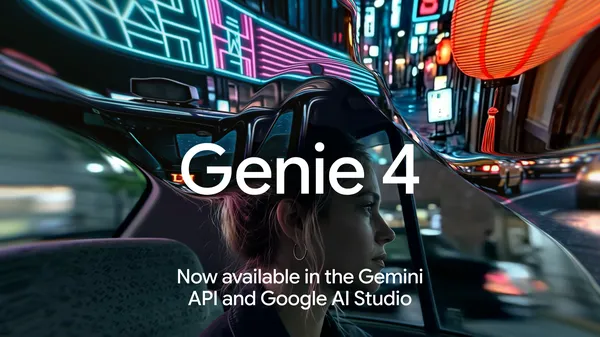
Genie 4, the world model from Google that went to Google AI Ultra subscribers through Project Genie a day earlier, is now available to developers through the Gemini API and Google AI Studio, according to Google's announcement. A world model generates an environment you can move through: instead of rendering a finished clip, it produces each new moment in response to what the user does. Moving it into the API means developers can put these worlds inside their own apps instead of sending people to Google's.
The developer documentation shows what a session looks like. A developer's server opens a session with the genie-4 model through the Interactions API and hands the browser a single-use ; the client connects over WebRTC or WebSocket, sends one setup event with a text prompt and optionally a 16:9 starting image, and then streams keyboard and camera moves plus text instructions, such as a change of weather or lighting, while the world runs. What comes back is continuous 1280 by 720 video at 24 frames per second with stereo audio, which Google says can include ambient sound, effects and character dialogue. Google says Gemini's reasoning keeps the world consistent as it changes.
The documentation also sets the limits. A paid-tier API key is required, each frame is billed as 240 output tokens, and Google estimates the cost at about $0.10 per second with audio included. Sessions have a hard cap of 120 seconds, so at Google's estimated rate a full-length session works out to roughly $12, 120 seconds at $0.10 each; that total is simple arithmetic on Google's estimate, not a figure Google publishes. Google warns that visual stability may degrade after about 60 to 90 seconds, and closing the connection without formally ending the session does not stop billing. That makes Genie 4 in the API suited to short interactive scenes and experiments, such as the prototyping, spatial design and robot or training uses Google suggests, rather than long-running worlds. Every output carries SynthID, Google's invisible watermark for identifying AI-generated content.



Checking sign-in…
Loading comments…