Reinforcement Learning for Design Taste — Jasper Lu
- Source
- jasperlu.com
- Author
- Jasper Lu
- Date
Context
Jasper Lu's experiment suggests that reinforcement learning can teach a model design taste, but the taste it learns is the judge's. Reinforcement learning improves a model by rewarding good attempts, which works well for math and code because answers can be checked automatically. Design has no such check, so the usual workaround is to have another AI model score the output. Lu trained Qwen3.8-27B on web design tasks from environments Xiaomi open-sourced alongside MiMo-V2.6, ran the training twice with identical settings, and changed only the judge: GPT-6 Sol in one run, Claude Sonnet 5.5 in the other.
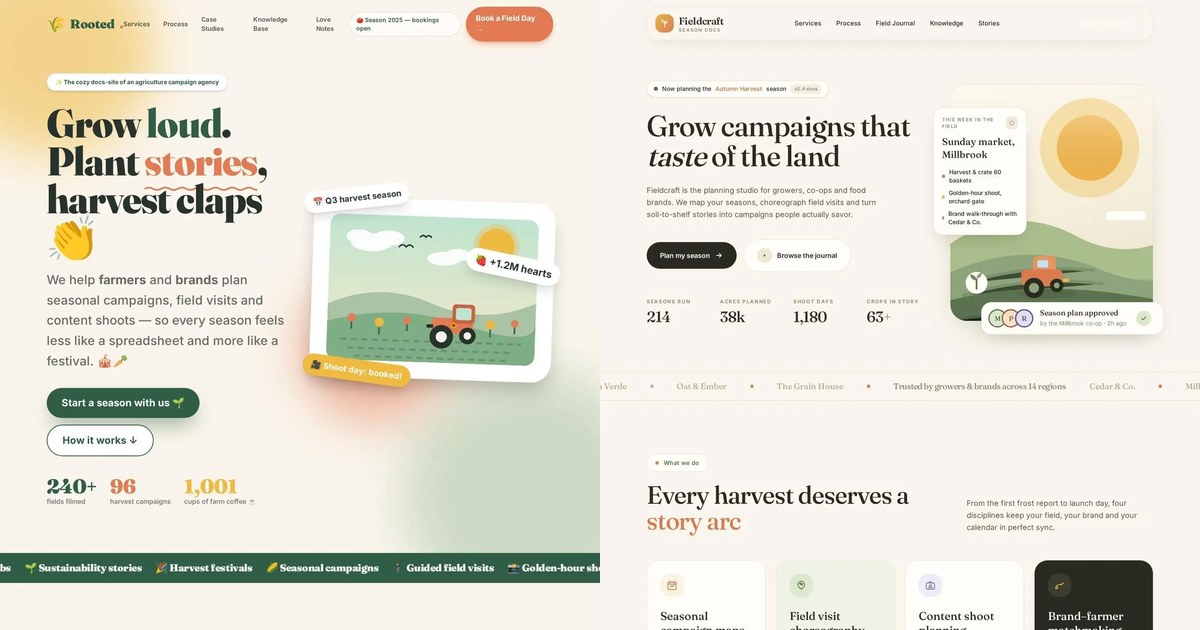
Each trained model's best checkpoint beat the untrained model under both judges, but the two drifted in different directions. Lu describes the Sol-trained model as converging on wackier pages with playful fonts, emojis and background images, many with clipped or overflowing text. The Sonnet-trained model converged on what Lu calls classic Claude design traits, such as serif display fonts, muted palettes and small labels above each heading, with little variation between briefs. When the two final models were compared head to head, both judges preferred the Sonnet-trained one, by a net 44% when Sol judged and 60% when Sonnet judged. A rubric grader that Xiaomi shipped with the environments told the same story: overall scores of 64.5 for the base model, 66.8 for Sol-trained and 70.6 for Sonnet-trained, with the Sol-trained model's layout integrity falling from 73.1 to 64.7.
The run also showed how a judge's quirks become the model's habits. Lu measured that early in training both judges favored longer pages within each group, which he calls the most likely reason the models' pages kept growing until, by step 10, more than half of attempts were cut off by the output limit and delivered nothing. Lu says he has no firm explanation for why Sol trained a worse model, and offers two guesses: judging eight full-page screenshots at once may be too hard for it, and the training reward asks the judge to pick pages that are clearly better or worse than the rest of a group, which favors pages that simply look different and can reinforce eye-catching tics. He also says he is not a designer and finds the Sonnet-trained pages safe and bland.
Lu's conclusion is that the reward should split two questions the current judge blends together. An absolute rubric would check whether a page is well built, and only pages that pass would go on to a relative comparison of which looks better, possibly with a penalty for common AI design tells. He argues that taste itself may not be delegable to one model at all, citing a study by Contra that found human designers agree on pairwise choices as little as 60% of the time. These results come from one 24-step run per judge on a 32-brief set, so they show how judge choice shapes training rather than settling which judge is best. The full write-up, with the judge prompts and per-step charts, is on Lu's blog.
- Under the environments' reward, (pick_score + fulfillment + 1) / 3, a page that fully meets the brief but does not stand out scores about 0.67. Mean reward ended near where it started after 24 steps, so the author judged progress with held-out evals rather than reward curves.
- The length creep came from longer generated pages, not overlong reasoning. By step 10 more than half of rollouts had a truncated reply, and the zero reward for undelivered pages later pulled length back down without any explicit length penalty.
- In blind head-to-heads, both judges preferred the Sonnet-trained model over the Sol-trained one, Sol included: +44% net under Sol and +60% under Sonnet at step 24. The Sonnet-trained model still won when each model's best checkpoint was compared.
- On Xiaomi's seven-axis rubric, averaged over both judges, the Sol-trained model's layout integrity fell from 73.1 to 64.7 against base, while the Sonnet-trained model's premium-asset score rose from 35.5 to 46.4 as it drew custom illustrations where the Sol model used emojis.
- The author proposes admitting only pages above an absolute rubric threshold into relative taste judging, so a broken but striking page cannot win, and cites Contra's finding that human designers agree on pairwise design picks as little as 60% of the time.
- eval — A repeatable test for AI quality — a set of tasks plus scoring — used the way software teams use test suites, because model output is too variable to judge by eyeballing.
- LLM — A large language model — the neural network behind tools like Claude and ChatGPT, trained on huge amounts of text to predict what comes next.


Checking sign-in…
Loading comments…