FinProBench: Evaluating Financial AI Agents with Role-Grounded Rubrics Derived from Professional Deliverables
- Source
- arxiv.org
- Author
- Ben Wang, Kang Zhou, Lifan Guo, Feng Chen, Chi Zhang
- Date

Context
FinProBench addresses a problem in grading financial AI work: the assignment may leave professional expectations unstated. Its rubric-building method extracts those expectations from practitioners' completed work and turns them into criteria. The researchers then check coverage against standards extracted from separate, held-out documents. The paper describes this as evaluation in the work a role actually produces.
Across 27 specialized roles, the resulting criteria covered 99.1% of held-out professional standards, compared with 78.0% for criteria generated from task prompts alone, at similar criterion counts. This is a result about the completeness of grading standards. It suggests that examples of professional work can supply requirements a task description leaves implicit.
- eval — A repeatable test for AI quality — a set of tasks plus scoring — used the way software teams use test suites, because model output is too variable to judge by eyeballing.
- grounding — Tying a model's answers to checkable sources — retrieved documents, live data, tool results — instead of letting it answer from memory alone.
- Large language model — A model trained on large amounts of data to process and generate language.
- Prompt — Information or instructions supplied to a model; in a chat, the request you type is often called your prompt.

 articleInducing Reward-Free Judging Rubrics that Reduce Over-Crediting in Agent EvaluationDarragh Quinn, David Dylan, Roisin Healy, Fionn Carroll, Maeve Donnelly, Cormac Sheehan
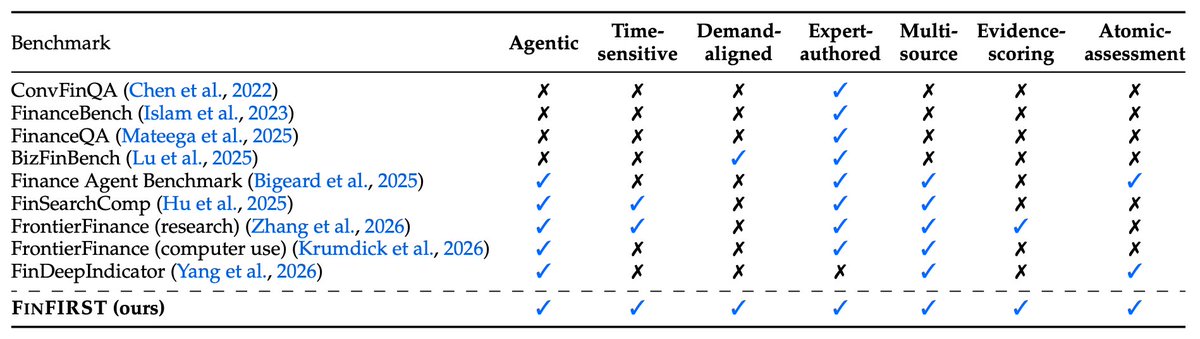 postSince its release, FinFIRST has drawn a lot of interest.Ant Ling
 articleLlm As A Judge Evaluate Ai AgentsOpenRouter editorial sitemap
Checking sign-in…
Loading comments…