Amazon's perception-agent workshop connects visual feedback to a check of the resulting webpage. A browser extension lets someone select an element or mark a location and describe a change. It exports structured feedback for a Agent modeA mode in which one agent can inspect, edit, run commands, and iterate toward an outcome.Full definition →; this annotation step does not require ModelA computational system that uses learned patterns to produce an output from information supplied to it.Full definition →InferenceUsing a trained model to produce an output from a supplied input.Full definition →. The talk distinguishes collecting that feedback from evaluating the result.
After the coding agent edits the ApplicationSoftware arranged so that a person can use it; in this course, the software around a model that accepts your request, prepares the context and shows the reply.Full definition →, a browser verification step checks the rendered page against design expectations and user flows, then produces a report. The workshop implementation connects these stages. This gives a reviewer evidence about the page users encounter, beyond the coding agent's statement that it changed the code.
Key takeaways · AI-distilled
Amazon AGI Lab's perception agents workshop builds on two primitives: visual annotation, where a person selects an element, draws on the page or drops a pin and exports structured JSON feedback, and visual verification, which checks the rendered site.
The annotation step is deterministic, while verification lets a coding agent inspect the rendered result of its change against design expectations and user flows, instead of accepting the agent's claim that the change is done.
Participants connect a browser extension to a coding agent through a local bridge and add an Apply Changes button, so exported feedback flows into code edits, a verification run and a report. Several audience extensions were still at the concept stage.
Terms in this piece · Glossary
Agent mode — A mode in which one agent can inspect, edit, run commands, and iterate toward an outcome.
Model — A computational system that uses learned patterns to produce an output from information supplied to it.
Inference — Using a trained model to produce an output from a supplied input.
Application — Software arranged so that a person can use it; in this course, the software around a model that accepts your request, prepares the context and shows the reply.
 video1,000 Claude Agents Formalized Fermat's Last Theorem — Lance Martin, Anthropic
 videoHow 21 People Built a $100M+ Agent Company — Quinn Slack, Amp
 videoSoftware Factories: Escape from Trash Mountain — Steve Yegge, Gas Town
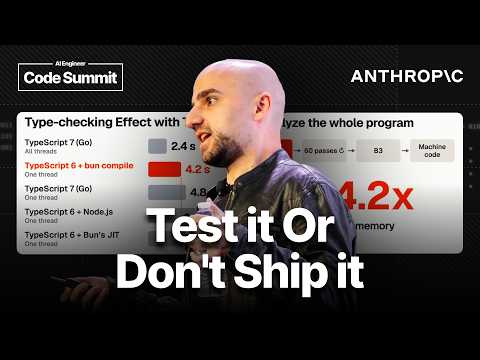 videoHow to Ship Millions of Lines of Agent-Written Code — Jarred Sumner, Anthropic


