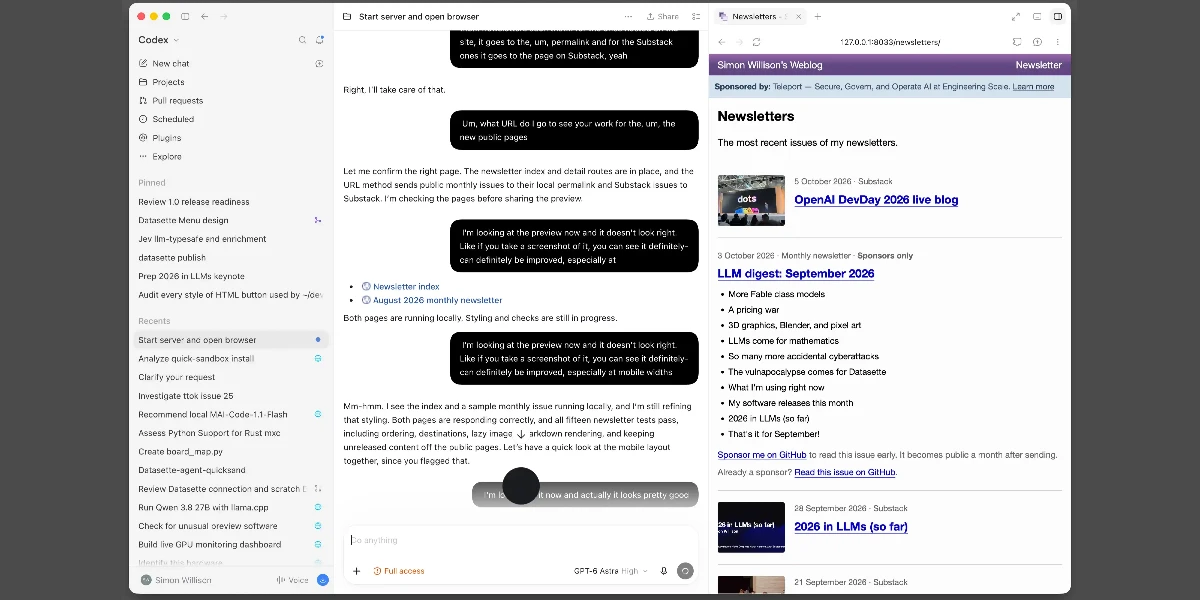
Shows a concrete hands-free workflow: start a local dev server, open a Codex voice chat, and dictate a model, migration, views and importers. Useful for judging whether voice-driven coding agents can ship real features.
Key takeaways · AI-distilled
Willison first typed "Start dev server and open in browser" in the Codex tab, then started a voice chat, so he could ask the AI agentAn AI system that doesn't just answer once but works toward a goal in a loop — taking actions, reading the results, and deciding what to do next.Full definition → to show new pages and follow its progress visually from across the kitchen.
About half an hour of talking to GPT-6 Astra High produced a Django model and migration, admin config, four working importers (RSS, an undocumented Substack API, two GitHub repos), archive pages and site search integration.
Code review in the GitHub PR caught one wrong choice: an import shelled out to Git in a subprocess, but pulling from a private repository made an API-based import the better fit, so Willison switched to typing to fix it.
Getting to a deployable PR took roughly another half hour of typed prompting. Willison says typing still wins for details, because pasting examples and error messages or highlighting code beats describing it aloud.
His verdict: voice coding suits multi-tasking more than daily use and would not work in a shared office. The live visual preview plus a keyboard fallback is what made it more capable than his earlier phone voice-mode sessions.
Terms in this piece · Glossary
AI agent — An AI system that doesn't just answer once but works toward a goal in a loop — taking actions, reading the results, and deciding what to do next.