Introducing Gemini 3.8 Live and 3.8 Live Extended Thinking
- Source
- deepmind.google
- Date
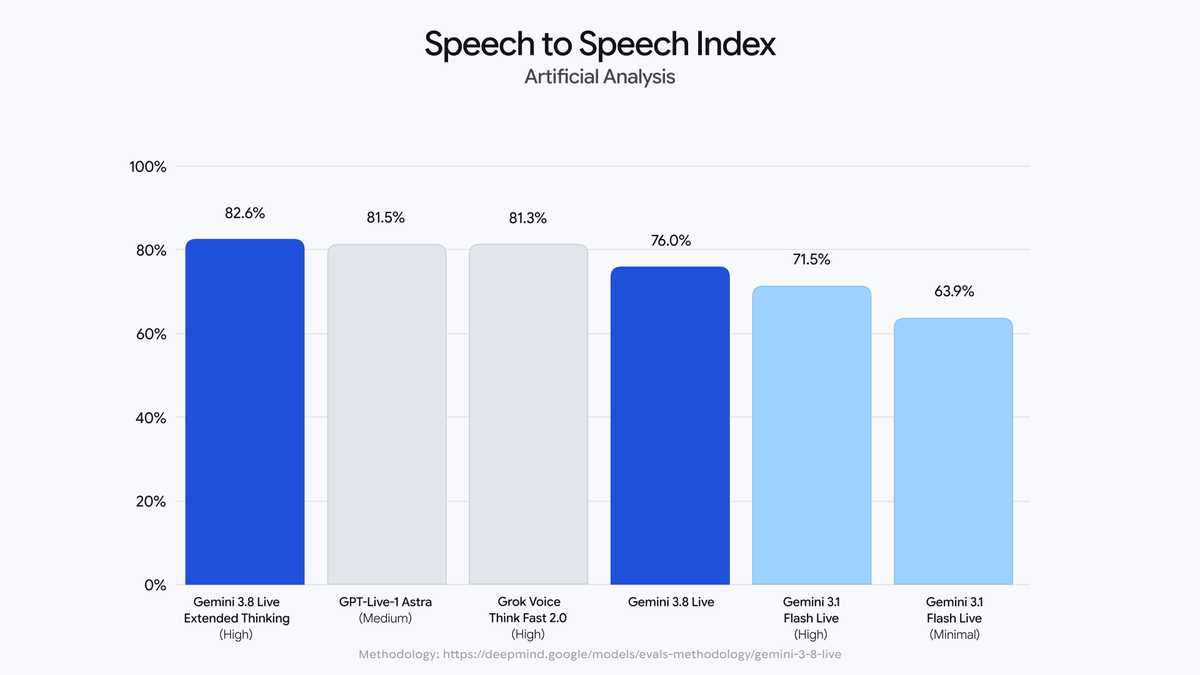
Google DeepMind released Gemini 3.8 Live alongside a Live Extended Thinking variant that adds configurable reasoning effort to speech-to-speech interaction. Artificial Analysis places the Extended Thinking model first on its Speech to Speech Index at 82.6 and first on the Tau Voice agentic benchmark at 68.6 percent, ahead of GPT-Live-1 and Grok Voice. The agentic benchmark result matters because it tests something harder than transcription and turn-taking: the model executes tool calls in the middle of a live conversation rather than pausing to think between turns. That closes a gap that has limited voice agents to scripted, turn-based flows. Google published the announcement on its developer and DeepMind blogs, and Vercel confirmed same-day availability through its AI Gateway, so teams can route to the new models without waiting for a separate SDK release. For anyone building voice agents today, the practical change is that a single model can now hold a conversation and act on it at the same time, which removes a common design compromise: routing tool calls through a second, slower model while the voice layer stalls.
Context
Google DeepMind's Gemini 3.8 Live Extended Thinking is designed to keep speaking while it works through a complex request. According to the model announcement, reasoning runs alongside speech, allowing an early acknowledgment and progress narration during a multistep task.
The standard Live model also supports background tool and API calls while conversation continues. That separates the moment a request is acknowledged from the moment its work finishes. For a voice interface, the useful capability is keeping the user informed during that interval without requiring the task to complete before any response begins.
- Gemini 3.8 Live Extended Thinking takes #1 on Artificial Analysis' Speech to Speech Quality Index (82.6) and leads agentic voice task completion at 68.6% on tau-Voice and 35.1% on Sierra's tau-Voice-banking , while scoring 97.7% on Big Bench Audio.
- Both Live models auto-detect and switch between 97 languages mid-conversation and execute tool calls and API requests in the background while the conversation keeps flowing, using verbal cues like "Let me check that" and live progress narration for multi-step tasks.
- On ServiceNow's EVA-Bench, which grades voice agents on both task accuracy and conversational quality together, Google says the new models push the Pareto frontier for complex workflows rather than trading one for the other.
- All audio the models generate is watermarked with SynthID, an imperceptible signal woven directly into the audio output meant to keep AI-generated audio detectable and help prevent misinformation, per Google's stated approach to safety and responsibility.
- Voice platforms including Agora, LiveKit, Pipecat, Vercel, and LangChain get access via the Gemini Live API to handle real-time media , while partners like Salesforce, Genspark, and Lumeris are integrating the models for latency, fluidity, and tool-calling.
- context window — The maximum amount of text a model can consider at once — its working memory for the current conversation or task.
- benchmark — A standard public test set for comparing AI models — the shared scoreboards behind every "model X beats model Y" claim.
- streaming — Sending a model's response token by token as it is generated, so the reader sees text immediately instead of waiting for the whole answer.
Checking sign-in…
Loading comments…