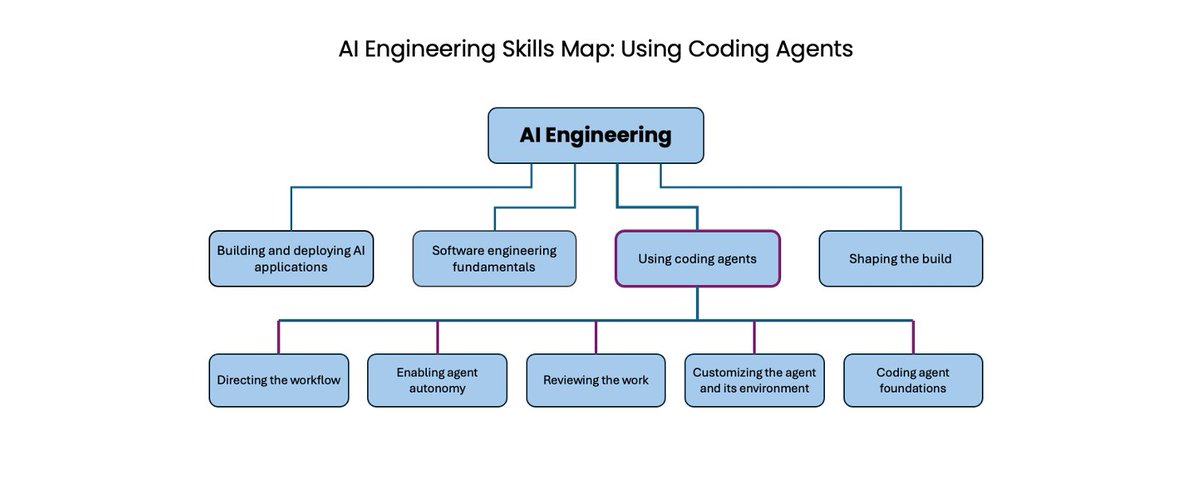
Gives specific habits for working with coding agents: expose logs, deploys and flags as tools, ask for end-to-end proof, test whether agents use your AGENTS.md, and focus review on a few critical files.
Key takeaways · AI-distilled
The author argues against cheaper models for AI agentAn AI system that doesn't just answer once but works toward a goal in a loop — taking actions, reading the results, and deciding what to do next.Full definition → work: a model that is wrong 10% of the time leaves you not knowing which 10%, so any saving goes to repeated attempts.
The author's case for exposing logs, deploys, flags and bug reports to agents is that tool calls are what reduced hallucinationWhen a model states something false with full confidence — inventing facts, citations, or APIs that don't exist.Full definition →: an agent makes up whatever it cannot see, so anything a human can see the agent should see too.
Rather than iterating turn by turn, the author asks agents to build iteration tools, such as 20 variations plus a small page to combine and test them, or four theories for a slowdown with all four checked.
The author leans on async work and scheduled check-ins ("check the logs in 2hrs", "check every day at 9am") and stops managing context windowThe maximum amount of text a model can consider at once — its working memory for the current conversation or task.Full definition → by hand, keeping one thread per task and relying on context compactionSummarizing an agent's earlier conversation to free room in the context window so a long session can keep going.Full definition →.
Code review is limited to fewer than five central files plus database migrations. Elsewhere the author asks whether it works, whether they understand it at the arrows-in-a-diagram level, whether the agent tested it end to end, and whether they can change it in a month.
Terms in this piece · Glossary
AI agent — An AI system that doesn't just answer once but works toward a goal in a loop — taking actions, reading the results, and deciding what to do next.
hallucination — When a model states something false with full confidence — inventing facts, citations, or APIs that don't exist.
context window — The maximum amount of text a model can consider at once — its working memory for the current conversation or task.
context compaction — Summarizing an agent's earlier conversation to free room in the context window so a long session can keep going.