Reiner Pope – The math behind how LLMs are trained and served
- Source
- dwarkesh.com
- Author
- Dwarkesh Patel
- Date
Context
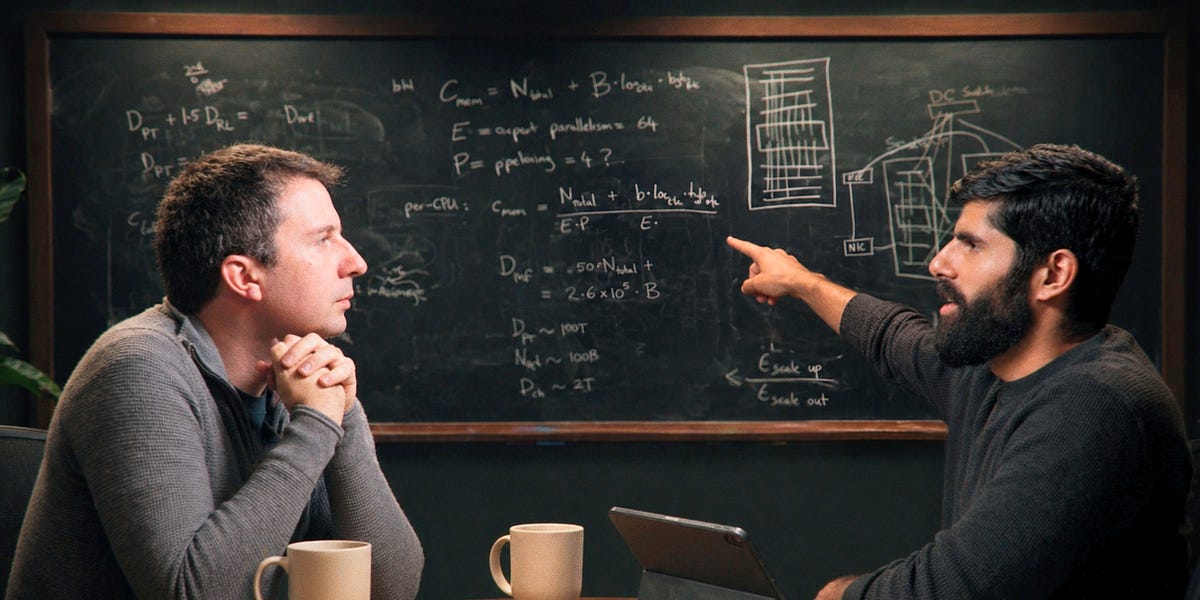
Serving several AI requests together can reduce the cost of each response because they share part of the work of reading the model's parameters from memory. Reiner Pope, CEO of the chip startup MatX, explains this batching tradeoff in his lecture on model serving. Smaller batches can produce faster responses, but distribute that shared cost across fewer requests. Larger batches improve the economics until other work becomes limiting: each request still requires its own computation and processing of its conversation . This explains both why a faster service can cost more and why accepting ever-slower responses cannot make generation arbitrarily cheap.
- context window — The maximum amount of text a model can consider at once — its working memory for the current conversation or task.
“if you do not batch together many users, the cost and the economics you get can be a thousand times worse than if you do batch many users together”
Reiner Pope
“Pipelining totally solves the capacity problem, but scale-up size helps solve the bandwidth problem.”
Reiner Pope
“I mean, you are incentivized to price close to your costs because otherwise someone could scoop you.”
Reiner Pope
“This is why you should just approximate everywhere, because there are big error bars on this. But it’s kind of empowering to just set A equal to B and figure it out.”
Reiner Pope
“The empirical result is that the context lengths haven’t been increasing that much. I think it’s because there is no solution to the memory wall here.”
Reiner Pope
- 00:00:00How batch size affects token cost and speed
- 00:32:09How MoE models are laid out across GPU racks
- 00:47:12How pipeline parallelism spreads model layers across racks
- 01:03:37Why Ilya said pipelining is not wise
- 01:18:59Models may be 100x over-trained beyond Chinchilla-optimal
- 01:33:02Deducing long context memory costs from API pricing
- 02:04:02Convergent evolution between neural nets and cryptography





Checking sign-in…
Loading comments…