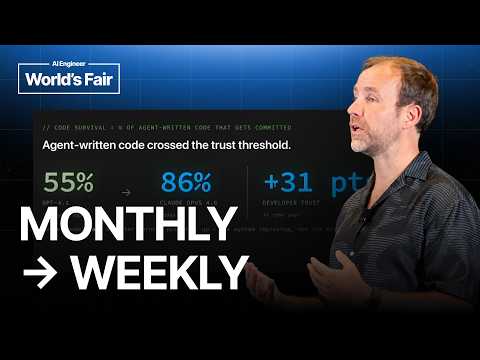
How Stanford Teaches AI-Native Engineering — Mihail Eric, Monaco
Source
latent.space
Author
swyx .ai
Date
Why it matters
Shows how a Stanford course restructured assignments once agents can one-shot homework, and which agent tooling a real team chose to build or buy. Useful for deciding what engineers should learn and own.
Key takeaways · AI-distilled
Stanford's CS146S replaced homework students can now one-shot with an AI agentAn AI system that doesn't just answer once but works toward a goal in a loop — taking actions, reading the results, and deciding what to do next.Full definition →: part of the new coursework is contributing a patch to an open-source project, where the repo's maintainer reviews it. Every sophomore and junior Mihail Eric surveyed already coded with an agent.
Monaco's team evaluated code review products and kept using Devin, but built its own agent workspaces, since a headless agentAn agent running with no one watching — in CI, on a schedule, or triggered by an event — with its output reviewed after the fact.Full definition → must run the product, reproduce a failure and test the patch inside Monaco's own cloud setup. Eric's rule: "You buy to learn, and you build to keep."
Monaco's internal agent Hal serves two audiences: an engineer can ask it to investigate a breakage and open a PR, while a salesperson can ask how the product works. One needs a reviewable change, the other an explanation to give a customer.
The show notes cite a Faros study in which teams with high AI adoption merged 98% more PRs while their PR review time was 91% longer, the evidence behind the episode's segment on code review becoming the bottleneck.
The host flags a gap agents still have: they see the current code but not why a team rejected the same change months earlier. The episode points to Basis's Authority Map as a guide to where agents should find past decisions and intent.
Terms in this piece · Glossary
AI agent — An AI system that doesn't just answer once but works toward a goal in a loop — taking actions, reading the results, and deciding what to do next.
headless agent — An agent running with no one watching — in CI, on a schedule, or triggered by an event — with its output reviewed after the fact.

 articleWhy Agents Love Supabase