Mitigating memorization in LLMs
- Source
- blog.janestreet.com
- Date
Context
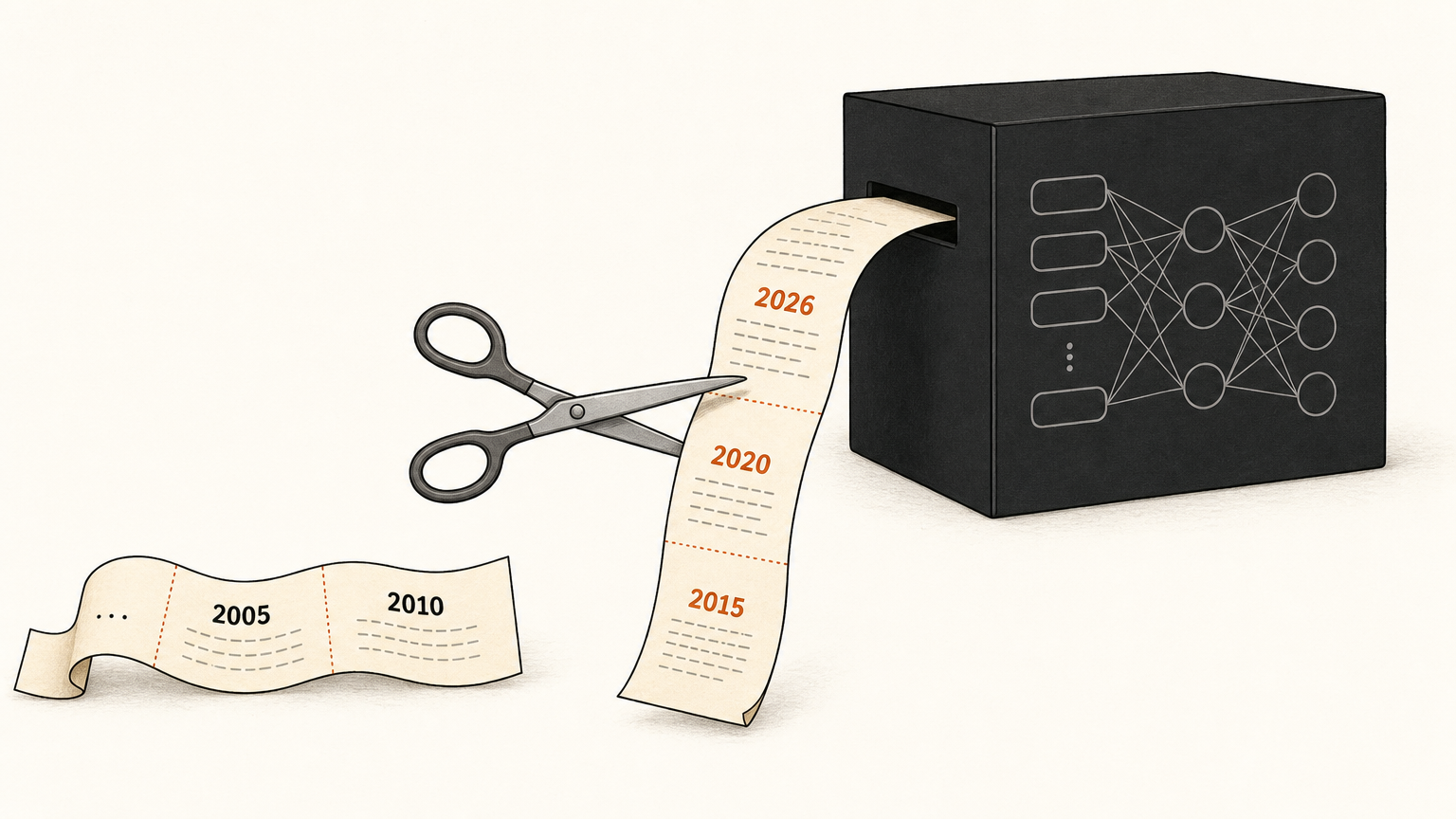
A can appear good at predicting past events because its training data already contains the outcomes. A Jane Street summer intern project investigated that problem using cricket match previews, comparing performance before and after a model's .
The most promising method, divergence decoding, adjusts a large model's predictions at time using two smaller models: one trained on data before 2015 and one trained up to the large model's own knowledge cutoff. Steering away from what the later model adds aims to make the large model behave as if it knew only the earlier period, without retraining it. On the cricket dataset it reduced performance on matches from before the cutoff, where memorization would help, without harming performance after the cutoff, which the project presents as evidence of reduced memorization. The work was exploratory and produced no working de-memorizer, and the pre- and post-cutoff matches differ in kind, which complicates the comparison.
- LLM — A large language model — the neural network behind tools like Claude and ChatGPT, trained on huge amounts of text to predict what comes next.
- knowledge cutoff — The date after which a model saw no training data — everything later has to reach it through search, tools, or the context window.
- inference — Running a trained model to get answers — the phase where AI is actually used, as opposed to trained.
 articleMemorization Diagnostics for Code LLMs Should be Scale-AwarePrateek Kumar Rajput, Abdoul Aziz Bonkoungou, Alberick Euraste Djir\'e, Xunzhu Tang, Yewei Song, Iyiola Emmanuel Olatunji, El Hacen Diallo, Jacques Klein, Tegawend\'e F. Bissyand\'e
 articleAre the Financial Reasoning from LLMs Credible? A Real World Test over Long-Horizon StatementsXinke Tong, Xuanming Zhang, Tianyi Tang, An Yang, Jiatu Hu, Guojie Lin, Zhenzhen Shi, Lingfeng Zeng, Boyu Yang, Bing Zhao, Hu Wei, Lin Qu, Dayiheng Liu
 articleWhen Does Memory Help? A Cost-Aware Evaluation of Long-Term Memory in Tool-Using LLM AgentsShweta Mishra, Shashank Mishra
Checking sign-in…
Loading comments…