Introducing Clef: our open-source decision models, and new RL fine-tuning platform
- Source
- blog.cloudflare.com
- Date
Clef and Clef-flash are small decision models: they answer bounded questions such as which category, which route or which score, rather than generating open text. Cloudflare publishes the weights under Apache 2.0, hosts both on Workers AI, and makes them compatible with the Jev API. The second half of the launch is an RL fine-tuning platform that adapts Clef to a team's own categories and data. That combination targets a common agent pipeline cost: sending every routing or triage step to a general model. A fast model with constrained outputs is cheaper to call on each request, and fine-tuning it on real traffic is an alternative to tuning a long classification prompt. Teams already on Workers AI can test it directly. Others can take the open weights and run the same step elsewhere.

Context
Cloudflare's Clef models provide a constrained decision step for software workflows. An application supplies and allowed answer types, and receives structured decisions with probabilities. The release article gives support-ticket routing as an example: assess urgency, select a team, then let application code act on those outputs.
Cloudflare says Clef processes the supplied context and scores valid choices in parallel, avoiding intermediate text generated one piece at a time. That design targets decisions whose possible outputs are already known. The company released model weights under Apache 2.0 and offers hosted access, allowing teams to experiment with either deployment path.
- Cloudflare released Clef and Clef-flash, decision models that return typed answers with probabilities instead of free text. They run on Workers AI, are compatible with the Jev API, and ship as Apache 2.0 weights on Hugging Face.
- Clef does a prefill-only pass on a frozen Qwen backbone (Qwen3.8-27B for Clef, Qwen3.5-9B for Clef-flash), then scores the valid schema choices in parallel. Cloudflare says skipping token-by-token generation makes it much faster than autoregressive LLMs.
- Training paired label-smoothed cross-entropy with a Brier loss to calibrate probabilities, plus an RL step Cloudflare calls RLCD that gives partial credit to adjacent ordinal choices and applies a reference penalty to prevent distribution shift.
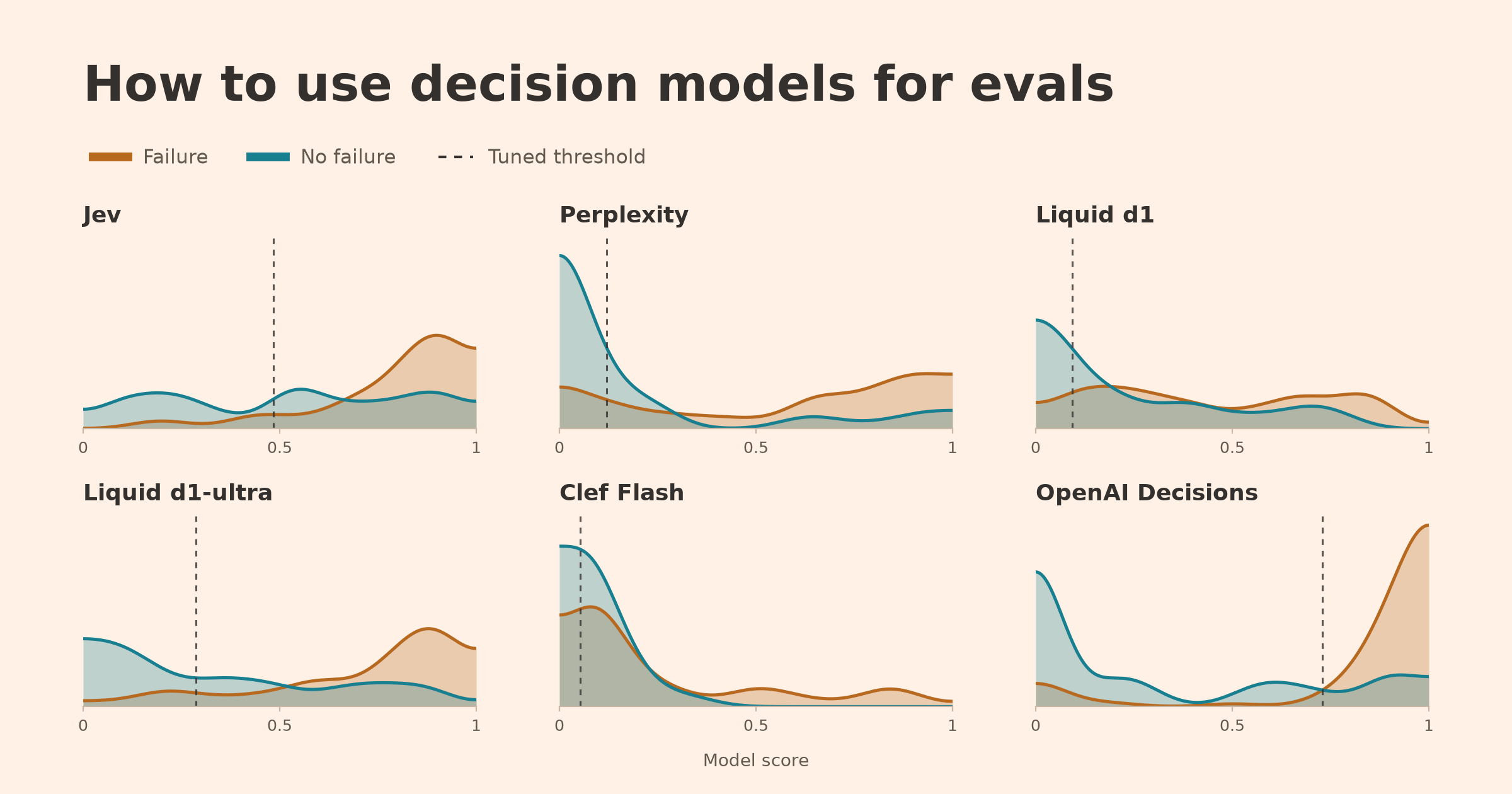
- In Cloudflare's own tests, median latency was 209 ms for Clef and 39 ms for Clef-flash versus 524 ms for Jev. Quality was mixed: Clef led on BANKING77 and CLINC150, while Jev led on When2Call and trace observability.
- Unlike Jev, Clef accepts images and has a 64k context window versus Jev's 32k. Cloudflare's threat intel team used it to fetch, render and classify a domain in 2.2s, against 4.7s for gpt-oss-120b, which returned only two categories.
- context window — The maximum amount of text a model can consider at once — its working memory for the current conversation or task.
- open weights — A model whose trained parameters are published for anyone to download and run — unlike API-only models you can access but never possess.
- fine-tuning — Taking a trained model and training it a bit more on your own examples so it gets better at one specific job.
- AI agent — An AI system that doesn't just answer once but works toward a goal in a loop — taking actions, reading the results, and deciding what to do next.


Checking sign-in…
Loading comments…