Muse Spark Open goes live on Fireworks for inference and LoRA training
- Source
- fireworks.ai
- Author
- Fireworks
- Date

Context
Fireworks' model page explains what 'inference and training' means for Meta's Muse Spark Open: two ways to run the model and one narrower path for customizing it. For inference, the model is on Fireworks' serverless API, billed per token at $1.25 per million input tokens, $0.15 per million cached input tokens and $4.25 per million output tokens. Fireworks runs it on US-only capacity and says there is no premium for that. Teams that want dedicated GPUs can deploy it on demand or reserve throughput. Fireworks' announcement adds that it serves the model with zero data retention.
Training is more limited than the headline suggests. Customers can train adapters, small sets of added weights that adjust a model's behavior without retraining the whole thing. They do it through Fireworks' Serverless Training API, starting from a separate NVFP4 version of the checkpoint. Managed fine-tuning in the Fireworks interface isn't available yet, and the page's metadata panel lists fine-tuning as not supported. Fine-tuned models have to run on on-demand deployments.
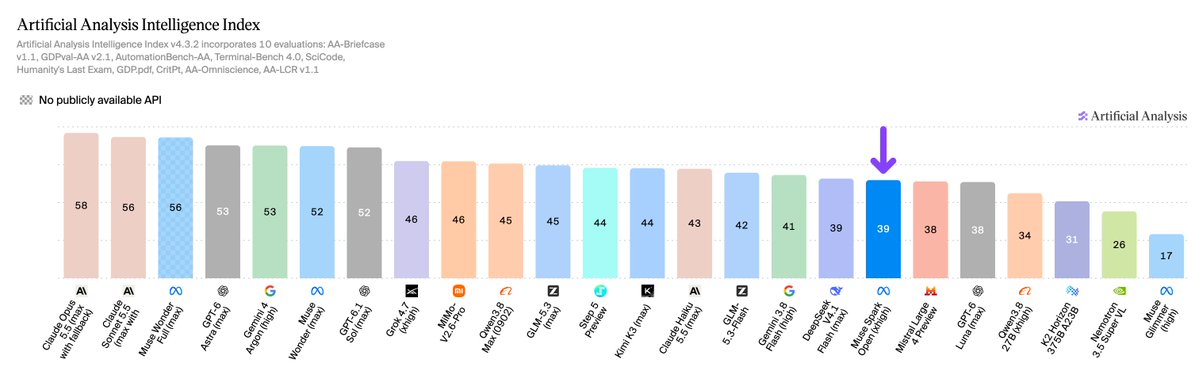
The page describes the model as an open-weights for coding and agentic work. It uses a sparse design with 816 billion total and 42 billion active parameters, routing each token to 8 of 256 experts. For inputs, it lists only text and images, with a context length of 1,040k tokens. Meta's own release post describes the model as natively multimodal across text, image, video and audio, so Fireworks' listing currently accepts less than Meta describes. The serverless prices match the per-token rates OpenRouter announced at launch, where Fireworks was named as one of the day-zero providers. The benchmark chart attached to Fireworks' post is left out here because the text description supplied with the image is internally inconsistent.
- LoRA — A cheap way to fine-tune a model by training a small add-on layer instead of changing all of the model's weights.
- reasoning model — A model trained to think — generating extended internal reasoning before answering — trading time and tokens for accuracy on hard problems.
- mixture-of-experts — A model built from many specialist sub-networks where only a few activate per token, giving big-model capability at small-model running cost.
- tool use — A model's ability to call external functions — run code, search the web, edit files — instead of only generating text.


Checking sign-in…
Loading comments…