Can AI Agents Conduct Open-Ended AI Research? Early Evidence from Two Case Studies
- Source
- arxiv.org
- Author
- Peter Kirgis, Sayash Kapoor, Andrew Schwartz, Stephan Rabanser, David Africa, Konstantinos Voudouris, Viet Nguyen, Toby Pilditch, Magda Dubois, Harry Coppock, Cozmin Ududec, Nitya Nadgir, Matilda Orona, Tilman Bayer, Derrick Chan-Sew, Yue Ling, Abhishek Shetty, Helen Toner, Gillian Hadfield, Seth Lazar, Steve Newman, Shoshannah Tekofsky, Rishi Bommasani, Arvind Narayanan
- Date

Context
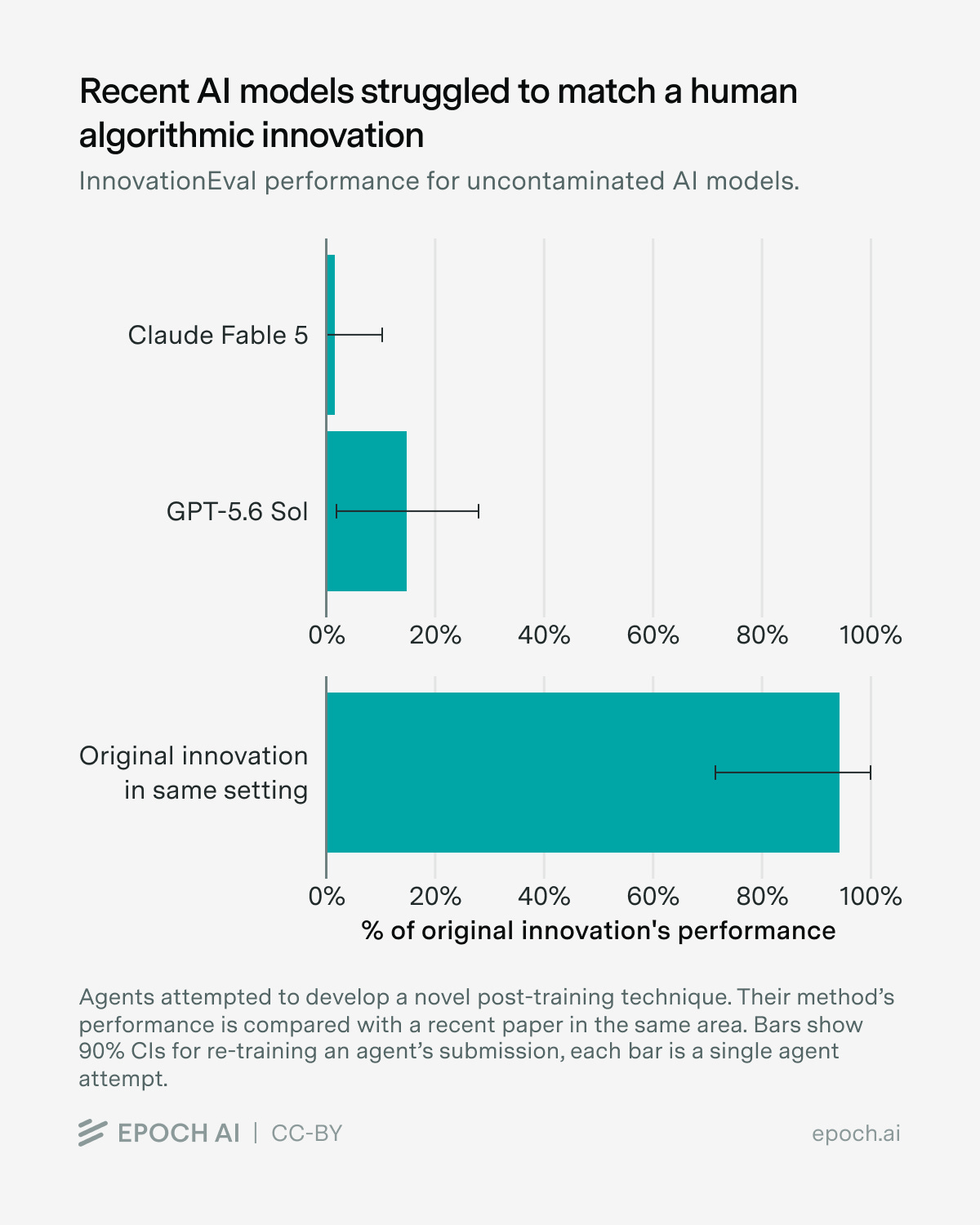
Completing research code does not necessarily resolve a research question. A two-case study gave AI agents the central questions from two unpublished papers, six days and thousands of dollars of compute, then asked the original authors to assess the resulting work.
The researchers report that agents completed the engineering without human help but made insufficient substantive progress for either output to be accepted by the authors. Reported failure modes included poor judgment about the bar for publishable research, uncreative responses to shortcomings in the research design, and ineffective backtracking from dead ends. These cases separate implementation ability from research judgment: producing working experiments can leave the central scientific problem unanswered.
- Existing -research fail two ways: narrow verifiable tasks exclude open-ended work by construction, and submitting AI-written papers to blind peer review inherits a process that is overstretched, stochastic, and noisy.
- The split result is the finding: agents finished all the engineering with no human help, yet made no substantial progress on the research question itself. Capability is unevenly distributed across the research lifecycle.
- The five failure modes were misjudging the bar for publishable work, uncreative responses to flaws in the research design, ineffective backtracking out of dead ends, poor resource awareness, and instruction drift.
- Grading comes from the paper's own authors rather than outside reviewers, since they already know how hard the question is and what a real answer looks like. That is what makes the rejection of both submissions meaningful.
- AI agent — An AI system that doesn't just answer once but works toward a goal in a loop — taking actions, reading the results, and deciding what to do next.
- eval — A repeatable test for AI quality — a set of tasks plus scoring — used the way software teams use test suites, because model output is too variable to judge by eyeballing.
“The agents completed all of the engineering without human help, yet could not make substantial progress towards answering the research questions.”
“We identify five recurring failure modes: poor judgment about the bar for publishable research, uncreative responses to shortcomings in the research design, ineffective backtracking from dead ends, poor resource awareness, and instruction drift.”
“Our results provide early evidence that today's agents can do the engineering of AI research, but struggle with critical parts of the research lifecycle.”

Checking sign-in…
Loading comments…