LangChain October release roundup: LangSmith, Deep Agents v0.9, FastMCP
- Source
- langchain.com
- Author
- LangChain
- Date
Context
LangChain's October newsletter rounds up what it shipped at its Interrupt events in New York and London, and it groups them under one argument: lasting value goes to companies that own the model, the and the that make a generic model fit their business (langchain.com). Several of the LangSmith additions are about seeing what agents do. AI Search lets teams query traces by meaning, with questions like whether a user got frustrated or personal data leaked, instead of building filters; Trajectories lays out a session chronologically across a main agent and its subagents; and Engine v2 adds and, according to LangChain, tests and validates the fixes it proposes.
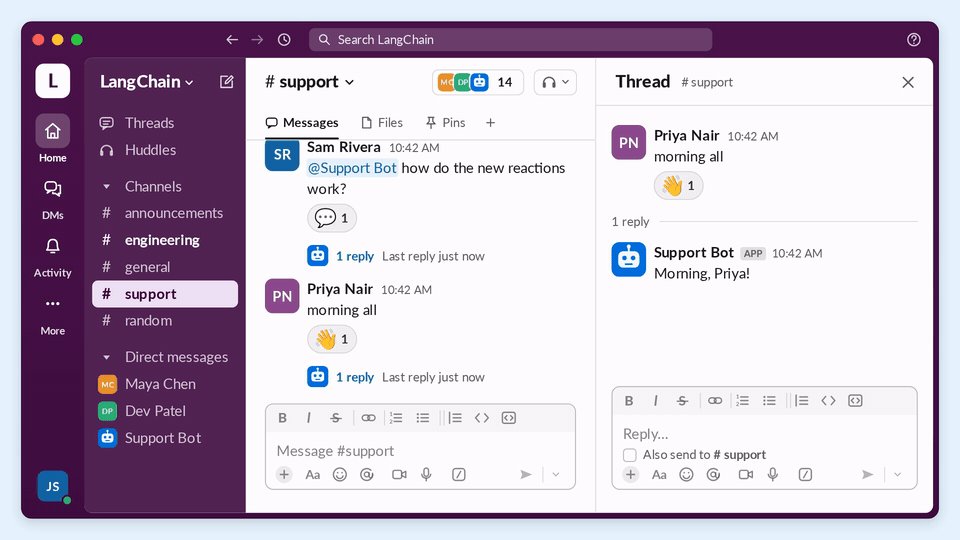
The release that most directly carries the ownership argument is LangSmith . It takes the trajectories an agent produced in production, turns them into training data, fine-tunes a model through Baseten or Fireworks, and then evaluates and serves the tuned model, so the record of an agent doing its job becomes the material for a model specialized to that job. An earlier LangChain post described it alongside a smithtune CLI. Elsewhere in LangSmith, Managed Deep Agents reached v0.9 with run-specific personalization, Slack reactions and user-level memory, and on the open-source side LangChain v1.4.0 supports FastMCP through a langchain.mcp namespace. The newsletter describes each item in a sentence, so how well any of them works is not something it establishes.
- LangSmith AI Search finds traces by semantic questions such as whether a user got frustrated or whether PII leaked, instead of relying on traditional filters.
- LangSmith Engine v2 adds red teaming before production and, per LangChain, detects inefficient agent work and metric trends, then tests and validates its own proposed fixes.
- LangSmith Fine-Tuning turns production trajectories into training data, fine-tunes through Baseten or Fireworks, then evaluates and serves the tuned models.
- LangChain v1.4.0 adds FastMCP support through the langchain.mcp namespace, and Managed Deep Agents v0.9 adds user-level memory, scheduled tasks, Slack reactions and free built-in web search.
- agent harness — The scaffolding around a model that turns it into a working agent — the loop, the tools it can call, and the rules for when to stop.
- context window — The maximum amount of text a model can consider at once — its working memory for the current conversation or task.
- red teaming — Deliberately attacking your own AI system to find what makes it fail before someone else does.
- fine-tuning — Taking a trained model and training it a bit more on your own examples so it gets better at one specific job.

Checking sign-in…
Loading comments…