Coding From the Himalayas With an Offline AI Agent
Source
latent.space
Author
Rittika Jindal
Date
Why it matters
Shows which everyday coding-agent tasks (explaining code, debugging tests, small refactors) can run on a local model with no network, useful for flights, outages and restricted environments.
Key takeaways · AI-distilled
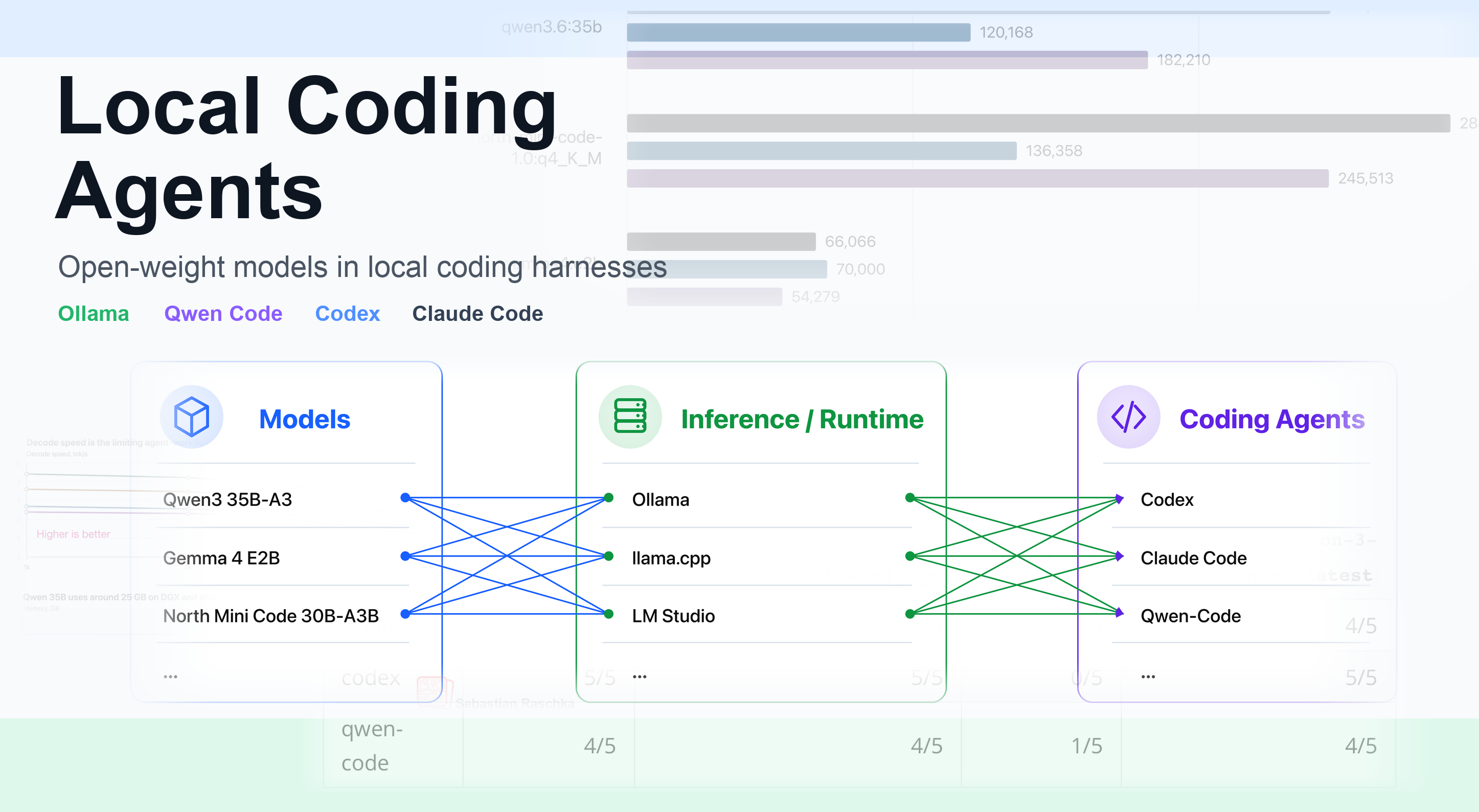
The author ran OpenCode against Qwen3.5 9B served by Ollama on localhost with Wi-Fi off; with the model, project, dependencies and test tools downloaded first, the AI agentAn AI system that doesn't just answer once but works toward a goal in a loop — taking actions, reading the results, and deciding what to do next.Full definition → fixed a bug and ran the tests with no network.
Qwen3.5 9B was chosen over the 4B size for its higher published scores on LiveCodeBench v6 (65.6 vs 55.8) and BFCL-V4 tool useA model's ability to call external functions — run code, search the web, edit files — instead of only generating text.Full definition → (66.1 vs 50.3). The 6.6 GB download is not the RAM need: one guide budgets 12 to 16 GB.
The local agent first proposed pytest for a project that uses Python's unittest; the author recommends putting the exact test command in the prompt to avoid such detours.
The offline run fixed a one-line accumulator bug (total = Decimal(amount) to total +=), and the author warns this says nothing about how the local model handles large repositories or unfamiliar frameworks.
A cited preprint found most pass-rate differences between OpenCode, Goose and OpenHands-SDK on 50 Terminal-Bench Pro tasks were not statistically clear, but OpenCode used about 40 times Goose's tokenThe chunk of text a model reads and writes in — roughly three-quarters of a word — and the unit AI usage is billed in.Full definition → per solved task. Those runs used cloud models.
Terms in this piece · Glossary
AI agent — An AI system that doesn't just answer once but works toward a goal in a loop — taking actions, reading the results, and deciding what to do next.
tool use — A model's ability to call external functions — run code, search the web, edit files — instead of only generating text.
token — The chunk of text a model reads and writes in — roughly three-quarters of a word — and the unit AI usage is billed in.