An AI bill of materials identifies the AI components a project depends on. Snyk's documentation describes scanning a local project to identify AI models, agents, tools and Model Context Protocol (MCP)A published agreement for an AI application to discover what a separate program offers and ask it to run one of those offerings.Full definition → components and how they connect. This supplies a concrete inventory for security review instead of relying on developers to remember every DependencyAnything a program needs to run that its author did not write: the language, its standard library, or a separately installed package.Full definition →.
The security workshop follows that inventory into a dashboard where components, including a dataset in the demo, can be filtered and queried. The presenter also argues for refreshing it as applications change. Knowing which model or external tool appears in which project gives a security team a starting point for deciding where further assessment or access restrictions are needed.
Key takeaways · AI-distilled
Snyk's Javier Garza starts from an AI bill of materials, a scan that inventories a repository's models, datasets and agents, arguing teams cannot assess shadow AI components they do not know exist.
Defenses are layered: a database view limits what an assistant can retrieve, while restricted permissions, output validation and human approval constrain what it does next. Threat modeling maps assets and trust boundaries before deployment.
For skills and MCP servers, Garza separates scanning tool definitions for hidden instructions from scanning the underlying code for vulnerabilities, and argues guardrailsThe checks around a model that block bad inputs and outputs — filters, validators, and permission rules the model itself can't override.Full definition → must be explained as well as enforced because unexplained restrictions invite workarounds.
Terms in this piece · Glossary
Model Context Protocol (MCP) — A published agreement for an AI application to discover what a separate program offers and ask it to run one of those offerings.
Dependency — Anything a program needs to run that its author did not write: the language, its standard library, or a separately installed package.
prompt injection — An attack that hides instructions in content an AI will read — a webpage, email, or document — tricking it into following the attacker instead of the user.
guardrails — The checks around a model that block bad inputs and outputs — filters, validators, and permission rules the model itself can't override.
 video1,000 Claude Agents Formalized Fermat's Last Theorem — Lance Martin, Anthropic
 videoHow 21 People Built a $100M+ Agent Company — Quinn Slack, Amp
 videoSoftware Factories: Escape from Trash Mountain — Steve Yegge, Gas Town
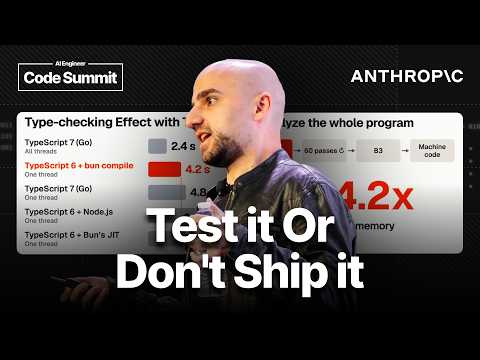 videoHow to Ship Millions of Lines of Agent-Written Code — Jarred Sumner, Anthropic


