Building on Nemotron 3.5 Parse: Open Data, Fine-Tuning, and Faster Inference
- Source
- huggingface.co
- Publisher
- NVIDIA
- Date
Context
NVIDIA's Nemotron 3.5 Parse is a compact model that reads images of document pages and returns structured data: the content in reading order, each piece labeled as a heading, paragraph, table or chart, with a bounding box locating it on the page, and tables and charts converted into structured records. This follow-up post releases material for training or adapting such a model: three synthetic datasets, a recipe and a faster decoding add-on called DFlash2 (Hugging Face blog). The datasets come from rendering charts, tables and pages whose correct contents are already known and training the model to work backward from the image, which is how NVIDIA says Parse learned to read values off charts that print no numbers. They hold 9.98 million chart examples, 1 million HTML table examples and 7.9 million multilingual pages.
The post also describes how Parse 3.5 was trained. Supervised fine-tuning taught it to produce the , and a second phase of reinforcement learning scored sampled extractions with automatic checks that reward correct chart series and values, usable structure, and output that finishes without repeating itself. Because a hard page can be represented correctly in more than one way, these checks judge the result instead of demanding one exact answer. In NVIDIA's comparison of development checkpoints, not the released model, pages flagged for looping fell from 126 to 29, outputs that ran into the 9,000-token limit fell from 185 to 35, and the overall score rose from 66.24 to 71.38.
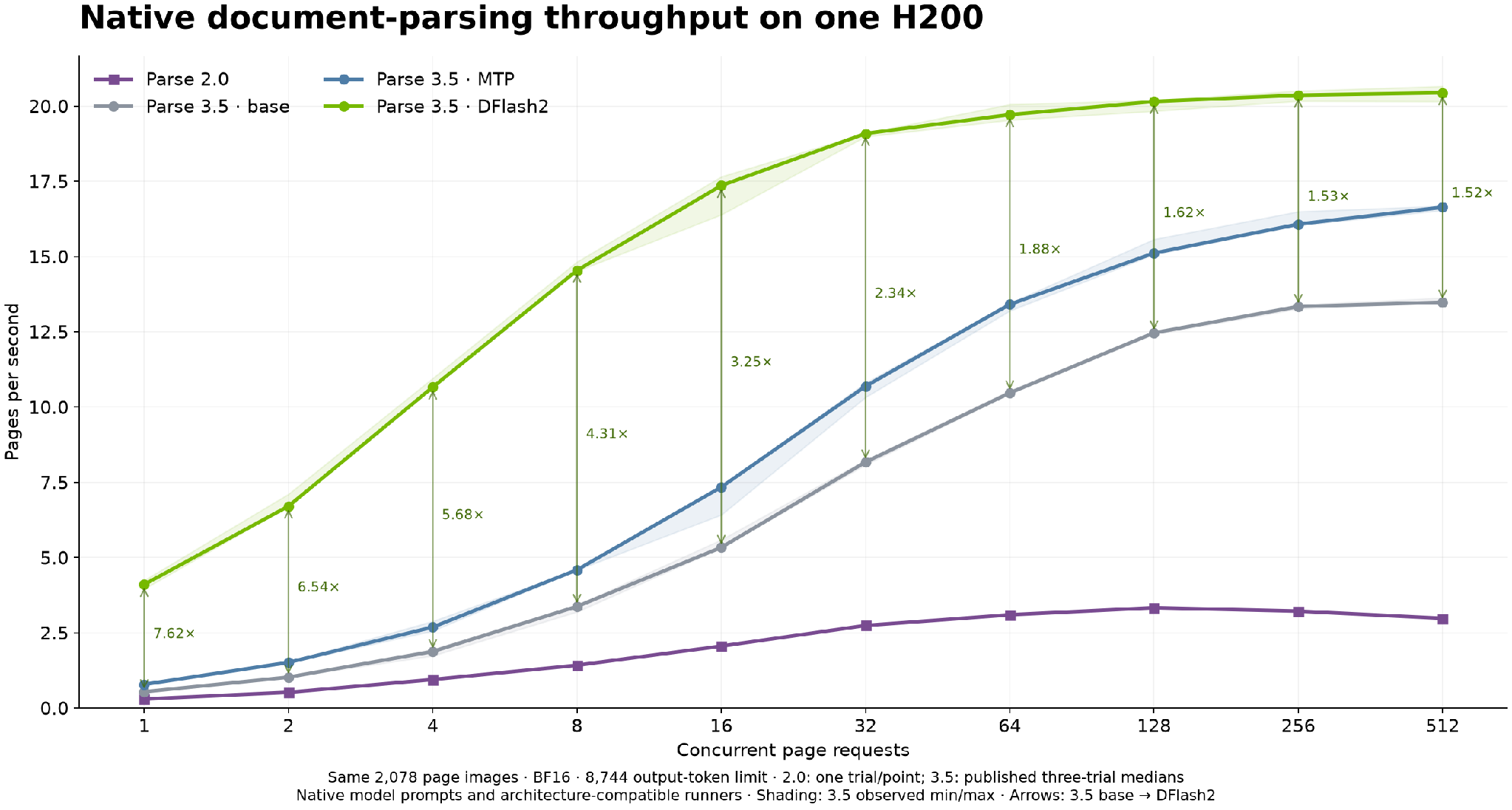
DFlash2 speeds up generation with a small draft model that proposes up to 32 tokens ahead, which Parse then checks together; in the measured setup it accepts about 14 drafted tokens per check. On one H200 GPU it raised 7.62 times at a concurrency of one and 1.52 times at 512 concurrent requests, compared with Parse 3.5 without . At 512, Parse 3.5 handled 20.44 pages per second with DFlash2, against 2.98 for Parse 2.0. The fine-tuning recipe applies the same two phases to a new document type using a developer's own image and label pairs plus a verifier that decides whether an extraction is correct. In NVIDIA's worked example, a synthetic dental form, the estimated first-attempt success rate went from 0.00 percent for the base model to 95.85 percent after fine-tuning and 96.58 percent after reinforcement learning, measured on 256 held-out forms from the same synthetic generator.
- NVIDIA trained Parse 3.5 with SFT to teach page reading, then GRPO with verifiable rewards for correct values, usable structure and clean completion. In a matched test, loop-flagged pages fell from 126 to 29 and outputs hitting the 9,000-token cap from 185 to 35.
- The chart and table gains came largely from synthetic data: NVIDIA renders charts and tables with known ground truth and trains the model to reverse the rendering, which lets it infer unlabelled bar values from the axes and bar heights. Three of these datasets are now open.
- NVIDIA's DFlash2 speculator drafts up to 32 tokens and averages about 14 accepted per verification step. On one H200 it raised throughput 7.62x at concurrency 1 and 1.52x at 512, where Parse 3.5 reaches 20.44 pages/s against 2.98 for Parse 2.0.
- Re-parsing cropped table and chart regions at higher detail (double pass) adds 2.18 ParseBench points over a single pass, and adding a detection-mode verification pass (triple pass) adds 2.46, trading throughput for accuracy on difficult regions.
- In NVIDIA's dental-form fine-tuning example, sampled pass@1 rose from 0.00% for the base model to 95.85% after SFT and 96.58% after RLVR, consistent with NVIDIA's framing that SFT teaches the capability and RLVR improves consistent completion.
- fine-tuning — Taking a trained model and training it a bit more on your own examples so it gets better at one specific job.
- structured output — Forcing a model's response to match a schema, so downstream code can parse it instead of guessing at prose.
- throughput — How much model output a provider can generate over time, commonly measured in output tokens per second.
- speculative decoding — A speed trick where a small model drafts several tokens ahead and the big model verifies them in one pass, often doubling generation speed.