Transcript
Prompt Engineering Isn’t Dead. You’re Just Doing It Wrong.
My best prompts are around two thousand words long.
That fact tends to stop conversations. People who’ve been told that prompt engineering is dead, that models are smart enough now to figure out what you want from a few sentences, that the whole concept has been “absorbed” into normal AI usage, don’t know what to do with the idea that someone sits down and writes a prompt the length of a long-winded wedding toast. It doesn’t fit their model of how this works. It suggests that the person typing is doing something categorically different from what they’re doing, and that what they’ve been calling "prompting" might not be the same activity at all.
It isn’t.
A Microsoft survey of 31,000 workers recently ranked “prompt engineer” second to last among roles companies plan to add.[1] Fast Company reported in 2025 that 68% of firms treat it as basic training, not a specialty.[2] The cottage industry of prompt-engineering courses and certifications has mostly collapsed. And the consensus, at least among people who write about AI for a living, is that the skill has been automated away by smarter models.
It’s true that some of the old tricks don’t matter as much anymore. Modern AI reasoning models don’t need me to preface every prompt with “you are a world-class expert in securities law” (they’re already pretty damn good at reasoning about securities law). But they still can’t read my mind. A model that can think doesn’t automatically know what to think about. It doesn’t automatically know my client’s risk tolerance, my counterparty’s negotiating posture, or which of the fourteen issues in this contract are the three that actually matter. I still have to tell it all of that. That’s the part of “prompt engineering” that didn’t die: the ability to communicate with AI the way a senior professional communicates with a talented but dangerously literal colleague (in detail, with precision, leaving no room for ambiguity about the former’s expectations of the latter). That ability is currently my greatest professional edge, and is becoming the most important skill in the white collar economy. Unfortunately, almost nobody understands it or is teaching it correctly.
I run an AI-native law firm. I draft contracts, review opposing counsel’s redlines, analyze regulatory questions, negotiate deal documents, and handle client communications. AI is my primary collaborator on all of it. After a couple of years at this full-time, I can tell you that the quality of what comes out is almost entirely a function of what I put in. The magic lives in the input layer.
The Genie
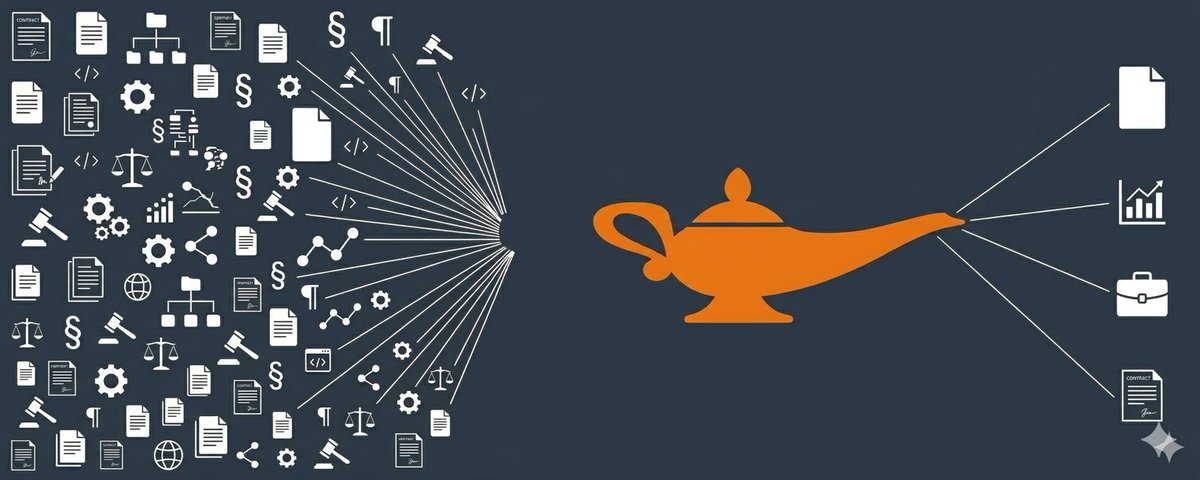
The best mental model for using AI effectively is one everybody already knows and yet almost nobody actually applies: the genie.
You get three wishes. The power is functionally infinite. And yet pretty much every genie story ever told runs on the same premise: the genie does exactly what you say, not what you mean. Wish for a million dollars and it falls from the sky and flattens your house. Wish to be the most powerful person alive and wake up alone on a dead planet. The genie isn’t cruel, it’s just literal, so the entire drama lives in the gap between what you said and what you thought you said.[3]
Large language models are functionally very literal genies. There’s a mechanical reason why vague prompts produce bad output that goes beyond the metaphor. These models were trained on the corpus of essentially the entire internet. When you give one a vague instruction, it does what it was trained to do: it regresses to the mean of everything it’s ever seen. In other words, it gives you the average of what the internet would say (with extra emphasis on Reddit posts, em-dashes, and “it’s not this, it’s that” prose structure). You know what that looks like. Everyone does by now. It’s the flat, confident, vaguely competent text that has become its own aesthetic category: AI slop. You recognize it instantly in other people’s LinkedIn posts.
But when you feed the model instructions that are specific and detailed enough to pin it to one narrow path, something different happens. The output snaps into focus. It stops reaching for the average and starts executing on the particular. The key insight, the one that took me the longest to learn, is that your instructions need to do two things: tell the model what to produce, and close off every other thing it might produce instead. It’s not enough to describe what you want. You need to describe what you want precisely enough that there is no room left for the model to wander back toward the generic. You are not just pointing at a destination. You are building a corridor. (See what I did there?)
In classic genie stories, the danger is never that the genie is weak, it’s that the wisher is lazy. They want the result without doing the cognitive work of figuring out what, specifically, they actually want. And this maps exactly onto how most people use AI. You have to be able to see th