Using Agents for Long-Horizon Financial Work — Aman Singh, Arca
- Source
- youtube.com
- Author
- Latent Space
- Date
Context
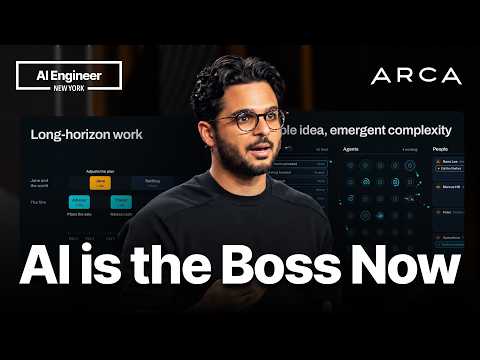
Arca, a wealth management firm that runs much of its operation through software agents, describes its work as long-horizon but not long-running. Arca's Aman Singh discusses that work in this Latent Space interview, recorded at AI Engineer New York. No transcript of the video was available for this explanation, so it relies on the video's description and on Latent Space's written account of the conversation, published on its site. The post spells out the distinction. A task does not keep a computer busy for days. It stays open for days while it waits on people. The post reports that in his conference talk Singh put agent tasks at Arca at up to ten days, and quotes him: "It's very stop-start, there's many actors in between, many decision points, many handoffs."
That shape of work is why memory carries so much of the load. An agent that picks a task back up on day six needs to know what happened on days one to five, including steps other people took. According to the post, Arca built an internal memory system that keeps a persistent record for every client: what has happened so far, what needs to happen in the next couple of days, what is being tracked for the longer term, and which person is responsible for which action. Singh said the agents themselves contribute to it. The record works less like a chat history for one session and more like a shared case file that every agent and advisor on the account works from.
The case file may also help explain Singh's line that "agents prompt people more than people prompt agents." If the memory knows which person owns the next step, an agent can go to that person when a decision is due, instead of waiting for someone to ask it. Singh's earlier AI Engineer talk is described in similar terms, with agents owning a client goal end to end and pulling in the right person at the right time. These accounts come from Arca and describe how its system is designed to work. Neither the video description nor the write-up gives measurements of how well the memory keeps long tasks on track.
- AI agent — An AI system that doesn't just answer once but works toward a goal in a loop — taking actions, reading the results, and deciding what to do next.
- agent harness — The scaffolding around a model that turns it into a working agent — the loop, the tools it can call, and the rules for when to stop.
- sandbox — An isolated environment where AI-generated code or agent actions run without being able to touch anything real.
- eval — A repeatable test for AI quality — a set of tasks plus scoring — used the way software teams use test suites, because model output is too variable to judge by eyeballing.
 videoWhy Agents Love Supabase — with Paul Copplestone and Ant Wilson
 videoHow Anthropic ships the #1 LLM in the World — with Katelyn Lesse and Angela Jiang
 videoAn Eval for AI Scientists That Knows the Answer Key - Ian Quigley, Leash Bio
 videoWhy AI Compute Comes in Rectangles — Erik Bernhardsson, Modal

Checking sign-in…
Loading comments…