OneModel moves business rules into model TrainingThe process that adjusts a model using examples and a measure of how well it performs.Full definition → to reduce the sequence of separate processing stages in a customer-service agent. Researchers at payments company Ant International describe training on domain knowledge and operating procedures while continuing to supply changing transaction information at runtime. The paper therefore combines learned procedures with fresh Context and context windowContext is the information available for a generation; the context window is the capacity available to hold it.Full definition →.
In their financial-service deployment, the authors report LatencyThe time between asking for a result and having it, including the model's generation time, tool calls, retries and any queueing.Full definition → falling from 18.7 to 8.0 seconds. The share of inquiries resolved without escalation to human staff rose from 64.3% to 83.3%. These results support the approach within that deployment, where fewer processing handoffs accompanied faster responses and more resolutions without escalation.
Terms in this piece · Glossary
Training — The process that adjusts a model using examples and a measure of how well it performs.
Context and context window — Context is the information available for a generation; the context window is the capacity available to hold it.
Latency — The time between asking for a result and having it, including the model's generation time, tool calls, retries and any queueing.
pretraining — The first, biggest phase of building a model: training it on enormous amounts of text so it learns language, facts, and reasoning in general.

 articleOccamy-1.0: Open Pareto-frontier 35B Intelligence for Co-workWenhui Chen, Shiwen Cheng, Hao Dong, Chenda Duan, Ruixiang Feng, Zhong Guan, Boqiang Guo, Xueyuan Han, Haojie Hao, Liangmeng Huang, Zhelong Huang, Xinke Kong, Hongyu Li, Jiazheng Li, Junbo Li, Qingchuan Li, Yukun Lian, Chang Liu, Tianyu Liu, Zicheng Liu, Shuyi Ouyang, Yijun Pan, Kunyu Shi, Xiaojun Tang, Bingquan Wang, Kesu Wang, Yuchen Wang, Sibo Wei, Sicong Xie, Xiaoying Xing, Yi Xu, Zhijun Xu, Hongwei Xue, Qingcheng Zeng, Di Zhang, Guannan Zhang, Haochen Zhang, Tianlong Zhang, Tianyu Zhao, Tianyu Zhao, Yanjun Zheng, Jialong Zhu, Zijian Zou
 articleAgent Stack for ML Training Lifecycle: Generation, Validation, and OptimizationJaideep Ray, Daniel Tang, Zejun Lin, Haoyue Tang, Lijuan Zhang, Tao Huang, Tommy Li, Aditya Jain, Ankit Goyal, Harsh Jain, Zhuo Zhi, Youmin Han, Santosh Jha, Shuying Liang, Yujie Ai, Jonathan Hung, Ethan Lyu, Abi Liu, Siddharth Singh, Feng Wen, Mahesh Ravindran, Souvik Ray, Yitong Zhou, Animesh Singh
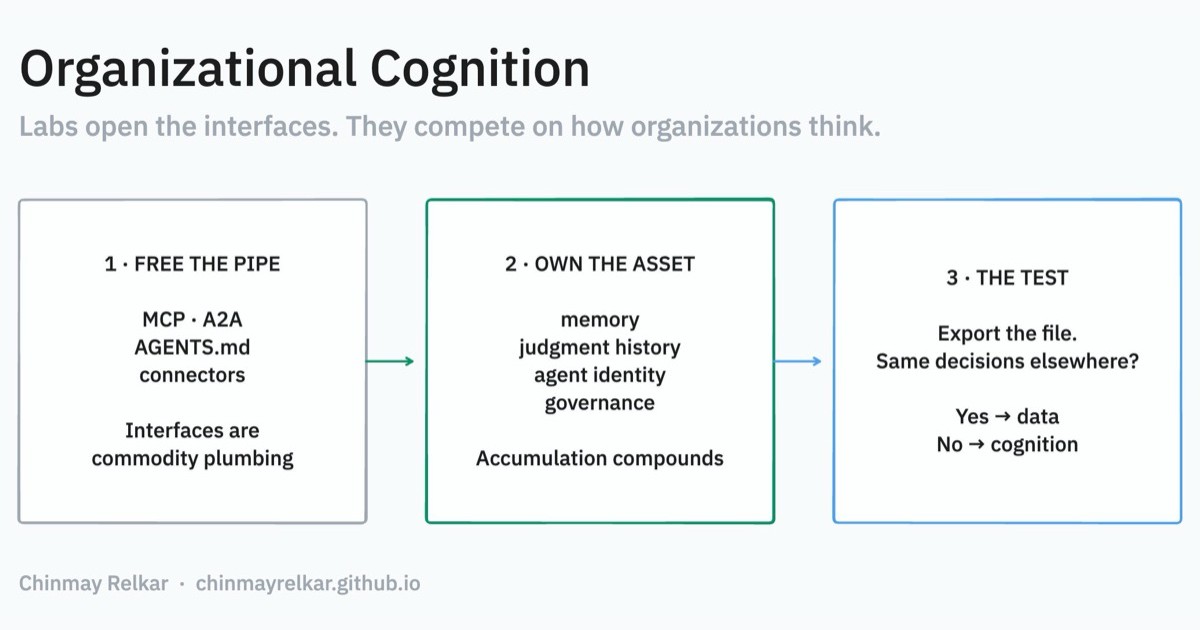 articleOrganizational Cognition: Why the Next AI Moat Won't Be IntelligenceChnmy