ECLoop derives its conditions per task from the issue text plus repo structure, tracks which ones the AI agentAn AI system that doesn't just answer once but works toward a goal in a loop — taking actions, reading the results, and deciding what to do next.Full definition →'s trajectory has actually satisfied, and postpones any action whose preconditions are still unmet. It wraps the model instead of changing it.
Structure beat prose in the ablation: giving the agent an equivalent natural-language summary of the same guidance worked worse than the machine-checkable condition list. The enforcement is doing the work, not the advice.
The result held across two different models and two different agent scaffolds over all 500 SWE-benchThe standard benchmark for AI coding agents: real GitHub issues from real repositories, scored by whether the agent's patch passes the project's own tests.Full definition → instances, which argues the gain comes from the execution layer rather than one lucky model-and-agent harnessThe scaffolding around a model that turns it into a working agent — the loop, the tools it can call, and the rules for when to stop.Full definition → pairing.
Blocking an action early is cheaper than letting it run: cutting off an unsupported edit also cuts the whole dead-end branch of work that would have followed it.
Terms in this piece · Glossary
LLM — A large language model — the neural network behind tools like Claude and ChatGPT, trained on huge amounts of text to predict what comes next.
AI agent — An AI system that doesn't just answer once but works toward a goal in a loop — taking actions, reading the results, and deciding what to do next.
SWE-bench — The standard benchmark for AI coding agents: real GitHub issues from real repositories, scored by whether the agent's patch passes the project's own tests.
agent harness — The scaffolding around a model that turns it into a working agent — the loop, the tools it can call, and the rules for when to stop.
Why it matters
If you're building or evaluating coding agents, this identifies a specific failure mode—agents editing or submitting patches before gathering sufficient evidence—and shows a lightweight, model-agnostic execution layer that reduces it without retraining, with measurable Pass@1 and token-efficiency gains on SWE-bench Verified.
Key quotes
“LLM-based coding agents often edit source code or submit patches before examining enough repository evidence to justify the change, a failure pattern we call premature commitment.”
“Evaluated on all 500 instances of SWE-bench Verified with two language models and two agent scaffolds, ECLoop raises Pass@1 by 4.8-11.8 percentage points without model retraining or scaffold changes.”
“These gains come at no additional inference cost: by redirecting the agent before it pursues unsupported actions, ECLoop lowers average token consumption by up to 12.1%.”

 articleLoopsBench: From Harness Engineering to Loop Engineering in Benchmarking Coding AgentHan Li, Zhemin Fang, Rili Feng, Yingqi Zhao, Jiaheng Liu, Pengfei Gao, He Ye, Dayi Lin, Qingwei Lin, Saravan Rajmohan, Dongmei Zhang
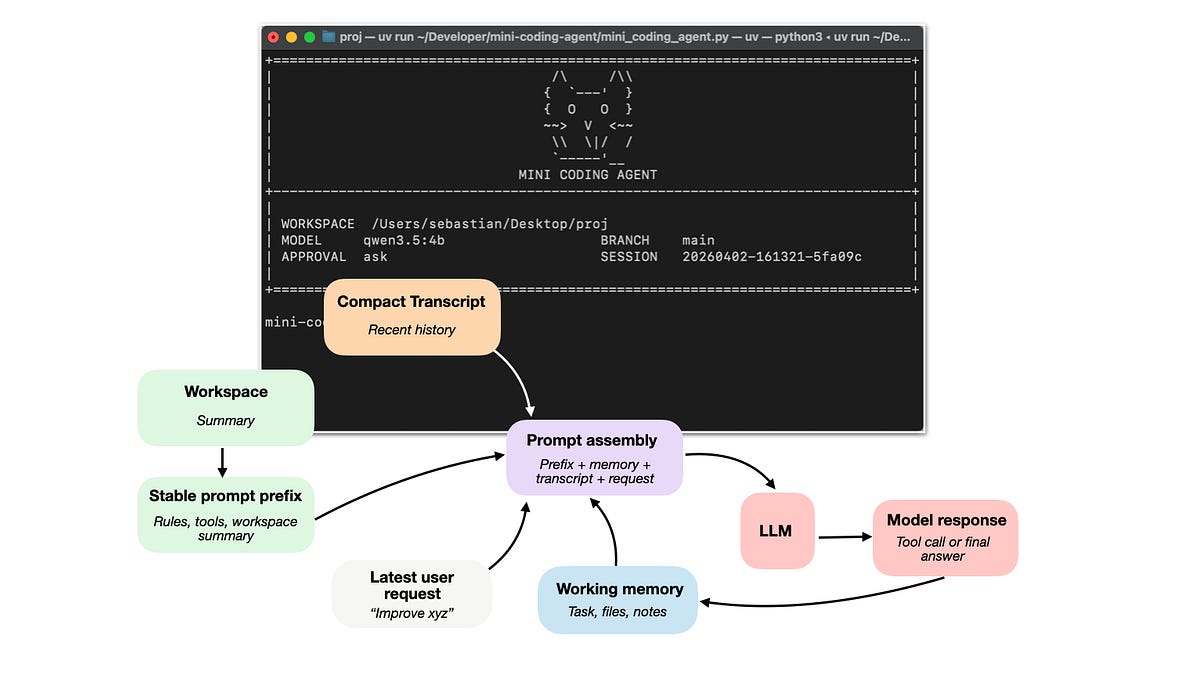 articleMini Coding AgentSebastian Raschka, PhD
 articleCoupling Planning with Episodic Memory in LLM Agents for Software Issue ResolutionJiahao Zhang, Yifan Zhang, Yu Huang