Clip transcript
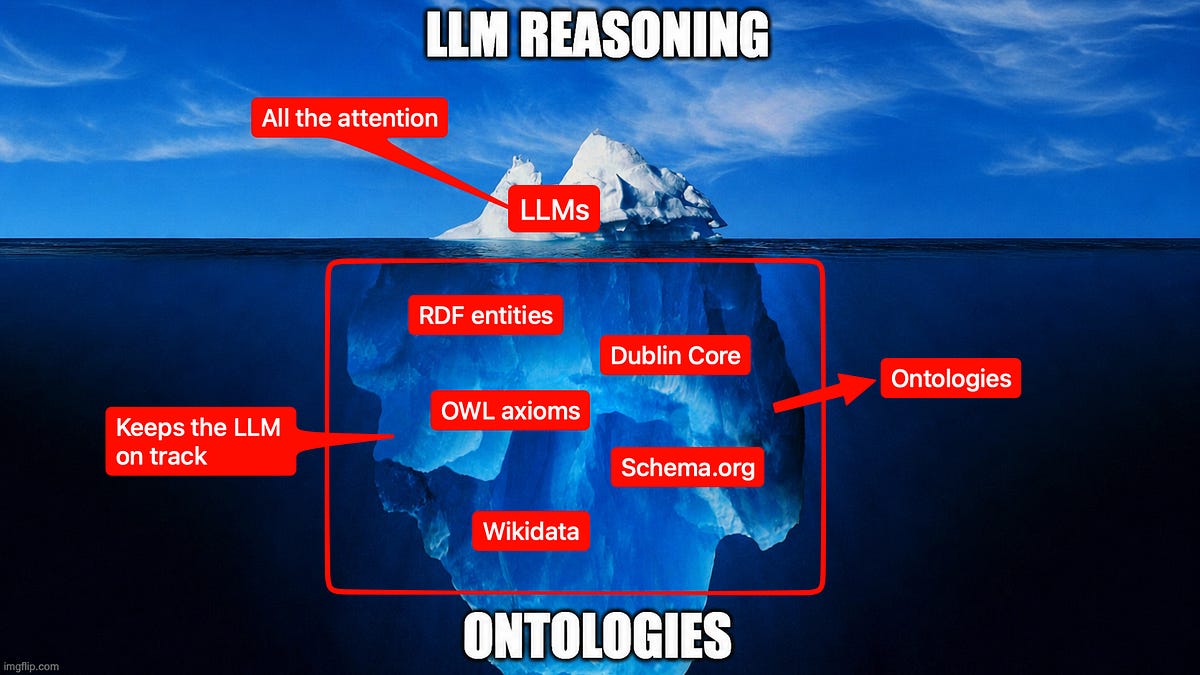
Von Quine was a philosopher and then this guy Gruber, 1993. And I think this captures what knowledge and uh graph technology really represents. It is a a formal specification of a shared conceptualization. And that's what we want to give to our agents. We want to give them our concept our conceptualization of the universe, our universe, our domains. Okay? And now, what's happening is you're getting the convergence of something that is probabilistic, the agents, the LLMs, with the the more formal representations that you have with ontologies. And so, this term is now being used you hearing this a lot, neuro-symbolic AI. Sounds pretty fancy, but it's really neural networks tied into symbolic AI, which rule-based systems come under that category, um as do the knowledge graphs that we're that we're assembling. And so, what I'd like to argue is that neuro-symbolic AI sort of represents a way to keep the LLM on its guardrails, because LLMs are by nature probabilistic. People worry about hallucinations, but that's the feature. That's actually a feature of large language models. It's who we are. We hallucinate in a way. We imagine things that may not exist, and then we turn them into reality. And that's what large language models do in in a way. Okay? So, let's just quickly overview what ontologies are. It's not They're not complicated. They're basically a representation of entities and their relationships to other entities. And these entities have properties. And this whole concept of graph databases arose when people began to realize that relational databases sticking data into tables was too restrictive. You wanted to add something new to a relational database, so you have to add a new column. Man, I had then then you have to redo the whole structure. With a with a graph database, you can just attach another item. You can just attach a property. You can attach a relationship. Okay? So, the question often arises, okay, I I get it. I need to have an ontology to represent in a formal way what my organization is doing. How do I do it? Okay? There are a couple of ways you can approach it. You can have a top-down approach or a bottom-up approach. Top-down approach is you get the experts together and they sit down and analyze the domain, come up with the entities. What do we have? We have purchase orders, we have customers, we have customer representatives, and we're going to structure them. They have properties. These are the relationships. Okay, that's one way. And this models what we were doing back in the '80s when I was involved in expert systems. Everybody thought expert systems was the way to do AI. Symbolic AI was the way to go. Companies rose, millions of dollars were spent. Uh the the Japanese created this uh future world project in the late '80s. People in America were my my son was taking Japanese in school because of these expert systems. And but they couldn't scale. They couldn't scale, and then we went into a kind of AI winter. Where did neural networks came come from? Neural networks were put out there in the '60s, but they couldn't scale because we didn't happen to have Nvidia who was off making GPUs to make make reality of the of the video games fantastic, and then someone said, let's turn these things over to the neural networks, and of course, that's kind of why we're here now. So,
 articleAn Ontology-Guided, Deduplication-Aware Extraction Layer for Knowledge Graph Construction from Heterogeneous DocumentsVaibhav Dangaich, Kevin Lewis, Kundeshwar Pundalik
 articleOntologies Are So Back: Why AI Agents Are Reviving the Semantic WebRichard MacManus