litellm v1.110.0
- Source
- github.com
- Author
- litellm-release[bot]
- Date
Context
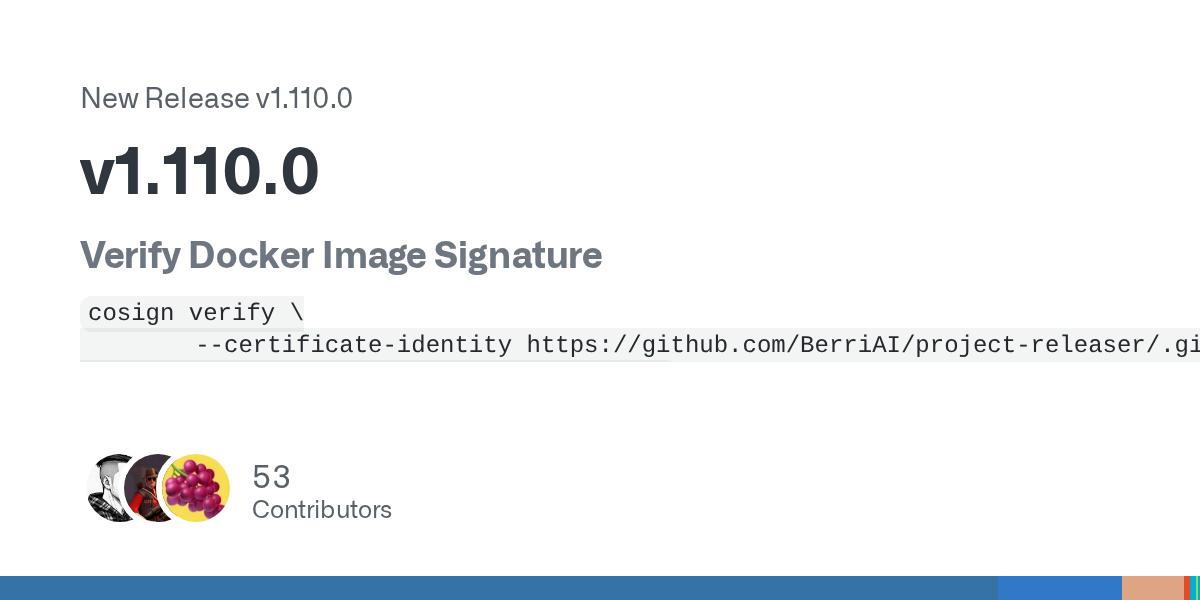
LiteLLM, an open-source library and proxy server that puts many AI model providers behind one interface, shipped version 1.110.0 as a large feature release with 32 changes its notes mark as breaking (release notes). The first thing operators should notice is the image-verification command. Releases since the October key rotation, including 1.108.2 and 1.109.1, told users to check Docker images with `cosign verify --key` against the public key from commit `e82a3c6`. The 1.110.0 notes instead check a certificate identity. That is cosign's keyless method: rather than holding a long-lived signing key, the release workflow receives a short-lived certificate tied to its GitHub identity, here a `release.yml` workflow on the main branch of a `BerriAI/project-releaser` repository, and verification confirms the image was signed by that workflow. The notes do not mention the change or say whether images are still signed with the old key too, so scripts and cluster admission policies that pin `cosign.pub` should be tested against this release before they are trusted.
Two security fixes concern what an authenticated caller could make the proxy do. One, backported as pull request 51263, now refuses requests that set Azure sign-in fields such as `tenant_id` or `client_secret`, or that put admin-style secret references like `os.environ/NAME` into credential fields. In the pull request's own test, a deployment that allowed client-side credentials resolved such a reference and sent the proxy's secret, as an API key, to an address the caller had chosen. Callers that relied on sending the Azure fields now get a 401 error unless an admin allows them for that deployment or for the whole proxy. The other fix, pull request 48979, checks the model named in every frame of the OpenAI WebSocket passthrough. Before it, a key whose model access came from an or access group rather than its own model list could name a different model in a later frame and get answers from it.
Two core paths have been replaced. Routing, which picks a deployment and handles fallbacks, now always runs on a new Rust core: pull request 50178 deletes the Python version, removes the `LITELLM_RUST` switch, and makes a configuration the Rust core declines raise an error instead of falling back. Spend accounting now goes through a SpendLogs ledger by default. Pull request 49872 says a worker applies the charges, so a key's spend shows up after the worker runs rather than immediately, and that setting `use_spend_logs_ledger: false` restores the old queues. With the router rewrite, the new ledger and the other breaking changes, operators should test this release before moving production to it. Teams that want only fixes can stay on the 1.108 long-term support line, which is still receiving patches.
- LiteLLM v1.110.0 makes the SpendLogs ledger the default accounting path, marked as a breaking change, and drops the unused accounting event tables.
- New spend-log controls include an opt-in latest_turn mode that stores only the current turn of stateless requests and a setting to turn off prompt storage per key or team.
- Deprecation handling expands: catalog rows record a successor_model and deprecation_source, the proxy adds deprecation alerts showing daily requests by key, and affected owners can be emailed before a model is deprecated.
- The router core moves to Rust and the Python router core is deleted; the proxy's common Redis call is also served through new Rust stores.
- A portable Agent Skills Hub API arrives with version history, submissions with admin review, and dashboard uploads of local ZIPs.
- AI agent — An AI system that doesn't just answer once but works toward a goal in a loop — taking actions, reading the results, and deciding what to do next.
- tool permissions — The rules governing which tools an agent may call and which need confirmation — the boundary between a mistake and an incident.
- streaming — Sending a model's response token by token as it is generated, so the reader sees text immediately instead of waiting for the whole answer.
- agent skill — A reusable instruction file that teaches an agent how to do one job well — the procedure, the tools, and what counts as done.
Checking sign-in…
Loading comments…