Arunachalam Manikandan is a software engineer at VIAVI Solutions who builds applied AI systems. His public work includes MinneDigest, biomedical image analysis and the Project Paradox multi-agent game framework.[1][2]
Start with MinneDigest project account →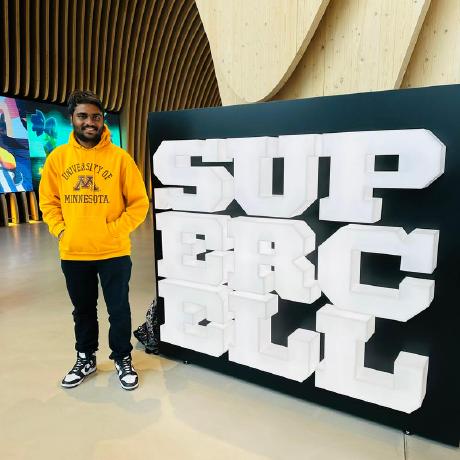

 X
Background
Manikandan’s GitHub biography describes computer science graduate study at the University of Minnesota and research using large language models, vision models and retrieval. He also describes biomedical image segmentation work: training models on computing clusters, performing inference on image patches and producing structured outputs for downstream analysis. His profile identifies his current role as software engineer at VIAVI Solutions.[1]
Contributions
Making local news easier to access
Manikandan, Erina Karati and Dipan Bag built MinneDigest during the Minnesota Journalism Center’s hackathon. The prototype summarizes local reporting and can turn it into audio or translate it into multiple languages. It won the event and support for continued development. The university account presents an access tool built around existing local journalism, rather than a replacement for the outlets that report the news.[2]
Game agents with persistent state
His public biography credits him with co-developing Project Paradox at Supercell’s AI Innovation Lab. Its agents maintain memories, beliefs, emotions and plans so earlier interactions can influence later gameplay. The AI Engineer session biography connects this work with experiments on social memory and trust. The research problem extends beyond producing a fluent next response: the agent needs to carry information into decisions over time.[3][4]
Tools, writing & talks
Writing, research & talks
Start here
MinneDigest project accounthubbardschool.umn.eduThe university describes the team’s multilingual local-news and audio prototype.
Read the university account for a nontechnical introduction to the project and the role of its three builders. It explains the intended news workflow before you explore the more technical agent experiments.
Co-builder profiled by university[2]Supercell's Project Paradox gave game agents memory and trust scores, but long interactions broke down (rumors lost their source, 'might' became fact). The fix: an autoresearch loop scoring source retention and uncertainty before keeping any change.
Catalog workOriginal source- Autoresearch in a Multi-Agent AI Villageaie-wf.sentry.dev
A conference session documenting the Project Paradox work and its collaborators.
Named participant[3]
Tools
- Project Paradox
 github.com
A modular game-agent framework with per-agent memory, planning and world-state APIs.
Repository owner and co-builder[4]