David Ha is co-founder and CEO of Sakana AI. His research explores systems that learn representations, generate drawings and improve through interaction, including World Models and the Agentic Scientist.[1][2][3][4]
Start with World Models →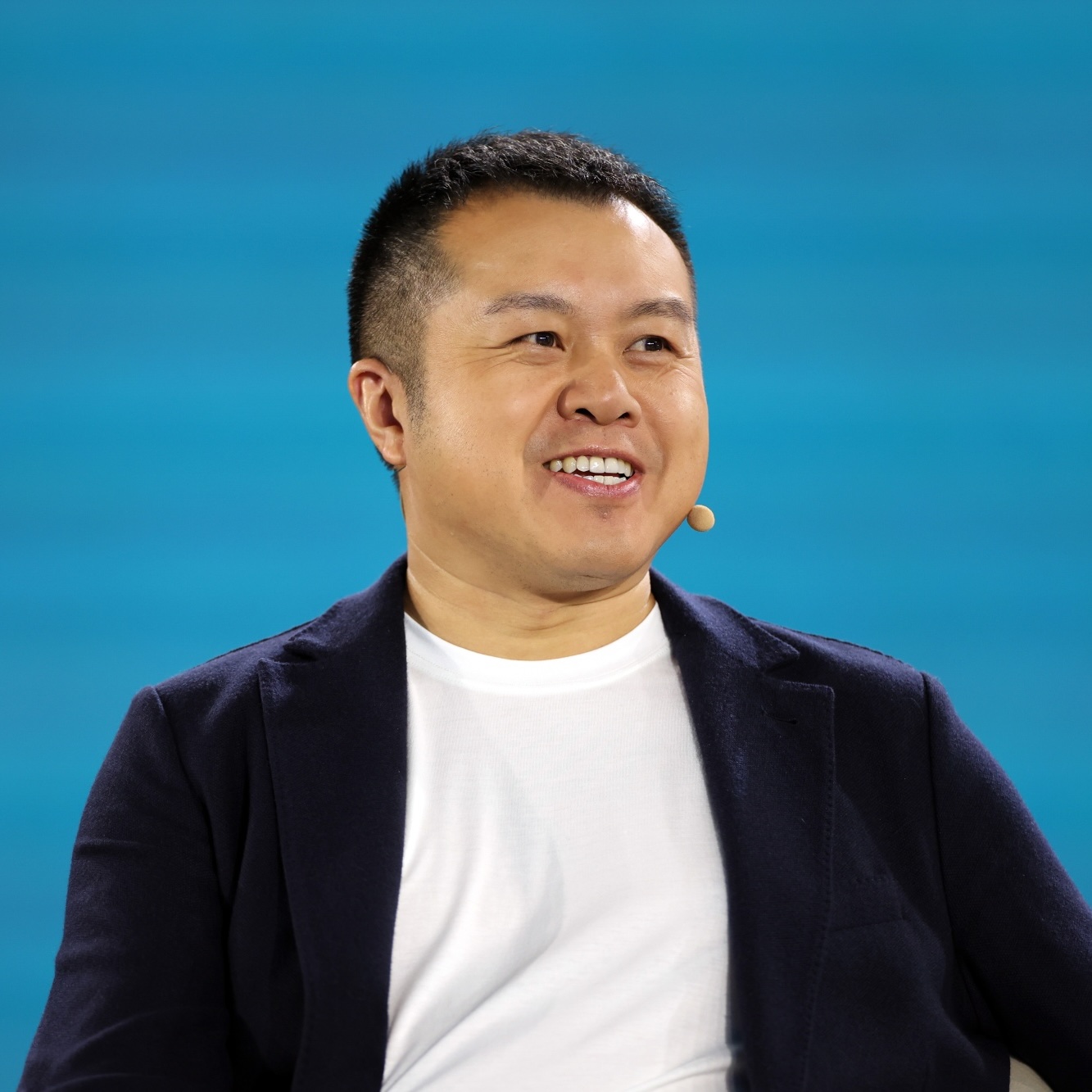

 GitHub
 X
Background
Ha earned an engineering science bachelor’s degree at the University of Toronto and a doctorate at the University of Tokyo. Before his machine-learning career, he worked in interest-rate trading at Goldman Sachs, where he became a managing director. Sakana’s biography describes his subsequent role as a Google research scientist who led the Google Brain research team in Japan. His work focuses on complex systems, self-organization and the evolution of artificial intelligence.[1]
Career
Ha co-founded Sakana AI with Llion Jones and Ren Ito in 2023 and serves as CEO. The company describes itself as a Tokyo research-and-development organization that also works with Japanese enterprises and the public sector. Its structure brings research and applied development into one company. Ha’s own public project site, Otoro, shows his work through small neural-network experiments and links to his public code.[1][5][6]
Contributions
Learning inside a simulated world
World Models, written with Jürgen Schmidhuber, separates learning a representation of an environment from learning how to act in it. One component compresses visual observations; another predicts how those representations change over time. A small controller then uses the learned representation to choose actions. The researchers demonstrated an agent trained within a model-generated environment and transferred its policy to the original task. The interactive article makes these parts visible through games and diagrams. Its demonstrations establish results in particular simulated environments, rather than general competence in the physical world.[2]
Drawing as a sequence of strokes
In sketch-rnn, Ha and Douglas Eck trained a recurrent neural network to generate drawings as sequences of pen strokes. This treats a drawing as an action sequence in vector form, rather than a fixed grid of pixels. Training on human sketches allows the model to generate coherent examples of familiar object categories. The paper describes both conditional generation and generation without a supplied example. It is a compact illustration of Ha’s interest in representations that match the structure of a task.[3]
Making automated experiments accountable
Ha co-authored the October 2026 Agentic Scientist report. The system coordinates coding agents through a research workflow that includes proposing ideas, running experiments, inspecting failures and producing evidence for written claims. Tasks need a clear goal and a scripted evaluator. The authors describe human researchers setting questions and constraints, then using the system’s experiments to choose further tests. Their account includes an ALIFE paper produced through that collaboration. The contribution is a framework for organizing computational research, with evaluation and human direction built into the process.[4]
Tools, writing & talks
Writing, research & talks
Start here
World Modelsworldmodels.github.ioAn interactive explanation of an agent that learns a compact model of an environment and uses it to learn actions. Start with the diagrams and game demonstrations before the equations.
The interactive world-model demonstration explains representations and control through a visible task.
Co-author[2]The sketch-rnn paper explains how to model a drawing as a sequence of strokes and generate new vector sketches.
Co-author[3]- The Agentic Scientistpub.sakana.ai
A report and implementation for coordinating coding agents across experiments, evaluation and scientific writing. It shows the evidence requirements that separate a research workflow from open-ended code generation.
Co-author[4]