James Zou is an associate professor of biomedical data science at Stanford, with courtesy appointments in computer science and electrical engineering. His research combines statistical machine learning with systems that help scientists evaluate ideas and design experiments.[1]
Start with TextGrad: Automatic “Differentiation” via Text →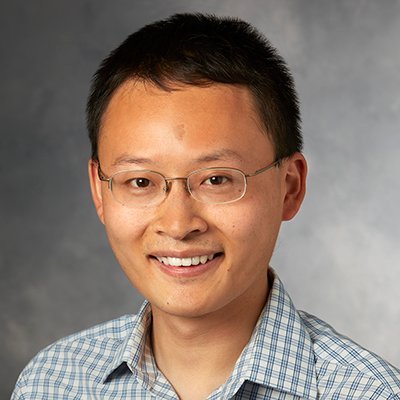
Education



Links
Stanford faculty profile Research website TextGrad paper Virtual Lab paper X · james_y_zou
Associate Professor of Biomedical Data Science · Stanford University
Associate Professor of Computer Science, by courtesy · Stanford University
Associate Professor of Electrical Engineering, by courtesy · Stanford University
Career
Zou joined Stanford in 2016 after research appointments at Microsoft Research and UC Berkeley’s Simons Institute. His group works on reliable and accountable machine learning, including human disease and health. His current research website identifies leadership of the Stanford AI for Science Lab and faculty direction at the Stanford Data Science Institute.[1][2]
Contributions
Use written feedback to improve a compound system
TextGrad treats an AI application as connected components whose outputs can be evaluated in language. A model critiques an output against an objective; that feedback is propagated to components such as prompts or code, then used to propose revisions. The analogy to automatic differentiation concerns how feedback is routed through a system, while the updates themselves use text rather than numerical derivatives. Zou is a coauthor of the framework paper.[4]
Give virtual researchers tools and human direction
The Virtual Lab paper organizes language-model agents into scientific roles, with a human supplying high-level feedback. In its nanobody study, the agents assembled a computational design pipeline using protein models and structural-analysis tools, then proposed candidate molecules. Laboratory experiments tested the resulting binders against SARS-CoV-2 variants. The study demonstrates a design-and-test workflow; a promising binding result is not evidence that a candidate is an effective medicine.[5]
Ideas
In the Einstein Arena talk, Zou describes agents exploring open scientific problems with shared discussions and executable verifiers. Changing the verifier can change the research task, from a mathematical construction to optimizing a GPU kernel. The environment supplies information, incentives and constraints while leaving agents room to choose an approach, rather than prescribing every step of a fixed workflow.[6]
Tools, writing & talks
Writing, research & talks
Start here
A framework for improving connected AI-system components using model-generated textual feedback.
Start with the framework diagram and a simple feedback-and-revision example. Familiarity with prompts and model evaluation helps; the word “gradient” describes feedback propagation and does not imply an exact derivative or a guaranteed improvement.
Coauthor[4]- Einstein Arena: Harnessing Collective Agent Intelligence for Open Science — James Zou, Together AIyoutube.com
James Zou on Einstein Arena, an agents-only environment pairing curated open problems with deterministic verifiers, a shared forum and a live leaderboard. Collaborating agents pushed the 11-dimensional kissing number from 593 to 604 and produced GPU kernels over 2x the prior state of the art.
Catalog workOriginal source A study combining scientific-role agents, computational protein design and experimental testing.
Coauthor[5]A talk on verifiable environments for agents collaborating on research problems.
Presenter[6]