Koray Kavukcuoglu leads Google DeepMind as senior vice president and also serves as Google’s chief AI architect. His research includes deep reinforcement learning and speech generation. He is an equal-contributing author of the DQN paper and a co-author of WaveNet and Parallel WaveNet.[1][2][5][6][7]
Start with WaveNet: A generative model for raw audio (DeepMind explainer) →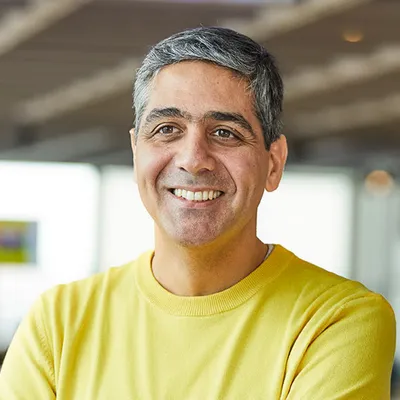
Education

Links
Google biography X (historical title in bio) Doctoral dissertation
Senior Vice President · Google DeepMind
Chief AI Architect · Google
Background
Kavukcuoglu completed a computer science PhD at New York University in Yann LeCun’s group. His dissertation, dated January 2011, studies ways to learn visual features from data rather than hand-design every detector. It investigates sparse representations and multilayer models for recognition tasks, including objects, handwritten digits and pedestrians. CERN’s speaker biography also reports an aerospace-engineering master’s degree.[4][3]
Career
Before DeepMind, Kavukcuoglu worked as a researcher at NEC Labs America. At DeepMind he established the deep-learning team and later held research-leadership and chief-technology-officer roles. On 5 August 2026, Google announced his appointment as SVP of Google DeepMind, reporting to Sundar Pichai while retaining his Google chief-AI-architect role. The stated remit covers Gemini model development, frontier research, and the Gemini app and developer teams.[3][1][2]
Contributions
Learning control from pixels and rewards
The DQN research combined neural networks with reinforcement learning, in which an agent learns actions from rewards. Its test environment was Atari games: the agent received screen pixels and score information rather than a separately programmed strategy for each game. The 2015 Nature paper lists Kavukcuoglu, Volodymyr Mnih and David Silver as equal contributors. Its contribution statement credits him with developing and testing algorithms as well as project management. This is direct research authorship, beyond his position in the lab’s leadership.[5]
Generating speech one sample at a time
WaveNet models the raw audio waveform, predicting the next tiny audio sample from previous samples. This differed from systems that stitched together recorded fragments or used a more constrained speech synthesizer. Kavukcuoglu co-authored the original paper. The same sequential process that supported natural-sounding output also made generation expensive. Parallel WaveNet addressed that deployment problem by training a faster network from a trained WaveNet; its paper reported use in Google Assistant. He is a co-author of that work too.[6][7]
Research results and practical systems
The speech papers offer a concrete way to understand the span of Kavukcuoglu’s work. One establishes a generative model and evaluates the sound it produces; the next changes the computation needed to make the model useful in a live product. Start with DeepMind’s original WaveNet explainer and its audio examples, then read the two papers together. That sequence makes the research-to-deployment problem visible without treating every later Google speech or Gemini feature as his individual invention.[6][7][8]
Tools, writing & talks
Writing, research & talks
Start here
DeepMind’s illustrated explanation includes audio examples that make the model’s purpose understandable before the mathematics. Kavukcuoglu co-authored the underlying paper; the blog itself is written by Aäron van den Oord and Sander Dieleman.
The audio examples make raw-waveform generation tangible; read the credited research papers afterward for technical detail.
The DQN paper explains learning Atari play from pixels and rewards. It identifies Kavukcuoglu as an equal contributor and details his algorithm-development and project-management work.
Equal-contributing co-author[5]The original paper describes audio generation as repeated prediction of waveform samples. It evaluates speech naturalness and demonstrates that the same approach can model music.
Co-author[6]The follow-up paper tackles the cost of sequential generation by training a parallel network from a WaveNet teacher. It connects the research model to a system deployed in Google Assistant.
Co-author[7]