Lex Fridman hosts long-form conversations about science, technology and other fields. His research work concerns human interaction with AI, including driver behavior, automation and learning systems.[1]
Start with Demis Hassabis: Future of AI, Simulating Reality, Physics and Video Games →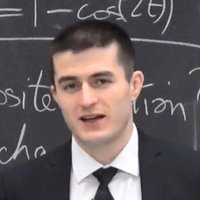
 X
Career
Fridman completed a Drexel doctorate in electrical and computer engineering in 2014. Drexel’s alumni account describes subsequent work at Google on authentication before his MIT research. His MIT page lists research on human-AI interaction, robotics and machine learning. Its projects include observing how people use driving automation and estimating where a driver is looking from camera data. The connecting question is how a person and an automated system share a task.[2][3]
Contributions
Learning to navigate simulated traffic
Fridman co-authored DeepTraffic with Jack Terwilliger and Benedikt Jenik. The project lets participants train a neural-network controller for vehicles in a simulated traffic setting and compare configurations in an open competition. Reinforcement learning means improving a policy using feedback from actions; here the simulation supplies a controlled place to experiment. The paper studies crowdsourced tuning of the network’s settings. Its educational and simulation results do not establish the safety of an autonomous vehicle on public roads.[4]
A conversation with the people behind AI systems
The podcast extends his public work into long-form interviews. His second conversation with Demis Hassabis connects AI research with video generation, games, biological simulation and scientific questions. The episode page supplies a full transcript and topic timestamps, letting listeners follow one subject without having to begin with the entire conversation. Fridman is the interviewer; the research and company products discussed remain the guest’s work.[5]
Tools, writing & talks
Writing, research & talks
Start here
A long-form interview connecting AI systems with scientific research, games and simulation.
Begin with the Hassabis interview’s timestamps and transcript and choose one topic, such as games or scientific discovery. It offers an accessible route into the research; DeepTraffic is a technical next step requiring machine-learning background.
Host and interviewer[5]Rails creator and 37signals CTO DHH sits for a long-form conversation on where programming heads as coding agents absorb implementation work, covering agentic engineering, vibe coding, and the Linux tooling he maintains.
Catalog workOriginal sourceJensen Huang, co-founder and CEO of NVIDIA, on building the company powering the AI computing revolution.
Catalog workOriginal source- OpenClaw: The Viral AI Agent that Broke the Internet - Peter Steinberger | Lex Fridman Podcast #491youtube.com
Peter Steinberger explains building OpenClaw, an agent that understands its own source and harness well enough to modify itself, and shares his voice-driven, multi-terminal agentic engineering workflow.
Catalog workOriginal source - OpenClawlexfridman.com
Peter Steinberger on building OpenClaw, the open-source framework for agents that rewrite their own capabilities, covering the design decisions behind it and what its unusually fast adoption revealed about what builders want from an agent harness.
Catalog workOriginal source Lex Fridman's state of AI in 2026 with Nathan Lambert and Sebastian Raschka, covering the year's technical breakthroughs across LLMs, coding, scaling laws, China and agents, and what they expect next.
Catalog workOriginal sourceDemis Hassabis, CEO of Google DeepMind and Nobel laureate for protein structure prediction, on the future of AI, simulating reality, physics and video games.
Catalog workOriginal sourceDylan Patel of SemiAnalysis and Nathan Lambert of Ai2 on DeepSeek, China, OpenAI, NVIDIA, xAI, TSMC, Stargate and the economics of AI megaclusters.
Catalog workOriginal source- #452 – Dario Amodei: Anthropic CEO on Claude, AGI & the Future of AI & Humanitylexfridman.com
Dario Amodei with Amanda Askell on Claude's character and Chris Olah on mechanistic interpretability, covering AGI timelines and what the models are actually doing inside.
Catalog workOriginal source - DeepTrafficarxiv.org
A paper on a traffic simulation and competition for exploring deep reinforcement learning and tuning model settings.
Co-author[4]