Ming Ding is an AI researcher and a first author of CogView and CogView2, early transformer-based systems for generating images from text. His work also includes cognitive graphs for multi-hop question answering.[3][4][1]
Start with CogView2 →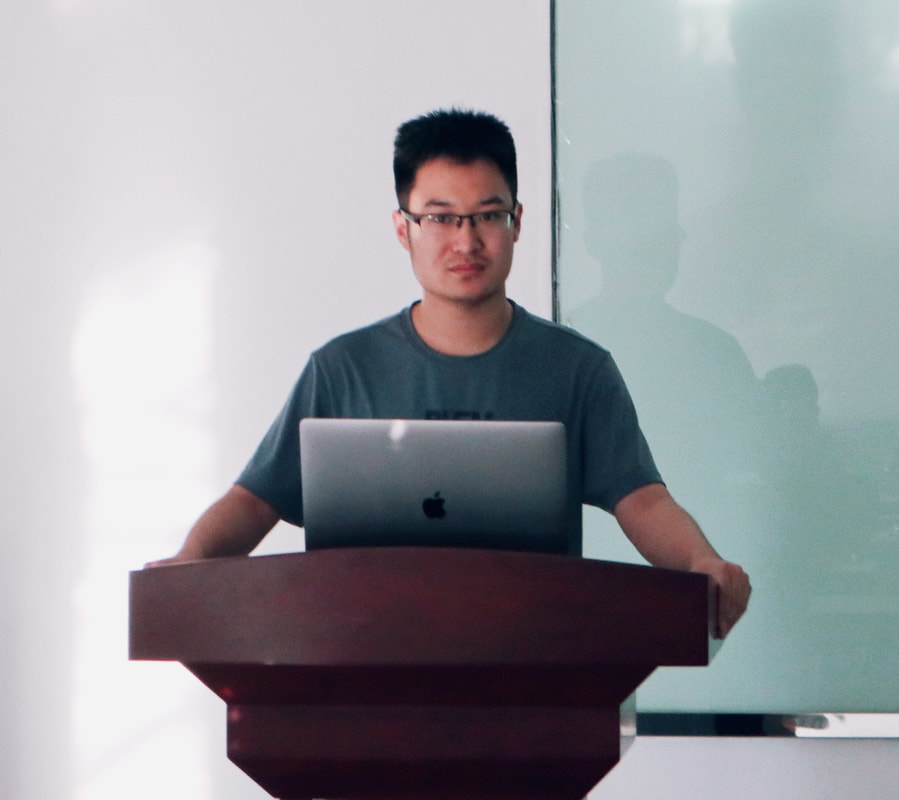
Education

Links
Academic website GitHub Google Scholar
Contributions
Combine neural extraction with explicit reasoning
Ding’s 2019 academic biography describes work at Tsinghua University with Jie Tang. The CogQA project builds a graph while answering questions across documents: a neural extraction component finds useful text, while an explicit reasoning component coordinates the next steps. The resulting graph exposes a reasoning path alongside the answer.[1]
Generate images as sequences
CogView trains a large transformer on text and image tokens. It applies the language-model idea of predicting tokens to text-conditioned image generation. The original paper studies training stability and strategies for improving generated images, providing an early example of scaling a general sequence model beyond text.[3]
Use a hierarchy for higher-resolution images
CogView2 addresses the speed and resolution limits of this approach. It combines hierarchical transformers with local parallel autoregressive generation and fine-tunes its cross-modal model for super-resolution. The system also supports text-guided image editing. The paper’s comparisons describe its 2022 experiments, rather than a current model ranking.[4]
Tools, writing & talks
Writing, research & talks
Start here
CogView2arxiv.orgHierarchical transformers for faster text-to-image generation and editing.
Read the hierarchy and local parallel generation diagrams, then compare them with CogView’s token-by-token approach. Transformer knowledge helps. Begin with the paper; reproducing these research models requires the repository’s specific checkpoints, environment and substantial GPU resources.
First author[4]
Tools
- CogView implementationgithub.com
The original research repository and instructions accompanying CogView.
Research author[5]