Robin Rombach is co-founder and CEO of Black Forest Labs. His co-authored work on latent diffusion and high-resolution image synthesis helped establish the technical foundation of Stable Diffusion. He advocates making visual AI technology available for others to build on.[1][4][6]
Start with High-Resolution Image Synthesis with Latent Diffusion Models →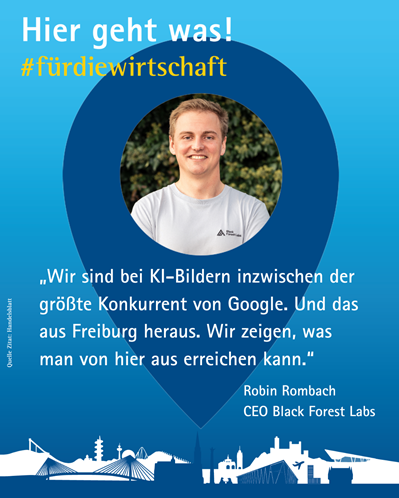


 X
Background
Rombach studied physics at Heidelberg from 2013 to 2020, according to the regional chamber of commerce’s profile. He subsequently pursued doctoral research in Björn Ommer’s computer-vision group at LMU Munich. The group lists him among its PhD students, and his GitHub biography describes him as a long-term doctoral student. This path connects his work to an academic research group whose image-generation projects published papers alongside code.[3][7][2]
Career
Rombach is the co-founder and CEO of Black Forest Labs, a visual AI company operating in Germany and the United States. His chamber-of-commerce profile describes two years as research lead at Stability AI before the founding of BFL in March 2024. In his June 2026 G7 address, he described the company’s aim as developing models that learn and reason about visual environments. That is a broader research ambition than producing a single still image, and he presents it as a complement to language-model development.[3][1]
Contributions
Images represented as learned components
Taming Transformers, written with Patrick Esser and Björn Ommer, addresses the expense of applying transformers to long sequences of image pixels. Its method first uses a convolutional network to learn a vocabulary of image components. A transformer then models how those components fit together. This division allows the system to combine local visual structure with longer-range relationships. The paper demonstrates conditional image synthesis, including control through scene layouts and object categories, and releases code and pretrained models.[5]
Moving diffusion out of pixel space
The latent-diffusion paper takes another route to reducing the cost of image generation. Instead of repeatedly denoising a full-resolution pixel grid, it applies diffusion in a compressed representation learned by an autoencoder. Cross-attention allows text and other conditioning inputs to guide the generation process. Rombach is a co-author of the paper; the CompVis Stable Diffusion repository explicitly builds on that work and credits collaboration with Stability AI and Runway. This distinction matters when tracing the research method into the later public model release.[4][6]
Ideas
In his G7 speech, Rombach argues that access to visual AI models lets businesses build their own systems and supports competition and technological independence. He also acknowledges the difficulty of withdrawing released models and the possibility of harmful modifications. His position combines an argument for open distribution with a call for evaluation standards, safety tools and targeted regulation. The speech is useful for understanding how he connects a model company’s distribution choices to public policy; its predictions about economic importance remain his argument.[1]
Tools, writing & talks
Writing, research & talks
Start here
The clearest starting point for understanding why diffusion in a compressed image representation can reduce computational cost. Familiarity with autoencoders and denoising helps.
Explains the compressed representation that connects his academic work to Stable Diffusion.
Co-author[4]Shows an earlier approach to efficient image synthesis: learn visual components first, then model their composition with a transformer.
Co-author with Patrick Esser and Björn Ommer[5]
Tools
- Stable Diffusion
 github.com
The original CompVis repository connects the latent-diffusion research to a runnable text-to-image model, with setup instructions and a model card.